
Podcast content planning
Build a podcast content calendar that can change
A podcast social media content calendar should show both when a post is planned and what must be true before it can go out. Record the episode, reader purpose, channel, draft version, owner, date and timezone, source check, and publication status. A reserved slot is not proof that its asset is ready.
Start with the material you can support, then leave room to change the plan. The filled example below turns a historical interview into an archive recommendation and a separate editorial response. A third idea is cancelled because it repeats the same recommendation. The dates are illustrative appointments, not recommended posting times.
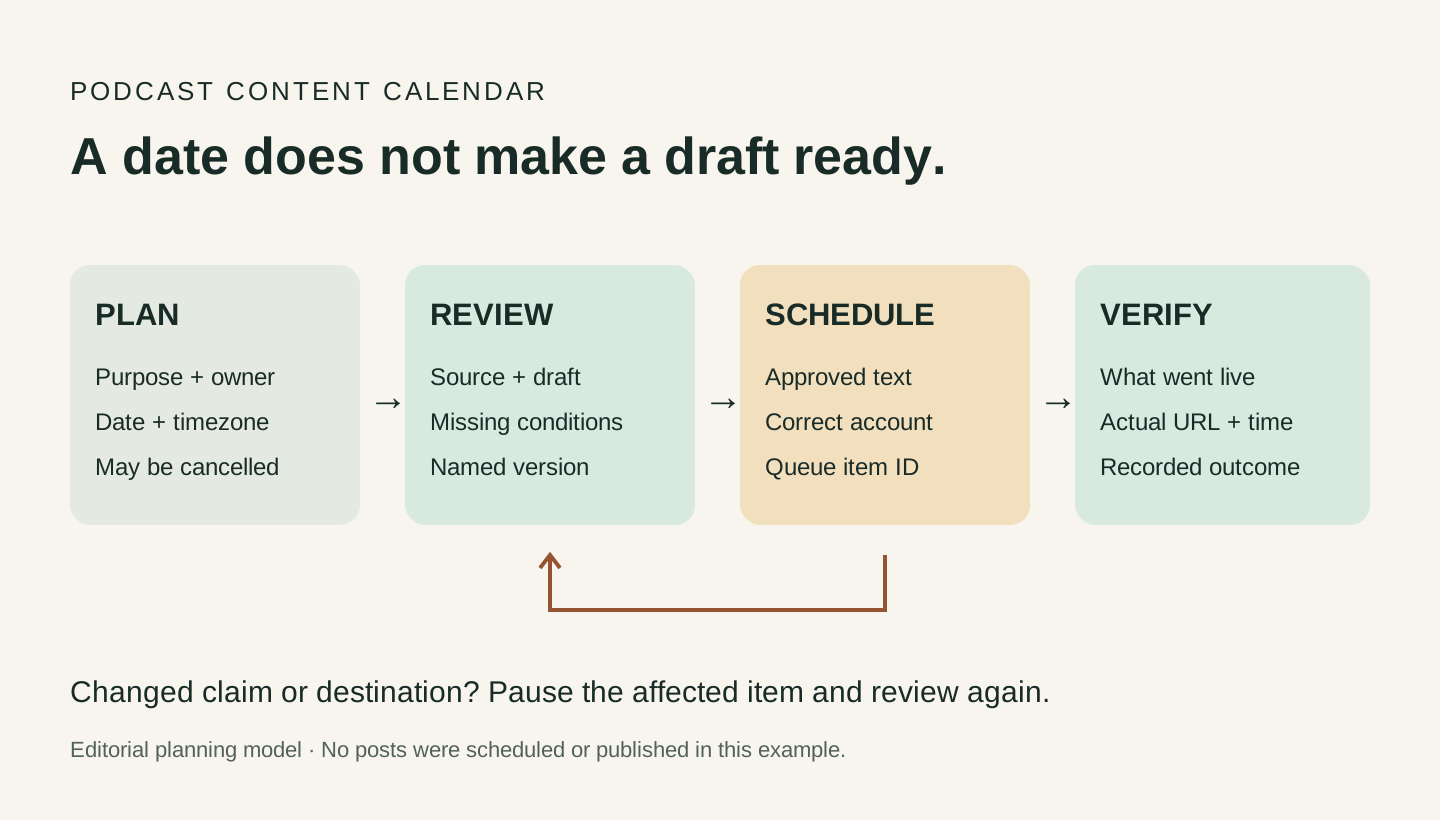
Keep the plan separate from the publishing queue
Spotify’s promotion guidance recommends preparing social content in batches and using reminders, a spreadsheet or a scheduling tool to plan distribution. The useful principle here is making the work visible before the posting date; it does not establish a universal cadence. Source: Spotify on organizing promotion.
A publishing tool may distinguish drafts, scheduled posts, sent posts and items awaiting approval. Buffer’s calendar documentation, for example, offers those post-type filters. In your own sheet, keep a separate status column so “planned” cannot be mistaken for “scheduled.” Source: Buffer calendar post types.
Use an idea list for possibilities, a calendar for chosen assignments, and the actual publishing queue for approved versions. One person can own all three. What matters is knowing which version is intended to go out and where to stop it if something changes.
Choose a source before filling the dates
The worked calendar uses Stanford’s Grit & Growth interview with Ethan Mollick, published on 2024-06-11. The transcript passages at 06:56 and 24:18–25:40 discuss experimentation, accuracy and uneven capabilities. This is a historical source, not a benchmark of current AI models. Source: Stanford episode and transcript.
Review status: transcript-only. The relevant exchange was reread as text for this guide. Stanford says its machine-generated, lightly edited transcript may contain errors. No audio, clip boundary or speaker emphasis was checked. The proposed editorial response belongs to this guide’s author, not to Mollick.
The campaign’s first item helps a reader decide whether to open the archive episode. The second offers a proposed way to evaluate an AI-writing workflow. A third item is optional: it must answer a different question, rather than repeat the same recommendation in another layout.
Copyable planning record
Give every item a decision trail
Copy this record into a sheet or document. The scheduled URL and actual publication fields stay blank until those events really happen. This is a manual template, not an import format or a PodInk scheduling feature.
Item ID / episode title and original date:
Reader question / distinct contribution:
Channel / format / destination link:
Source passage / locator / evidence limitations:
Draft version / asset path / owner:
Review due date / reviewer / unresolved issue:
Planned date, time and named timezone:
Go condition / hold reason / cancellation trigger:
State: idea | drafting | review | approved | scheduled | published | cancelled
Approved version and timestamp:
Scheduler item URL or ID (only after scheduling):
Actual publication URL and time (only after checking):
Observation / next decision (do not infer a result from an empty cell):
Calendar method
Make the schedule depend on the finished post
Assign a different job to each item
Write the reader’s question before choosing a format. An announcement helps someone find an episode; an argument helps them assess your view; a question invites a response. If two items answer the same question with the same evidence, combine them or leave a slot empty.
Record a release condition
A launch post needs a working destination and accurate availability wording. An archive post needs the original date and a present reason to revisit it. A direct quote or clip needs its own review. Mark the missing condition explicitly instead of assuming a deadline completes it.
Set review time before publication time
Name the person responsible for the final version and give them a review appointment before the planned post. Choose that interval for your actual workload. Store the date, time and timezone together; a number such as 9:00 alone is ambiguous across a distributed team.
Move only the approved version into a queue
Check the text, media, destination, account and timezone in the tool that will publish the post. Record its item ID or URL. Open the queued item and compare it with the approved draft; the spreadsheet alone cannot confirm a match.
Reopen affected items when the evidence changes
If a source correction changes the claim, pause the affected queued item before editing the calendar. Check other items that reuse that claim. If only a date changes, review timing language and dependencies rather than automatically rewriting unrelated copy.
Close the row with an observation
After the planned time, verify what actually appeared and save the public URL. If the item did not publish, record that state. When reviewing performance later, separate observed link activity or responses from guesses about listening, sign-ups or sales.
Worked planning exercise
A filled calendar for revisiting an archive episode
The archive calendar is an original paper exercise for a hypothetical editor. The dates and owner role below are assigned for illustration; no account was connected and no campaign was run. Each item uses the same historical interview, but serves a different reader decision.
Source record for every row: Mollick with Darius Teter, Grit & Growth, 2024-06-11; transcript 06:56 and 24:18–25:40. Owner: the hypothetical editor. Timezone: Asia/Hong_Kong. Review each draft before its listed slot. Source: Official transcript.
| Planned slot | Reader task and draft | Decision before scheduling |
|---|---|---|
| A · 3 November 2026, 09:00 | LinkedIn text: archive recommendation. Reader question: why open this interview now? Draft A1 uses the complete example below. | Review due: 2 November, 09:00, same timezone. Planned, not queued. Go only after checking the episode link, date and paraphrase. If unavailable, hold A and remove any dependent listening prompt. |
| B · 5 November 2026, 09:00 | X thread: an editorial proposal to evaluate claim traceability and total writing effort. Use the linked thread guide as a starting draft, not as a report of a completed test. | Review due: 4 November, 09:00. Drafting. Check the full argument, attribution and live composer. B names its source directly; it must make sense even if the reader never saw A. |
| C · 8 November 2026, 09:00 | Proposed quote card repeating “test before expanding.” The idea has no reviewed quotation and adds no new reader task beyond B. | Cancelled during planning. Do not invent a quotation or a reader response to fill the gap. If C had entered a scheduler, the editor would first remove or pause that item and record the result. |
Complete draft A1 — an unpublished archive recommendation:
“An archive listen for anyone deciding how to use AI at work: Ethan Mollick’s June 2024 conversation on Stanford’s Grit & Growth. His discussion of experimentation and uneven capabilities is a reason to inspect a task carefully, not assume every task behaves alike. I’m revisiting the question of how to evaluate a workflow, not treating the episode as a benchmark of today’s models. Episode and transcript: https://www.gsb.stanford.edu/insights/co-intelligence-ai-masterclass-ethan-mollick”PodInk editorial rule for this calendar
A1 uses a paraphrase, not quotation marks. The calendar’s source record identifies where to check the interpretation. A1 does not claim that this guide’s author listened to the recording; the underlying review was transcript-only.
B needs more space because it must explain why an error log alone cannot decide whether a workflow is worthwhile. The existing thread example separates the source idea, the author’s cost objection and a proposed test. Adapt the argument only if it expresses your own view.
C is deliberately cancelled because it repeats B and lacks a reviewed quotation. Removing C prevents a duplicate idea from becoming an invented quote card. Keep the empty slot unless different, supportable material gives the reader another reason to return.
The sequence demonstrates planning decisions, not a successful campaign. It does not show an ideal frequency, a reach result or a conversion effect. Choose your own dates after checking audience needs and production capacity.
Compare how the approved core changes in the LinkedIn workflow and the X workflow.
Change the plan
What to do when a calendar item changes
| Change | Affected items | Calendar action |
|---|---|---|
| Episode destination is unavailable | A cannot fulfil its listening invitation; inspect B’s source destination too. | Hold affected items. Recheck the destination before assigning another publication time. |
| Source claim was corrected | Every draft using that claim, including a card or thread with different wording. | Pause queued versions, revise the source note and affected text, then review again. |
| Only the planned date moved | Timing phrases, release status and any post that promises the next item. | Verify the new date and timezone in both calendar and queue. Recheck only the dependencies that changed. |
| No distinct idea remains for C | C only, unless other items promised it. | Cancel C and remove promises of C. Do not manufacture an engagement question to complete the grid. |
- Each item has a distinct reader task and a recoverable source.
- Planned time includes a named timezone and a prior review appointment.
- The approved version matches the version in the publishing tool.
- A held or cancelled row has a recorded action, not merely a new color.
- Archive posts preserve the episode’s original date.
- Actual publication and performance fields contain observations, not assumed outcomes.
Scope
What this example cannot promise
- This calendar is an editorial template, not tested advice about optimal posting frequency or timing.
- The Stanford case was reviewed as transcript text only. No recording or social-media account was used.
- The example posts, dates, review appointments and cancellation are illustrative. No reader response, campaign result or customer outcome is claimed.
- Spotify and Buffer documentation support the planning distinctions cited here; they do not validate this schedule. The template can be used in a document or spreadsheet. It does not claim that PodInk includes an automated scheduler.
Human review remains necessary. No repurposing workflow can turn weak evidence into a strong claim.
FAQ
Frequently asked questions
How many podcast posts should go in a content calendar?
Use the number of distinct, supportable reader tasks you can finish and review. The worked plan starts with three ideas and cancels one. That illustrates a decision, not a recommended weekly count.
What changes if the episode release moves?
Hold launch-dependent posts, replace timing language, and verify the new destination and availability before scheduling again. An evergreen explanation may survive the date change, but check any promise or link that depends on the release.
Can an archive episode have a promotion calendar?
Yes. Keep its original date visible and explain why you are revisiting it. Do not call the archive newly released or treat historical claims as current evidence without checking them.
Does this template automatically schedule posts?
No. It is a planning record. Scheduling and actual publication must be verified separately in the tool and account you choose.
Evidence
Sources and comparison pages
- Podcast promotion on social mediaSpotify for Creators
- How to use Buffer’s calendar featureBuffer Help Center
- Co-Intelligence: An AI Masterclass with Ethan MollickStanford GSB — Grit & Growth