
Podcast-to-thread writing guide
Podcast transcript to X thread: order the argument before the posts
Turn a podcast transcript into an X thread by choosing a claim, arranging the support and reasoning, answering a serious objection, and keeping the limit beside the conclusion. Give each post a job in that argument before you shorten it. Numbering a sequence of excerpts does not explain why the conclusion follows.
A thread can contain good sentences and still leave a reader wondering how the conclusion follows. The worked example below checks the links between posts as well as the wording within each one. It is an AI-assisted teaching example, not a published thread or a tested workflow.
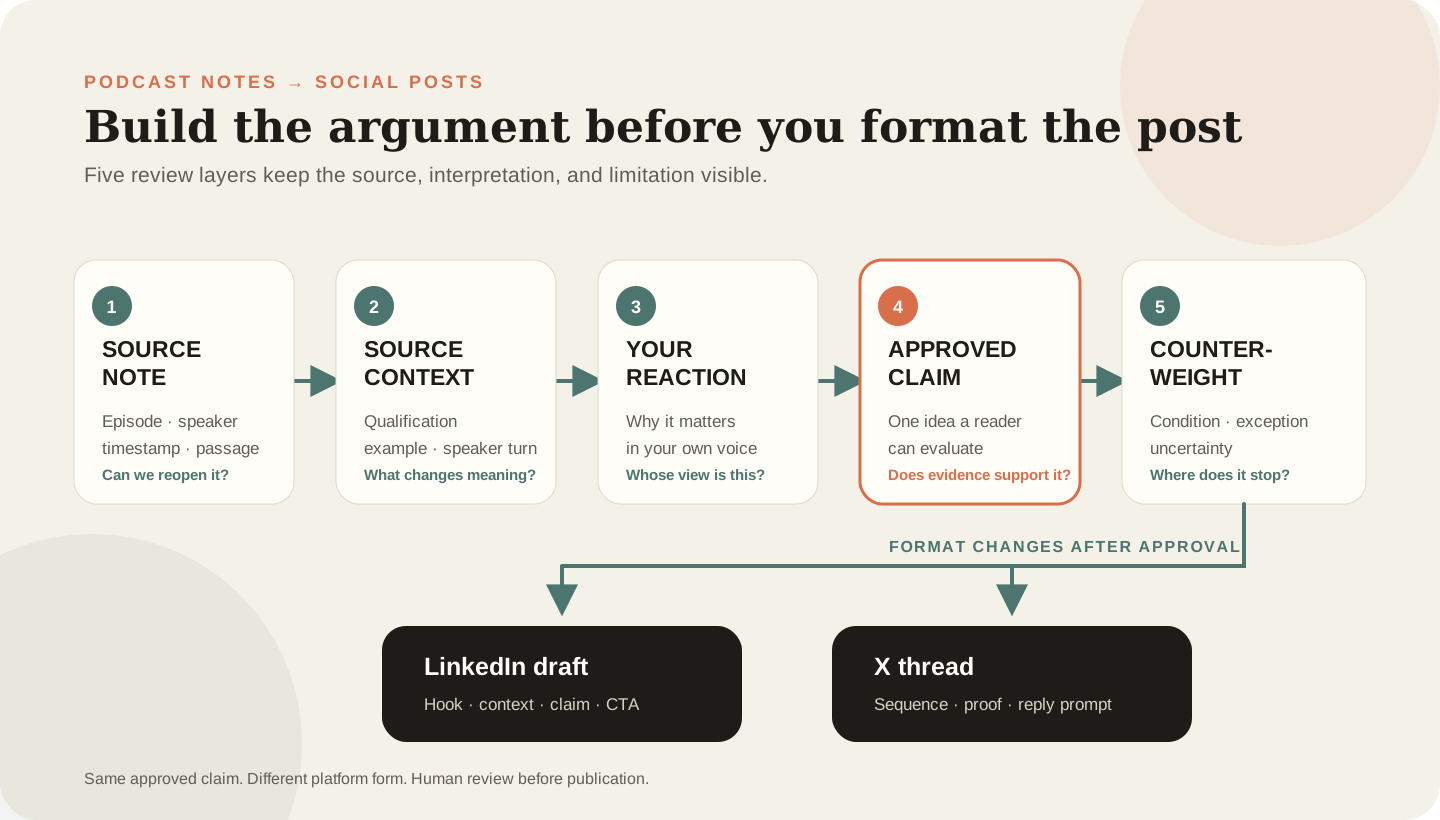
Decide what each post needs the reader to know
A list can collect useful observations without arguing for a decision. For an argumentative thread, write the relationship between posts: this source supports the claim; this explanation connects them; this objection tests the recommendation. If you cannot name that relationship, the sequence may need a different order or a narrower claim.
Purdue OWL’s Toulmin guidance separates a claim, its grounds, and the reasoning that connects them, with qualifiers and rebuttals for a fuller argument. The sequence below adapts those distinctions for editing a thread; it is not a platform rule or a claim that every thread needs the same format. Source: Purdue OWL on Toulmin argument.
The notes-to-argument guide covers preparing the source packet. The LinkedIn worked example develops an author’s contribution inside one post. Here the additional problem is dependency: a reader needs a reason to move from one post to the next without losing who said what.
Source case: a historical discussion about AI at work
The source is Stanford GSB’s Grit & Growth episode “Co-Intelligence: An AI Masterclass with Ethan Mollick,” dated 11 June 2024, hosted by Darius Teter. Read Mollick at 06:56 and the exchange from 24:05 through 25:40. Source: official episode transcript.
At 06:56 Mollick advocates experimentation to discover uses in a particular setting. At 24:18 he discusses limits around accuracy; at 24:45 he describes uneven capabilities and the risk of relaxing scrutiny. The thread uses that bounded idea, without repeating the episode’s model comparisons or study results. Source: transcript, 06:56 and 24:05–25:40.
Review status: transcript-only. Stanford warns that its machine-generated, lightly edited transcript may contain errors. These are passage locators, not verified clip boundaries. No recording was reviewed and no current AI model was benchmarked for this example.
Complete illustrative X thread
Copy the argument, then adapt the proposed test
This AI-assisted example is written for this guide. Mollick did not write the thread or prescribe its checklist. The objection and proposed writing test are the author’s additions. Each numbered block is a separate draft post; no post has been published.
1/7 My proposed rule for AI-assisted writing: decide how to check a task before expanding the workflow. A useful draft is a starting point for review, not permission to skip it. Here is a test plan inspired by a podcast.

2/7 In Stanford's Grit & Growth (June 2024), Ethan Mollick describes uneven AI capabilities and recommends skeptical experimentation. That is the source idea. The writing checklist here is my application, not his prescribed method.

3/7 For a source-based article, I would separate drafting from checking. The question is not only whether a paragraph reads well. Can I trace each claim to its source and spot anything the draft added?

4/7 Objection: what if checking costs more time than drafting saves? My answer is to count review and correction as part of the task. I would compare the complete process before deciding whether the AI-assisted version is worthwhile.

5/7 An AI-assisted writing test I would run: draft from one passage, then reopen it and log missing limits, added claims and wrong speakers. Record what needed correction. Passing that test would not approve every future article.

6/7 Mollick's June 2024 interview is not a benchmark of today's models. My proposed AI-writing check needs fresh evidence when the model, source or task changes. The aim is an inspectable decision, not a promised result.

7/7 Source: Ethan Mollick with Darius Teter, Grit & Growth, 11 June 2024. Transcript 06:56 and 24:18-25:40; transcript-only reading. https://www.gsb.stanford.edu/insights/co-intelligence-ai-masterclass-ethan-mollick
Plan the reasoning
Build a sequence the reader can follow
Write the decision before the hook
For this example, the decision is whether to expand an AI-assisted writing workflow. A hook that promises to reveal everything AI can do would create a much larger claim than the selected passage can support.
Place source evidence before the recommendation
Use a source post to name the speaker and episode. Then explain why that source matters to the decision. Do not ask a famous guest’s name to replace the reasoning between the source and your conclusion.
Build a proper reasoning bridge
Explain why the source supports the proposed decision. In this example, drafting and checking are different activities, so the author proposes evaluating both before judging the workflow.
Insert the objection while a revision is still possible
Choose an objection that could change the recommendation. Here, the author raises the possibility that review costs could undermine the value of the workflow, then proposes evaluating the complete process.
Narrow, count, and read each post separately
Make the thread understandable even when a post is read alone. Keep any condition that limits a recommendation in the same post as that recommendation. Count the actual draft text after numbering and links, then repair unclear references and missing attribution.
Thread dependency review
Why the thread uses this order
The sequence moves from a proposed decision rule to its source, reasoning, objection, test, limits, and source trail. The ordering is an editorial choice, not the order in which the guest spoke.
| Post | Job in the argument | Review requirement |
|---|---|---|
| 1 · Claim | Propose a review decision, not an AI performance result. | The opening explicitly calls the rule a proposal and keeps review attached to the draft. It can stand alone without implying research proved it. |
| 2 · Evidence and ownership | Name the historical source before applying its idea. | Keep Mollick, the show, and the historical date in the source post. The checklist must remain the writer’s application.Source: Stanford transcript |
| 3 · Reasoning | Connect the source idea with a writing task. | The question about traceable claims explains what the proposed review would examine. It is the writer’s reasoning, not a quote. |
| 4 · Objection and response | Ask whether verification costs change the decision. | Label the objection as an editorial challenge. Do not invent a guest’s disagreement, a measured time saving, or an actual experiment. |
| 5 · Proposed action | Describe a small test the reader could evaluate. | The local qualification prevents one satisfactory passage from becoming blanket approval. It stays in this post, not only in a final disclaimer. |
| 6 · Boundary | Separate a historical interview from present-day evidence. | The thread does not use an old model example to declare what current models can or cannot do. |
| 7 · Source trail | Make the full transcript recoverable. | The earlier source post already names the speaker. The final post supplies the link and locators; it does not retroactively fix missing ownership. |
Ordering rule:
“A new post should add a reason, answer an objection, or change the decision—not just continue the transcript.”PodInk editorial rule for ordering a thread
Try moving the proposed test before the objection. The reader would receive instructions before learning why the complete process should be evaluated. That edit could work for a quick tutorial, but it would change the job of this thread. Order the posts for the argument you intend to make.
Try deleting the evidence post. The remaining advice may still be readable, but the connection to the podcast becomes opaque until the last link. A bibliography at the end is not a substitute for attributing the idea where it enters the argument.
Draft measurement: this example contains 7 posts, each under a conservative 240-character drafting budget, including its number and raw URL. The count is a local plain-text check of the sample, not a claim about current X account limits, link weighting, or an optimal thread length. Check the actual composer before posting.
AI-assisted editorial review is complete; publication is approved. The source passages, post roles, and character counts are recorded. Before using the example, check the source and confirm that the first-person proposals express your own view.
Compare how the approved core changes in the LinkedIn workflow and the X workflow.
Break the thread deliberately
Test the argument before tightening the copy
| Test | Failure to catch | Revision |
|---|---|---|
| Read only the hook | A universal promise such as “AI handles every writing task” outruns the source. | Keep the opening scoped to a proposed decision about a writing workflow. |
| Read only the source post | The writer’s test plan looks like the expert’s named method. | Name the speaker’s idea, then label the application as the writer’s. |
| Read only the objection | A rhetorical question implies time savings were already measured. | Frame the tradeoff as a possibility that must be tested. |
| Read only the action | A small successful test looks like permission to stop reviewing. | Put the limit beside the action instead of saving it for the closing post. |
| Reverse two adjacent posts | The thread still reads like interchangeable observations. | Explain what the second post needs from the first, or remove a redundant post. |
- The first post states a claim narrow enough for the selected source.
- A named source appears where its idea is introduced, not only in the last link.
- The writer’s reasoning explains how the evidence connects to the recommendation.
- An objection tests the decision without being falsely attributed to the guest.
- Each actionable post preserves its own important limit and a clear subject.
- The final source link reopens the exact transcript; no timestamp is presented as audio-verified.
- The final character check uses the actual numbered copy, including links.
Evidence and use limits
What the example does not establish
- This is transcript analysis. It does not verify the recording’s precise wording, vocal emphasis, or visual context.
- The thread is an unpublished AI-assisted teaching example. The proposed writing test has not been performed and has no measured efficiency or quality result.
- The historical interview is not current evidence of any AI model’s performance. External factual claims would require their own verification.
- The sample count is a drafting check, not a platform policy statement. No X account, live composer, reach experiment, or publishing API was used.
Human review remains necessary. No repurposing workflow can turn weak evidence into a strong claim.
FAQ
Frequently asked questions
Should an X thread follow the podcast’s original order?
Preserve what the speaker meant, but choose the order needed for your argument. A transcript follows the conversation; a thread can introduce a claim, support it, address an objection, and narrow the action. Reordering must not imply the guest made a conclusion they did not make.
Where should podcast attribution appear in a thread?
Name the speaker near the post that introduces the source idea. Provide a recoverable episode link and useful locators. A final source post helps readers check the material, but it does not assign ownership clearly to every earlier sentence by itself.
Does every podcast idea need a thread?
No. Use one post when the claim, support, and necessary limit fit clearly together. A thread earns its length when the reader needs an additional reason, qualification, example, or objection to assess the point.
How do I shorten a thread without losing its argument?
Remove repeated setup and secondary examples before cutting source attribution or a material limit. Check that the remaining posts still explain why the recommendation follows and that each post has a clear subject when read separately.
Evidence
Sources and comparison pages
- Co-Intelligence: An AI Masterclass with Ethan MollickStanford Graduate School of Business — Grit & Growth
- Toulmin ArgumentPurdue OWL