
Podcast quote vs paraphrase
Direct quote or paraphrase? A podcast social post decision guide
For a podcast social post, use a direct quote when the speaker's exact wording matters and you have checked the words, speaker, and context against the recording. Use a paraphrase when the idea matters more than its phrasing and you can restate it faithfully. Keep attribution in both formats. If the meaning is uncertain, hold the passage instead of making it sound clearer than the evidence allows.
The choice is not between accurate and approximate writing. A paraphrase may change the sentence structure, but it should not change who did what, which names or numbers were involved, how certain the speaker was, or where the claim stops.
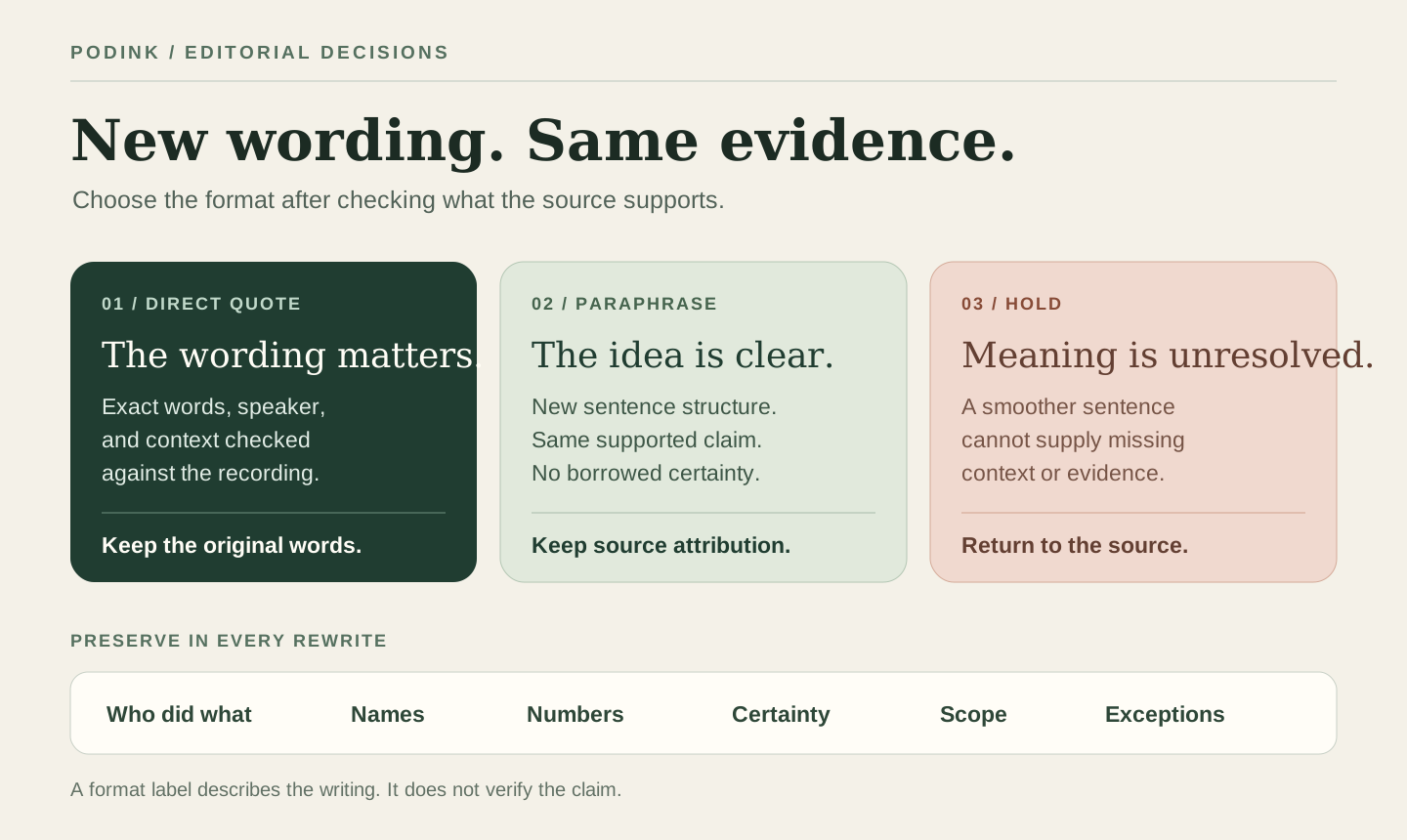
What is the difference between a podcast quote and a paraphrase?
A direct quote presents the source's words as the source's words. A paraphrase presents the source's idea in the writer's own phrasing. Purdue OWL distinguishes these forms by their relationship to the original wording and requires attribution for both. Source: Purdue OWL.
A quote can be surrounded by misleading commentary; a paraphrase can quietly add a stronger claim. Use the podcast quote context checklist for that separate review.
| Format | What can change? | What the reader should see |
|---|---|---|
| Direct quote | Choose a relevant, contiguous excerpt. Do not silently rewrite its words. | Quotation marks, named speaker, source locator, and enough context to preserve meaning. |
| Paraphrase | Sentence structure and ordinary phrasing can change; the supported proposition cannot. | Attribution and source link, without quotation marks around the rewritten sentence. |
| Your interpretation | You may develop a separate argument, supported by its own reasoning and evidence. | An explicit boundary between the guest's position and your conclusion. |
| Hold | Do not turn missing meaning into polished copy. | An internal unresolved status, not a public claim presented as verified. |
When should you quote directly, paraphrase, or hold?
AttentionClaw's podcast-carousel workflow separates checked direct quotes, paraphrases, and editorial interpretations. Its useful boundary is that compressing a conversation does not authorize combining speakers or upgrading a tentative result. Source: AttentionClaw.
For this guide, checking the recording is required before calling spoken words an exact podcast quote. Quoting a publisher's transcript as a written document is a different claim: say that the transcript records the wording. The quote extraction guide covers candidate retrieval and verification.
| Situation | Preferred decision | Check before using it |
|---|---|---|
| Your argument examines the speaker's particular phrase | Direct quote | Verify that wording and include any condition needed to understand it. |
| You need to explain a clear idea in less conversational language | Attributed paraphrase | Compare the rewritten claim with the original, not just its keywords. |
| The words match, but the speaker or intended meaning is unclear | Hold | Resolve attribution, irony, reported speech, or missing setup first. |
| Only a recoverable transcript is available | Paraphrase if the meaning is established; otherwise hold | Disclose the evidence limit. Do not label the passage audio-verified. |
| Your sentence combines ideas from separate turns | Attributed synthesis, if supported | Keep each source locator and each speaker's contribution distinct; do not present the combination as one continuous quote. |
Does “edited for clarity” make a rewritten sentence a quote?
No. A disclosure describes an edit; it does not prove that the edit preserved the original words or meaning. An edited quotation and an exact quotation are different labels, and editorial policies differ on which edits they allow.
AP's standards do not allow changing quotations even to fix grammar or word usage. They allow a faithful paraphrase when the meaning is clear, and reject use when the meaning is too unclear to paraphrase accurately. Source: Associated Press.
For this decision guide, a sentence rebuilt for readability belongs in the paraphrase lane. Removing fillers is not permission to delete a qualification, join distant passages, or turn the host's question into the guest's answer. Follow the publication's editing policy; do not present one outlet's rules as a universal license.
Copyable review note
Record the format and evidence behind the sentence
Attach this note to your timestamped podcast notes so the next reviewer can reopen the passage and distinguish the source from the rewrite.
SOURCE: episode / speaker / URL / turn marker
PROPOSED SENTENCE:
FORMAT: direct quote / paraphrase / interpretation / hold
WHY THIS FORMAT:
MEANING CHECK: names / numbers / certainty / scope / exceptions
RECORDING STATUS: checked / transcript only / unresolved
REVIEWER AND DECISION:
FOLLOW-UP NEEDED:
Wording review
A short workflow for approving the final wording
Record the source
Save the episode, speaker, date, link, candidate passage, and neighboring qualification. Use a timestamped notes template so the next reviewer can reopen it.
State why the wording matters
If your point depends on the actual phrase, verify a direct quote. If your point depends on the idea, prepare a paraphrase. If you cannot state the idea confidently, hold.
Write, then compare
Rephrase from your understanding rather than swapping synonyms while copying the sentence pattern. Reopen the source and check that essential information survived. This read–rewrite–compare process follows Purdue OWL's paraphrasing guidance. Source: Purdue OWL.
Check the whole social post
Review the hook and conclusion as well as the source sentence. Keep any independent fact-check separate from the question of what the speaker said.
Record the decision
Save the final copy, output label, reviewer, and evidence limit. A generated rewrite is a candidate, not a record of human approval.
Public transcript analysis — not audio-verified
Three source checks: names, numbers, and qualifications
The examples use the official transcript of Lex Fridman Podcast #440 with Pieter Levels, dated 2024-08-20. The small quoted fragments below reproduce transcript text, not independently verified audio. The suggested social-post sentences are attributed paraphrases.
The examples below reproduce short transcript fragments and compare attributed paraphrases. Rejected rewrites are teaching examples created for this guide, not real posts or statements by Levels. Source: official transcript.
| Source checkpoint | Faithful paraphrase | Reject this rewrite — and why |
|---|---|---|
| Names · 00:40:43 Transcript excerpt: “It’s PHP and jQuery, yes, and SQLite.” | Levels identifies PHP, jQuery, and SQLite as his stack. | Levels created PHP, jQuery, and SQLite. The names survived, but using tools became inventing them.Source: source turn |
| Numbers · 00:11:12 Transcript fragment: “12 Startups in 12 months” | Levels describes his 12-startup, 12-month project as making and launching something monthly. | Levels built 12 successful companies in 12 months. A project description became a verified success count.Source: source turn |
| Qualification · 02:50:54 Transcript fragment: “I’ve never done that” | Levels suggests learning a framework by building with an experienced user, while noting he has not tried that approach. | Levels tested this learning method and proved it works. A proposed approach became an observed result.Source: source turn |
Editorial rule for choosing the format:
“New wording does not permit a new claim.”Editorial rule for this guide — not a speaker quotation
All rejected rewrites are teaching examples created for this guide. They are not real social posts or statements attributed to Levels. The comparison illustrates why retaining proper nouns and numerals is not enough: the verb, evidence status, and qualification can still change.
Use the markers to reopen whole speaker turns, not to cut exact clips. The host and guest share the same marker in the names example. The numbers fragment is a project name inside a longer recollection, and the learning suggestion continues across several sentences. None of these locators establishes a word-aligned start or end.
GoTranscript's quote-safety guidance identifies scope, timeframe, certainty, attribution, and conditions as meaning-bearing details. Apply those checks to the rewritten sentence, not just to material inside quotation marks. Source: GoTranscript.
Keep your reaction in a separate sentence. For example, a writer may see an implication for team training, but that implication is not automatically the guest's recommendation. The notes-to-argument workflow helps keep evidence and interpretation separate.
Review status: The official transcript and neighboring turns were inspected. These newly selected passages have not been independently checked against the recording for wording, delivery, or visual cues. Prior listening feedback on a different passage is not approval of these excerpts. Keep the examples as transcript analysis and attributed paraphrases unless a separate recording review supports a direct audio quotation.
Compare how the approved core changes in the LinkedIn workflow and the X workflow.
Meaning checklist
What must stay the same when you paraphrase?
- Who and what: Keep the speaker, actor, and action distinct. Mentioning a product is not making it, endorsing it, or measuring it.
- Names: Preserve the correct identity and role of a person, organization, or tool. Do not silently substitute a better-known product for an unfamiliar one.
- Numbers: Preserve the unit, timeframe, denominator when applicable, and whether a quantity is a target, estimate, observation, or result. Repeating the digits is not a complete check.
- Certainty: A possibility, memory, prediction, or personal suggestion should not become a measured fact.
- Scope and exceptions: Keep the population, setting, conditions, and negative statements that limit the claim. If a short post cannot carry a necessary exception, narrow the claim or omit it.
Evidence boundaries
What this review does not establish
- The official transcript and neighboring turns were inspected. The new passages have not been independently checked against the recording for wording, delivery, or visual cues. Prior listening feedback on a different passage is not approval of these excerpts.
- The numbers example does not establish a count of completed, successful, or profitable companies. The learning example does not establish the effectiveness of the proposed method.
- Turn timestamps are source locators, not exact clip boundaries. The host and guest share the names example’s marker; the speaker labels distinguish their turns.
- These are editorial checks, not a determination of publication rights or a guarantee that the speaker’s underlying claim is true.
Human review remains necessary. No repurposing workflow can turn weak evidence into a strong claim.
FAQ
Frequently asked questions
Should podcast social posts use direct quotes or paraphrases?
Use a direct quote when the exact phrase matters and the recording and context have been checked. Use an attributed paraphrase when the meaning is established and new wording serves the reader. Hold the passage if its meaning is unresolved.
Does a podcast paraphrase still need attribution?
Yes. New wording does not make the source's idea yours. Name the speaker and make the episode recoverable with a source link and a useful timestamp.
Can I keep quotation marks around an AI rewrite?
Not if the AI has rewritten the speaker's words. Remove the quotation marks, identify the source, and check the proposed paraphrase against the original. If you need an exact quote, return to the recording.
Can I combine separate sentences into one podcast quote?
Do not present a stitched rewrite as a continuous verbatim sentence. Use a clearly attributed synthesis when all parts support the same bounded claim, and retain their individual source locators.
Is paraphrasing acceptable when I cannot verify a number?
Paraphrasing does not verify a number. Check the figure, unit, timeframe, and status in the source. If those remain unclear, omit or hold the numerical claim; removing quotation marks does not resolve the uncertainty.
Evidence
Sources and comparison pages
- Quoting, Paraphrasing, and SummarizingPurdue OWL
- Paraphrasing: Write It in Your Own WordsPurdue OWL
- Telling the Story: News Values and PrinciplesAssociated Press
- Repurpose Podcast Episodes to CarouselsAttentionClaw
- Publishing Quotes Safely: Context RulesGoTranscript
- Pieter Levels: Lex Fridman Podcast #440 — TranscriptLex Fridman