
Podcast quote context checklist
How to check the context of a podcast quote
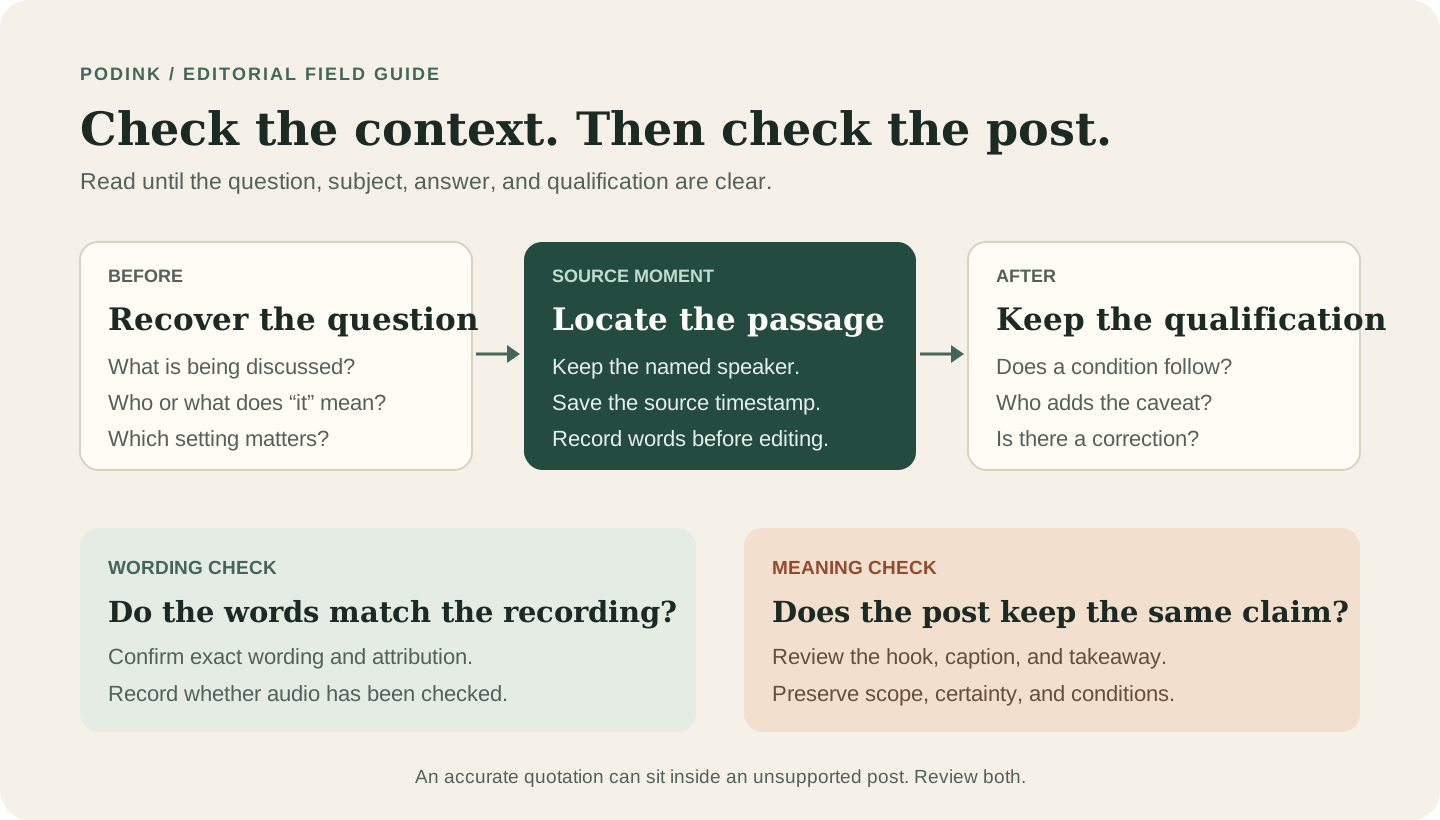
To check podcast quote context, reopen the original episode, read the question before the quote, and follow the answer through its qualifications and corrections. Identify the speaker, the subject being discussed, the scope, the level of certainty, and any conditions. Then compare those details with your entire proposed post, including the hook. Accurate words can still support a misleading post.
Keep separate decisions for wording and meaning. A quote may match the recording while the headline adds an unsupported cause, recommendation, or universal rule. Approve the post only when its interpretation remains within what the passage supports.
Why can an accurate podcast quote still mislead?
A quotation can preserve the speaker's words while losing the question, a condition, or the identity of the person whose opinion is being reported. AP's editorial standards require quotations to retain their context and meaning; they also recognize that the setting and the speaker's delivery may affect interpretation. Source: Associated Press.
A source link makes a passage recoverable, but it cannot repair a misleading headline. Resolve quote formatting with the podcast quote extraction guide in Continue reading; use the checks below to review the argument built around that quote.
| Review | Question | What a pass establishes |
|---|---|---|
| Wording | Does the proposed quote match the recording and the named speaker? | The attribution and words are accurate. |
| Meaning | Does the hook, caption, and takeaway preserve the original scope and conditions? | The post does not claim more than the passage supports. |
| Underlying facts | Is the speaker's factual claim independently supported? | The claim has evidence beyond the fact that somebody said it. |
How far before and after the quote should you check?
As a practical starting point, review about a minute to a minute and a half on each side of the passage. Treat that window as an editorial heuristic, not a guarantee. Extend backward until the question and referents are clear, and forward until the answer and relevant correction are complete.
Podscan recommends checking the surrounding 90 seconds before treating a podcast quote as publishable material. A fixed duration can still miss an earlier setup or later qualification. The stopping rule is a complete thought, not the end of a timer. Source: Podscan.
Watch the video when interpretation depends on a demonstration, gesture, or visual reference. W3C distinguishes a basic transcript of speech and relevant sounds from a descriptive transcript that also carries the visual information needed to understand a video. Source: W3C Web Accessibility Initiative.
Copyable review note
Copy a short context-review note
Attach this note to your timestamped podcast notes. Carry the supported claim and its limitation into the draft, rather than relying on the source link alone.
PROPOSED POST
Hook and main claim:

SOURCE
Episode, date, speaker, and URL:
Candidate turn timestamp:
Context range reviewed:
Question or setup:
Qualification or correction:
Whose view is being expressed:

DECISION
Wording: transcript located / audio checked / unresolved
Meaning: supported / revise / hold
Independent fact-check needed:
Change required before publication:
Context workflow
A repeatable podcast quote context check
Write down the post's claim before reviewing the source
Save the exact hook and takeaway you plan to publish. Underline any claim about who should act, what caused an outcome, or how broadly the advice applies. Otherwise, the review may confirm the topic without testing the actual claim.
Find the original episode and recover the setup
Record the show, guest, episode date, source URL, and passage timestamp. Read the host's question and identify what pronouns such as it, they, or that approach refer to. Check that the excerpt belongs to the main conversation rather than a trailer or edited introduction.
Follow the answer through the nearest qualification
Continue through interruptions and speaker changes. Look for conditions, exceptions, self-corrections, counterexamples, reported speech, and uncertainty. GoTranscript's editing guidance identifies scope, timeframe, certainty, attribution, and conditionals as context that must survive quotation. Source: GoTranscript.
Compare the source meaning with the whole post
Ask whether personal experience became universal advice, possibility became certainty, or an opinion became a measured result. Check the headline, thumbnail text, caption, and final sentence as well as the quotation. A careful body paragraph cannot neutralize a hook that says the opposite.
Record a decision and what remains unchecked
Use ready, revise, or hold for the proposed post. Record audio verification separately. If wording is uncertain but meaning is clear, consider an attributed paraphrase. If meaning is uncertain, hold the passage; paraphrasing cannot resolve missing context.
Public transcript and listening-review example
Public example: a PHP quote does not establish advice for every developer
The official transcript for Lex Fridman Podcast #440 with Pieter Levels is dated 2024-08-20. The software-stack discussion provides a useful context check because the surrounding turns separate a personal explanation from a general recommendation.
In the turn beginning at 00:41:06, Levels contrasts framework maintenance with the stability he associates with PHP. This is a paraphrase, not a verbatim quotation. Read the initial window from 00:40:06 through 00:42:36, then extend it through 00:43:33 to finish the host's later qualification. The candidate passage occurs inside a longer turn; 00:41:06 is a turn-level locator, not a word-aligned clip boundary. Source: official timestamped transcript.
| Source marker | What the transcript shows | Effect on the proposed post |
|---|---|---|
| Before: 00:40:35 | Fridman asks about the interface Levels built; the conversation turns to his stack. | The immediate subject is one builder's work.Source: source turn |
| Candidate: 00:41:06 | Levels contrasts framework maintenance with his experience using PHP. | The passage expresses a preference, not a comparative study.Source: source turn |
| Question: 00:41:23 | Fridman asks about the philosophy behind Levels's simple stack. | The follow-up asks for an explanation of his practice.Source: source turn |
| Answer: 00:41:47 | Levels explains that he already knew the tools and had little time to learn replacements. | Retain the personal constraints.Source: source turn |
| Qualification: 00:42:55 | Fridman cautions that building everything from scratch is not always appropriate. | Attribute the caveat to the host, not the guest.Source: source turn |
Illustrative rejected hook, written for this guide:
“Pieter Levels proves every developer should stop using frameworks.”Illustrative rejected hook, written for this guide — not a speaker quotation
The rejected hook adds proof, a universal audience, and an instruction to change tools. The cited passage establishes none of those additions. Even a word-perfect quotation underneath would not rescue that hook.
Bounded alternative, paraphrased: Levels explains his familiar stack through experience and time constraints; Fridman adds that the appropriate tools still depend on the work.
Review status: The table is based on the official transcript, with a human listening-review report confirming the general meaning, personal context, and attribution of the caveat to the host. The report does not establish verbatim wording or exact clip boundaries, and detailed delivery or visual observations were not recorded. The example therefore uses attributed paraphrases. The broad hook fails the meaning check; a direct quotation would still require a word-for-word recording check.
Compare how the approved core changes in the LinkedIn workflow and the X workflow.
Context checklist
Podcast quote context checklist: what changed between source and post?
| Check | Warning sign in the post | Required correction |
|---|---|---|
| Speaker and ownership | A host's question or another person's opinion becomes the guest's position. | Restore the correct speaker and distinguish reported speech from endorsement. |
| Scope | One person's experience becomes advice for everybody. | Name the person, setting, or population actually discussed. |
| Certainty | A prediction or tentative view becomes an established fact. | Preserve the uncertainty and identify opinion as opinion. |
| Conditions | The outcome survives, but the prerequisite disappears. | Keep the condition next to the claim. |
| Time | Old guidance is framed as the speaker's current view. | Give the episode date and investigate whether the claim still applies. |
| Causation | Events mentioned together become evidence that one caused the other. | Remove the causal claim unless the source and independent evidence support it. |
| Delivery and medium | Sarcasm, a demonstration, or a visual reference is flattened into literal advice. | Review the audio or video; hold the passage if interpretation stays ambiguous. |
- Check the original date and nearby caveats, as in PodRewind's archive-review workflow listed in Sources.
- Compare the recovered context with the claim that the finished post asks readers to accept.
Review boundaries
What the context check does not establish
- A context review checks whether the finished post preserves the source's meaning; it does not independently prove the speaker's factual claims.
- The suggested listening window is an editorial starting point, not a guarantee that every relevant correction falls inside it.
- The public example has transcript evidence and human-reported confirmation of meaning and attribution, not a word-for-word audio certification or word-aligned clip boundaries.
- If relevant delivery or visual cues leave meaning unclear, hold the passage; changing it into a paraphrase cannot resolve unknown intent.
Human review remains necessary. No repurposing workflow can turn weak evidence into a strong claim.
FAQ
Frequently asked questions
Is an exact quote automatically in context?
No. Exact wording can still mislead when the post omits a condition, changes the subject, merges speakers, or presents an example as a general rule. Review the complete claim around the quotation.
Is a fixed listening window enough?
No fixed duration guarantees context. Start around the passage, then expand until the setup, referents, answer, and relevant qualification are clear. Search farther through the episode if a later correction is relevant.
Can I paraphrase a quote when its context is unclear?
Only when the underlying meaning can be established. A paraphrase can address uncertain wording, but it cannot fix unknown scope, attribution, or intent. Hold the passage if its meaning remains unclear.
Can AI check podcast quote context?
AI can retrieve nearby turns and flag apparent qualifiers. A reviewer must still verify the source, speaker, relevant delivery, and the finished post's interpretation. A generated explanation is not evidence that the recording was checked.
Does adding the episode link fix a misleading post?
No. A link lets readers inspect the source, but the post itself should preserve the meaning. Narrow the hook or restore the missing condition before publishing.
Evidence
Sources and comparison pages
- Telling the story: quotations and contextAssociated Press
- The Podcast Quote Trap: Keep Context Intact When You Source AudioPodscan
- TranscriptsW3C Web Accessibility Initiative
- Publishing Quotes Safely: Prevent Re-Identification and Keep the Right ContextGoTranscript
- Pieter Levels transcript, Lex Fridman Podcast #440Lex Fridman
- Fact-check a podcast with a searchable archivePodRewind