
Transcript to LinkedIn
Podcast transcript to LinkedIn thought leadership: a worked example
Turn a podcast transcript into LinkedIn thought leadership by separating the source claim from your own point of view. Attribute the idea, explain what you would do with it, and keep the limit beside the takeaway. The result should give a professional reader a decision to consider, not just an episode to consume.
A transcript can leave you with a page of good observations and nothing you would put your name to. The worked example below turns a public Stanford podcast transcript into a complete LinkedIn draft. It is an editorial exercise, not a published post, a customer case study, or a claim about engagement.
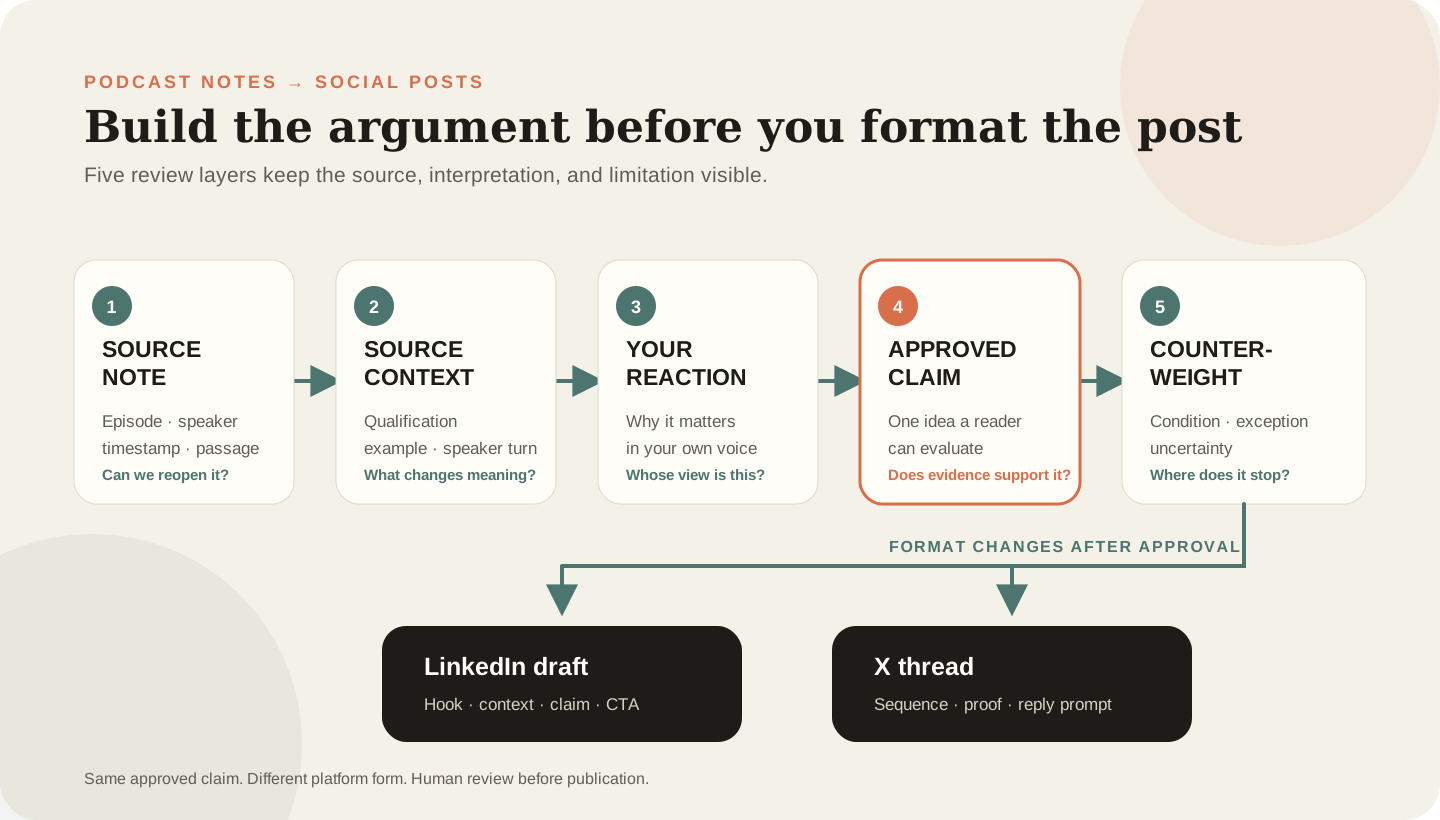
What does the writer add to the transcript?
For this exercise, thought leadership means a position the writer is willing to explain and defend. Choose a reader and a decision before choosing a hook. Here the reader is a manager preparing a project review; the decision is how to ask about emerging problems.
The notes-to-argument guide covers assembling evidence and a defensible claim. The LinkedIn workflow page covers using PodInk. This worked example covers the writing handoff: a complete post, the ownership of each paragraph, and the revisions needed to keep the hook honest.
Start with a recoverable passage, including its limit
Source: Stanford GSB’s Think Fast Talk Smart episode “Embracing Failure: How to Make Mistakes That Work,” dated April 15, 2024. Read guest Amy Edmondson’s response at [01:21] and her reply to host Matt Abrahams under [03:52]. Source: official episode and transcript.
In those responses, Edmondson connects candid reporting with how leaders frame the work, ask questions, and respond to difficult news. She also distinguishes appreciation for speaking up from agreeing with or praising every contribution. Source: transcript, [01:21] and [03:52].
Review status: transcript-only. Stanford warns that its machine-generated, lightly edited transcript may contain errors. The recording was not checked; markers locate sections, not exact clip boundaries.
Complete illustrative LinkedIn draft
A post a manager can adapt after reviewing the source
This AI-assisted editorial example was written for this guide, not by Edmondson or Abrahams. Its management prompts are the writer’s proposed application. It has not been posted to LinkedIn.
Before your next project review, write the question you want someone to feel able to answer.

In Stanford’s Think Fast Talk Smart transcript, Amy Edmondson connects candid reporting with leaders’ questions and responses. She also makes a distinction I want to keep: appreciating someone for speaking up does not require agreeing with their contribution.

My takeaway: prepare the difficult question as carefully as the status update.

For a project review, I would start with:
• Which assumption in our plan looks weakest now?
• What would be useful to raise before it becomes urgent?
• What needs a decision, and who needs to be in that conversation?

Those are my prompts, not a framework from the episode. I would use them to open a discussion, then record the issue, the owner, and the next decision.

A better question does not settle whether a concern is accurate or what the team should do. The concern still needs examination, and the follow-up matters.

What would you ask in your next review to make an unresolved concern discussable?

Source: Amy Edmondson with Matt Abrahams, Think Fast Talk Smart, 15 April 2024. Transcript sections [01:21] and [03:52]; transcript-only reading.
https://www.gsb.stanford.edu/insights/embracing-failure-how-make-mistakes-work
Build the post
How the transcript becomes a LinkedIn point of view
Choose the professional decision
Write who the post is for and what that reader could reconsider. In this example, a manager can change the agenda for a project review. Avoid opening with the guest’s reputation when the reader still cannot tell why the idea matters.
Reserve a sentence for attribution
Name the speaker near the paraphrase and link the episode. Purdue OWL recommends writing the meaning in your own words, comparing it with the original, and recording the source. New phrasing does not transfer ownership of the idea. Source: Purdue OWL paraphrasing guidance.
Give the reader an action to evaluate
Move from the attributed idea to a concrete action. If you have a real example from your work, label it as your experience. If you do not, use a proposal such as “I would” instead of inventing a story about what your team achieved.
Review the hook, evidence, and close together
Use the review table to check who owns each claim. Read the first and last lines beside the source summary. A careful middle paragraph cannot repair a hook that claims the guest proved something the transcript does not establish.
Sentence ownership review
Audit the complete post before you copy it
The draft offers a management question and a proposed review agenda. The transcript supports the attributed paragraph; it does not validate the writer’s prompts or predict their effect.
| Post element | What the draft does | What the reviewer checks |
|---|---|---|
| Opening: prepare a question | An editorial suggestion addressed to a manager. | The hook does not say Edmondson prescribed this exact agenda. No invented workplace anecdote is needed. |
| Named source paragraph | An attributed paraphrase with a nearby qualification. | Check both marked responses, including the follow-up. Keep the speaker’s name attached when copying the post.Source: Stanford transcript, [01:21] and [03:52] |
| “My takeaway” | The writer’s interpretation introduces a different writing voice. | An interpretation can be reasonable without being the speaker’s own conclusion. Do not move it into quotation marks attributed to the guest. |
| Project-review prompts | Original teaching examples for a specific professional setting. | They are proposals, not tested questions or a named method endorsed by the guest. Readers should adapt them to their responsibilities. |
| Limitation and closing question | The draft leaves evaluation and follow-up open. | Keep the limit when shortening. The closing question asks about the reader’s practice; it does not demand agreement with a claimed research result. |
Editorial principle:
“Let the transcript support your argument without impersonating the speaker.”PodInk editorial principle for this worked example
The key editorial move is the handoff between the named source paragraph and “My takeaway.” That boundary lets the writer contribute a practical idea without assigning the entire post to an expert. A source link alone would not make that distinction clear.
A shorter version may remove a prompt or introductory sentence. It still needs the source attribution, the writer’s application, and the limit. A materially different thesis needs another source check; it cannot inherit approval from this draft.
Editorial review complete; publication is approved. The source markers and paragraph-ownership checks are recorded above. Before adapting the post, review the source and replace any first-person statement that does not reflect your own view or experience.
Compare how the approved core changes in the LinkedIn workflow and the X workflow.
Hook and attribution review
Repair a stronger hook before it changes the claim
| Risky rewrite | Why it fails | Repair |
|---|---|---|
| Amy Edmondson proved these questions make any team speak up. | It assigns the writer’s prompts to the guest and adds proof and universal scope. | Frame the prompts as a proposed application and remove the promised result. |
| I used this method and transformed our reviews. | It invents first-person experience and an outcome absent from the evidence. | Say what you would try, or replace the line with a real experience you can explain. |
| Every concern deserves immediate agreement. | It converts an invitation to discuss into a rule about accepting the substance. | Preserve the distinction between hearing a concern and deciding what the concern warrants. |
- Can a reader identify the professional decision before following the source link?
- Does the source paragraph preserve the qualification as well as the main idea?
- Are the guest’s account, the writer’s interpretation, and the illustrative prompts visibly separate?
- Have invented first-person experience, results, and claims of scientific proof been removed?
- After shortening, do the hook and conclusion still fit what the attributed paragraph can support?
- Does the copied post retain the episode link and useful transcript markers?
Evidence limits
What this example establishes
- The review is transcript-only; it does not establish the recording’s exact words, delivery, or visual context.
- The example is an unpublished editorial draft. It is not an actual LinkedIn post, a customer outcome, an endorsement, or a performance experiment.
- The project-review questions are original suggestions for this guide. Their usefulness has not been measured, and the podcast does not establish their effectiveness.
- Source accuracy and publication rights are separate questions. This guide does not establish permission to reproduce an episode or imply that its speakers endorse the post.
Human review remains necessary. No repurposing workflow can turn weak evidence into a strong claim.
FAQ
Frequently asked questions
How is transcript-based thought leadership different from an episode summary?
An episode summary reports what the conversation covered. This thought-leadership exercise selects a specific professional decision, attributes a relevant source idea, and adds the writer’s own reasoning or proposed application.
Can I use first person if I was not the podcast guest?
Yes, for your own interpretation or a truthful account of your experience. Say “my takeaway” or “I would try” when that is the evidence you have. Do not imply you conducted the interview, tried the method, or achieved a result unless that happened.
Can an AI draft the LinkedIn post from the transcript?
AI can propose a draft, but review the source attribution, speaker identity, qualifications, and ownership of every added example. Fluency does not establish that the guest made the claim or that a proposed action works.
Evidence
Sources and comparison pages
- Embracing Failure: How to Make Mistakes That WorkStanford Graduate School of Business — Think Fast Talk Smart
- Paraphrasing: Write It in Your Own WordsPurdue OWL