
Podcast editorial template
A timestamped podcast notes template for social media
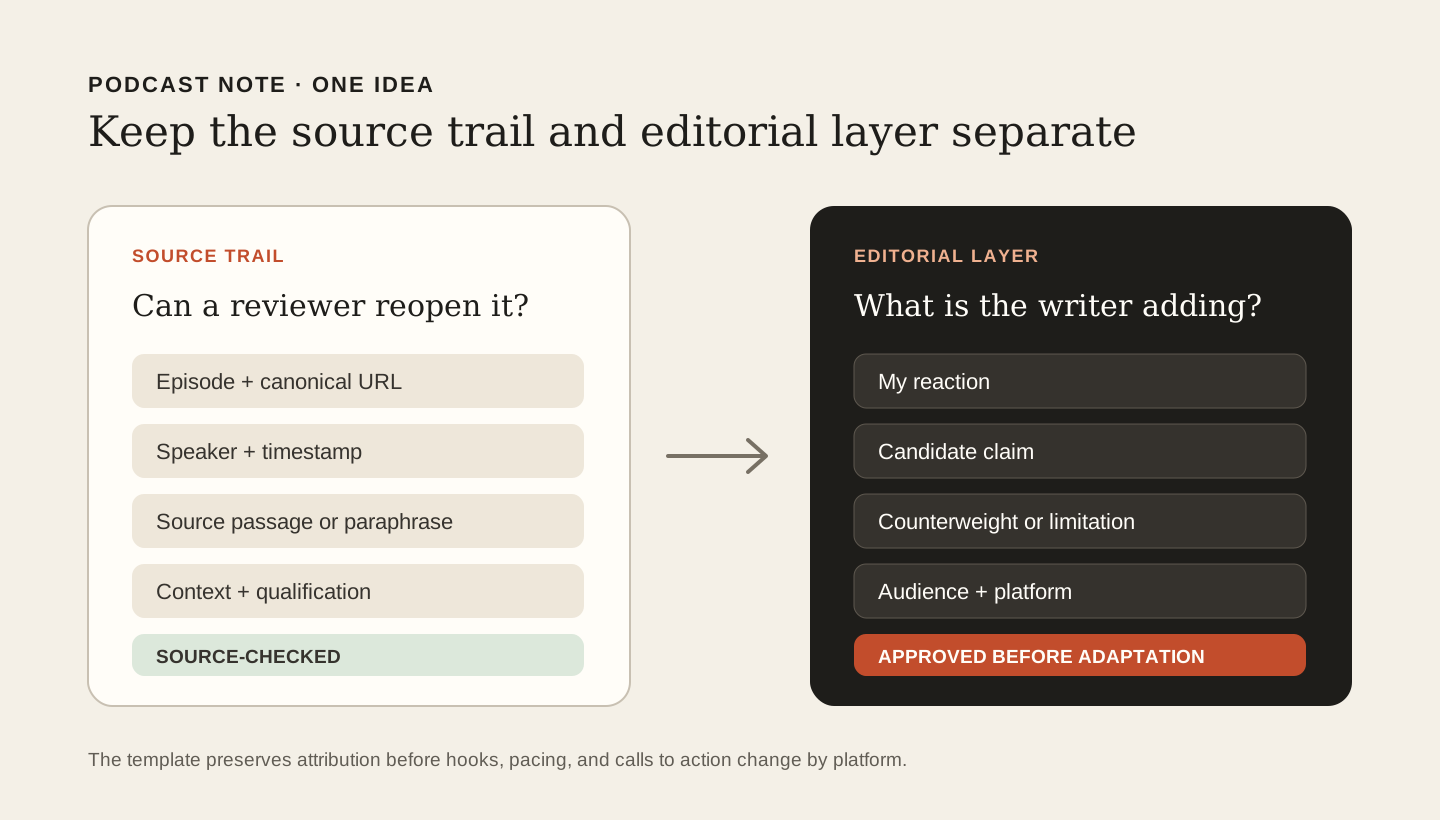
A podcast notes template for social media should preserve a recoverable source before it asks for a post. Record the episode, source URL, speaker, timestamp, passage, surrounding context, your reaction, candidate claim, counterweight, and review status. The result is one checked handoff, not a compressed summary of the whole episode.
The timestamp gets a reviewer back to the moment. The passage records what the speaker actually said. The reaction and candidate claim show what the writer is adding. Keeping those layers separate makes the note reusable without silently turning the speaker's idea into the writer's conclusion.
Copyable template
Copy this podcast notes template
Use one copy for each coherent idea. Create separate notes when different moments need different speakers, claims, or limitations.
EPISODE
Show and episode:
Canonical episode URL:

SOURCE MOMENT
Speaker:
Timestamp:
Source passage or faithful paraphrase:
Context before and after the moment:

EDITORIAL LAYER
My reaction:
Candidate claim:
Counterweight or limitation:
Intended audience and platform:

REVIEW
Names, numbers, and links checked:
Audio checked before any direct quote:
Status: unchecked / source-checked / approved
How to fill it
Complete the source note before adapting the platform copy
Lock the episode and final media version
Save the canonical episode URL before taking notes. If the recording is edited later, recheck the timestamp against the final file. YouTube's official chapter requirements likewise depend on ordered markers in the published media. Source: YouTube's chapter requirements.
Name the speaker before copying the passage
Speaker attribution is part of the evidence. Do not put a host's question, a guest's answer, and your conclusion into one undifferentiated note.
Capture the context boundary
Record whether the statement is an example, hypothesis, personal experience, prediction, or qualified conclusion. Include a nearby correction when it changes what the moment can support.
Write the reaction on its own line
Explain what the moment changes or clarifies for the intended audience. Keeping the reaction separate prevents your interpretation from becoming a fake quotation.
Draft one claim with one counterweight
The candidate claim should stand alone. The counterweight should travel with it when uncertainty, population, timeframe, or exceptions matter.
Approve the note before adapting the format
Only after the note is source-checked should you change the hook, pacing, length, or call to action for LinkedIn, X, or another channel.
Public transcript example
A filled note from a public timestamped transcript
Lex Fridman Podcast #490, State of AI in 2026, was published on January 31, 2026 with a public speaker-labeled transcript. At 00:24:27, Sebastian Raschka develops a point about executable work making some mistakes and misunderstandings easier to detect.
| Template field | Completed note | Editorial purpose |
|---|---|---|
| Episode | Lex Fridman Podcast #490 — State of AI in 2026 | Names the canonical episode and public transcript.Source: Lex Fridman transcript |
| Speaker | Sebastian Raschka | Prevents Lex's setup from being attributed to Sebastian. |
| Timestamp | 00:24:27 | Reopens the exact moment in the public video.Source: YouTube at 00:24:27 |
| Passage | Faithful paraphrase: building and running code makes some errors and misunderstandings observable in a way that static figures or explanations may not. | Avoids presenting an unchecked transcript sentence as a direct quote. |
| Context | Lex first frames from-scratch building as a learning method; Sebastian then explains why executable work is easier to verify. | Preserves the setup and scope of the answer. |
| Reaction | A source note becomes more useful when it records how a reader could test the idea, not only what the speaker said. | Labels the writer's interpretation. |
| Candidate claim | For technical podcast content, pair the takeaway with a reproducible check whenever the source provides one. | Turns the moment into one bounded editorial point. |
| Counterweight | Working code demonstrates behavior under a particular implementation and input; it does not prove every surrounding generalization. | Keeps verifiable from becoming universally correct. |
| Status | Transcript checked; paraphrase only; audio review required before converting wording into a direct quote. | Shows what remains before publication. |
“A reusable podcast note shows the source moment, the writer's reaction, the proposed claim, and the limit that keeps the claim honest.”PodInk editorial rule
This note can now move into the notes-to-argument workflow. The source marker and context remain fixed while the hook, pacing, and call to action change by platform.
Compare how the approved core changes in the LinkedIn workflow and the X workflow.
Review checklist
What to check before approving the note
- Confirm that the episode URL opens the canonical source rather than a copied fragment.
- Confirm that the speaker and timestamp reopen the intended moment in the final media file.
- Use direct quotation marks only after checking the wording against the audio.
- Preserve a relevant qualification, example boundary, or nearby correction in the context field.
- Keep the writer's reaction visibly separate from the speaker's statement.
- Make the candidate claim stand alone without becoming broader than the passage.
- Name the strongest relevant limit instead of adding a generic disclaimer.
- Distinguish an unchecked note from source-checked and approved material.
Boundaries
What a timestamped note does not prove
- A timestamp can drift when the media is edited, so markers must be checked against the final published file.
- A transcript can contain recognition or speaker-label errors and does not replace an audio check before direct quotation.
- A writer's reaction is an interpretation, not a statement that can be attributed to the podcast speaker.
- Working code or another reproducible artifact demonstrates behavior under particular conditions; it does not prove every surrounding generalization.
- PodInk prepares reviewable drafts and does not publish them without a human decision.
Human review remains necessary. No repurposing workflow can turn weak evidence into a strong claim.
FAQ
Frequently asked questions
What should podcast notes for social media include?
Include the episode and URL, speaker, timestamp, source passage or labeled paraphrase, nearby context, writer reaction, candidate claim, counterweight, intended platform, and review status.
Is a timestamp enough to support a podcast quote?
No. A timestamp is a locator. Check the wording against the audio, confirm the speaker, and review the surrounding context before using quotation marks.
Should one podcast note create several social posts?
Use one note for one coherent idea. Create separate notes when different moments need different speakers, context, claims, or limitations.
Can AI fill this podcast notes template?
AI can propose speakers, timestamps, passages, and draft reactions, but a human should verify the final media, attribution, names, numbers, links, and every direct quotation.
Evidence
Sources and comparison pages
- How to Write Podcast Show NotesBuzzsprout
- Podcast Show Notes: Templates, Examples, and What to IncludeDescript
- How to Use AI Podcast Show Notes to Grow Your ShowCastmagic
- Video ChaptersYouTube Help
- Making Audio and Video Media AccessibleW3C Web Accessibility Initiative
- PodcastEpisodeSchema.org
- SocialMediaPostingSchema.org
- State of AI in 2026 Transcript, Podcast #490Lex Fridman