
Podcast editorial guide
Podcast show notes vs social media posts: what changes?
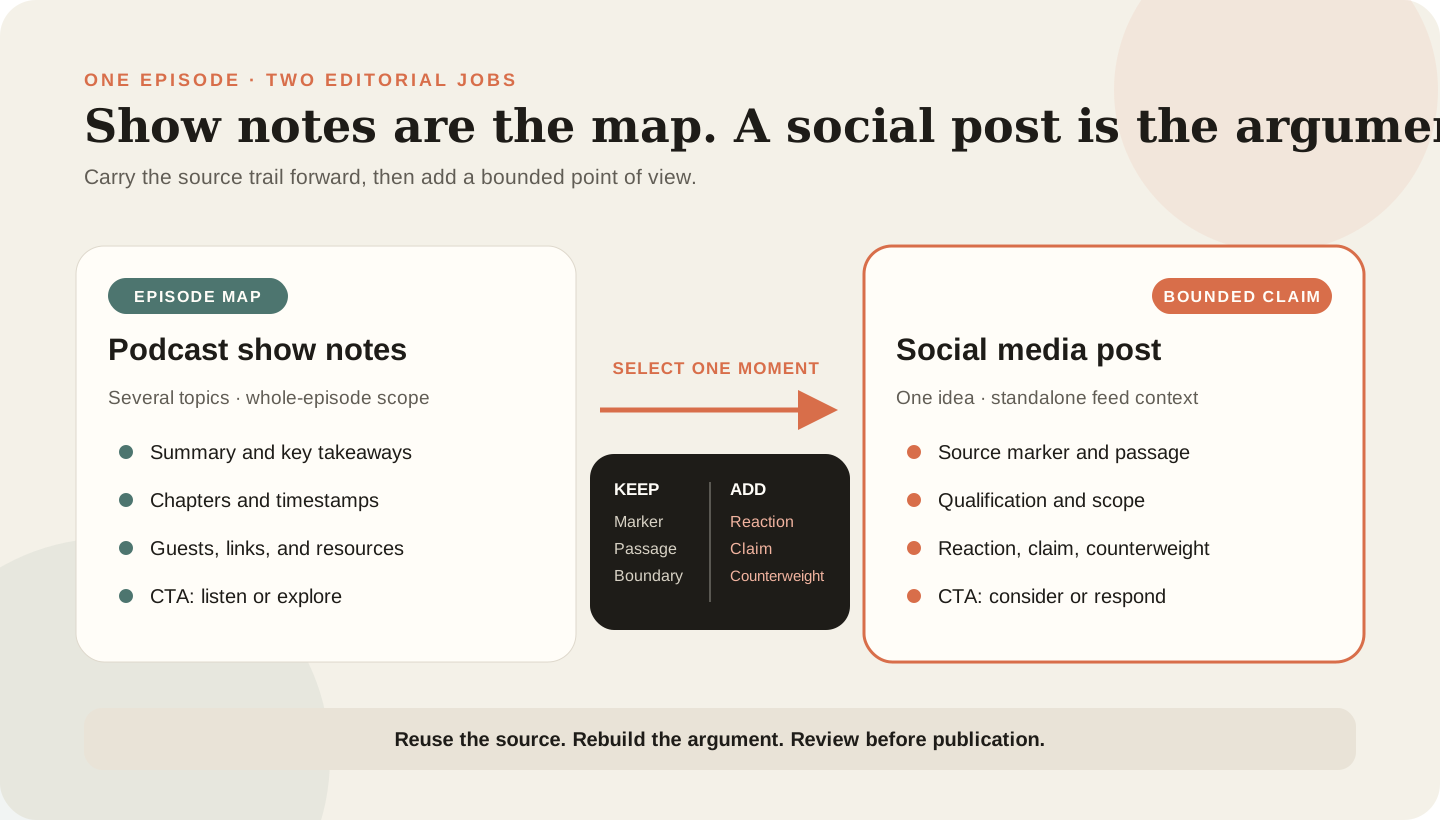
Podcast show notes help a listener understand and navigate an episode; a social media post makes one source-grounded claim that must stand on its own in a feed. Reuse the episode, speaker, timestamp, passage, and qualification from the show notes, then add an editorial reaction, a bounded claim, and a platform-specific reason to respond. Do not paste the notes page into LinkedIn or X.
The practical distinction is simple: show notes are an episode map, while a social post is a small argument. A map can cover the whole conversation. A post needs one point, the evidence that supports it, and the condition that stops the point from becoming broader than the source.
The editorial handoff
How show notes become one source-grounded social post
Choose one chapter, not the whole episode
Pick one timestamped section with a clear speaker, passage, and audience relevance. Show notes can cover several topics; one social post needs one point that can stand alone. Source: Cliposts' chapter-to-post guidance.
Reopen the transcript and linked source
Check the sentences around the marker, then follow links for names, dates, numbers, or research claims. A show-notes bullet can locate evidence without containing enough evidence to publish. Source: W3C transcript guidance.
Write the source boundary before the hook
Record the population, timeframe, uncertainty, example status, or exception that limits the finding. Keeping the boundary visible before drafting makes it harder for a strong opening to erase it.
Add the writer's reaction separately
State what the moment changes, challenges, or clarifies for the intended reader. Label the sentence as editorial interpretation rather than placing it inside quotation marks.
Approve one claim and one counterweight
The claim should stand alone in a feed. The counterweight should name the strongest relevant limit. If the two sentences cannot coexist, the claim is still too broad.
Adapt the approved argument to the platform
Change the hook, pacing, line breaks, and call to action without changing the evidence. LinkedIn and X versions should share the approved claim without becoming identical copies.
Public evidence case
The show notes contain the headline; the transcript supplies the boundary
The Artificial Intelligence Show episode 168 marks How People Use ChatGPT at 00:31:03 and links to the original research. The show notes surface the finding; the transcript and primary source define which accounts the finding covers.
| Review layer | Working text | Why it belongs |
|---|---|---|
| Show-notes seed | 00:31:03 — How People Use ChatGPT. | Locates the relevant chapter and the research discussed in it.Source: SmarterX episode 168 |
| Summary fact | The study analyzed 1.5 million conversations; approximately 70% of observed consumer usage was non-work-related. | Supplies the headline finding without dropping the population.Source: NBER working paper |
| Transcript boundary | At 00:32:57, the episode says the study covered consumer plans, not Team or Enterprise accounts. | Prevents a consumer sample from becoming a claim about every account type.Source: SmarterX transcript |
| Editorial reaction | A large number can still answer the wrong business question when its population disappears from the post. | States the writer's interpretation without attributing it to the hosts. |
| Approved claim | The 70% non-work result describes observed consumer-plan usage; it should not be presented as evidence about Team or Enterprise activity. | Preserves both the finding and its sample boundary.Source: OpenAI's research summary |
| Counterweight | A 1.5-million-conversation consumer sample remains useful for understanding consumer behavior. | The limitation changes the scope, not the existence, of the finding. |
“The social post is not a shorter set of show notes. It is one checked inference whose source marker and limitation survived the rewrite.”PodInk editorial rule
This handoff keeps three source fields — marker, passage, and boundary — then adds three editorial fields: reaction, approved claim, and counterweight. The result can stand alone without pretending to replace the episode.
Compare how the approved core changes in the LinkedIn workflow and the X workflow.
Review checklist
What to check before the post leaves the show notes
- Confirm that the episode, speaker, and timestamp reopen the exact source passage.
- Keep one claim rather than compressing the whole episode table of contents.
- Check every number, name, and quotation against the transcript or linked primary source.
- Keep the writer's reaction visibly separate from the host or guest's words.
- Preserve the source population, timeframe, uncertainty, and exceptions when they affect the claim.
- Use a platform-specific call to action instead of merely telling the reader to listen.
Boundaries
What show notes and timestamps do not prove
- Show notes can locate a useful chapter without preserving enough surrounding context to support a public claim.
- A transcript can contain recognition errors, speaker-label mistakes, or missing visual context, so quotations still need to be checked against the recording.
- A research result should keep its population, timeframe, exclusions, and uncertainty when it becomes a social post.
- One set of show notes can support several posts, but every materially different claim needs its own source check.
- PodInk prepares reviewable drafts and does not publish them without a human decision.
Human review remains necessary. No repurposing workflow can turn weak evidence into a strong claim.
FAQ
Frequently asked questions
Can I copy podcast show notes into a LinkedIn post?
Do not paste the whole notes page. Select one chapter, reopen its evidence, add a clearly labeled editorial reaction, and write one bounded claim that makes sense without asking the reader to reconstruct the episode.
Do podcast show notes need a full transcript?
Not every public notes page needs to display a full transcript, but a transcript or audio marker is valuable during editorial review because it lets a writer verify exact wording, speaker attribution, and nearby qualifications.
Can one set of show notes create several social posts?
Yes. Treat each strong chapter as a separate candidate, then give each post its own source check, approved claim, and counterweight. Do not force every chapter into a post when its evidence is too thin.
Is a timestamp enough evidence for a social post?
No. A timestamp is a locator, not proof that the post's interpretation is accurate. Reopen the surrounding passage and follow any linked primary source before approving quotations, numbers, names, or causal claims.
Evidence
Sources and comparison pages
- How to Write Podcast Show NotesWhisperTranscribe
- Podcast Show Notes TemplateSweet Fish
- Turn Podcast Show Notes Into Social Media PostsCliposts
- PodcastEpisodeSchema.org
- SocialMediaPostingSchema.org
- Making Audio and Video Media AccessibleW3C Web Accessibility Initiative
- The Artificial Intelligence Show, Episode 168SmarterX
- How People Use ChatGPTNational Bureau of Economic Research
- How People Are Using ChatGPTOpenAI