
Podcast discussion guide
How to write podcast discussion questions people can answer from the source
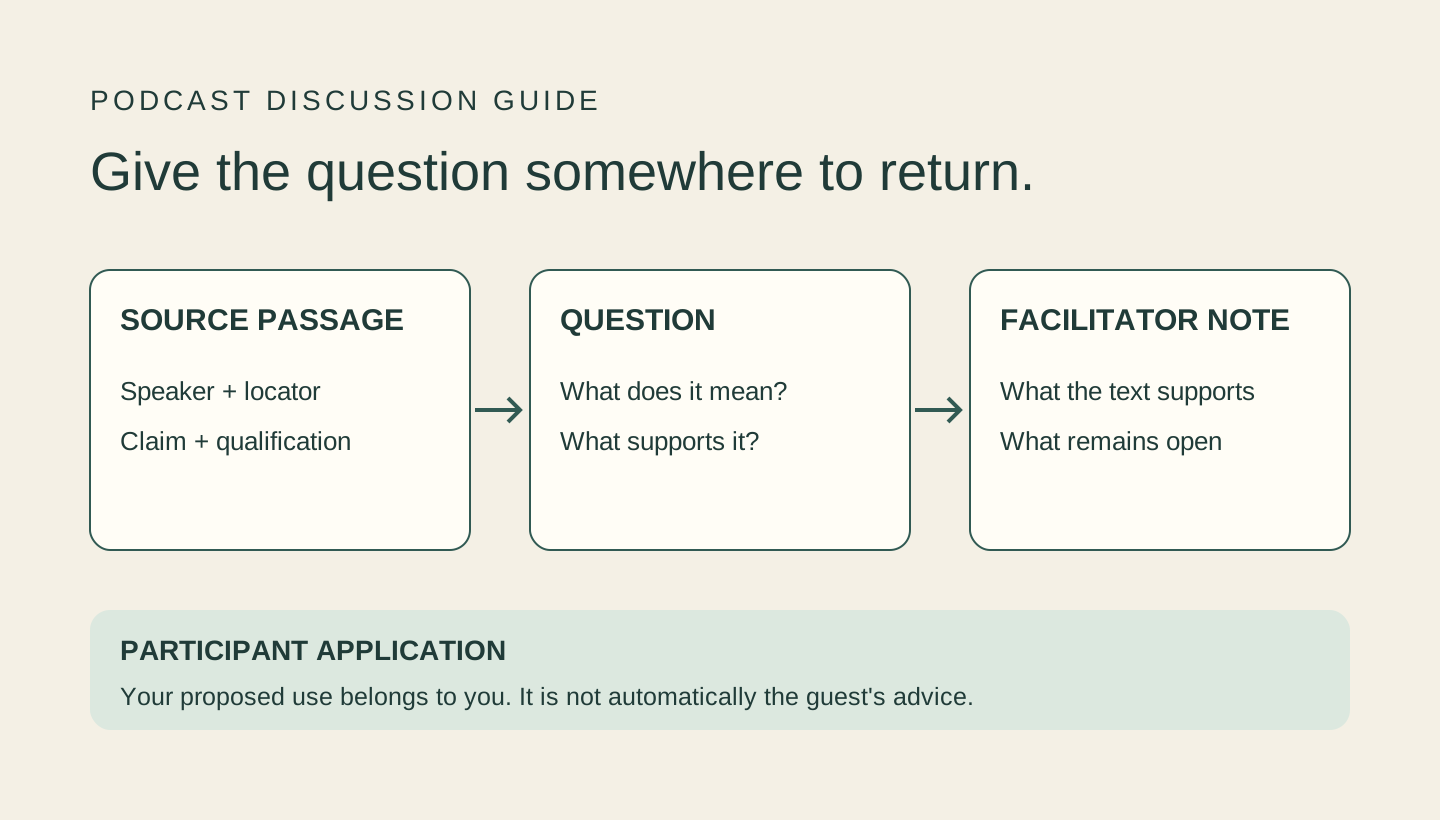
To write podcast discussion questions, choose a passage and a discussion goal, then ask readers to explain the speaker’s idea, examine its support and consider a bounded application. Give each source question a passage locator. Separate what the episode says from the questions and interpretations you add.
Participants need a shared source, and the facilitator needs notes that distinguish a supported answer from a plausible invention. Build those notes alongside the questions. The template and worked guide below keep interpretation open while making the source easy to check.
Give the discussion a different job from the promotional post
A promotional post invites someone to listen. A discussion guide helps people work with an episode they have accessed. An opinion poll collects choices; a discussion question asks participants to explain a reading, compare evidence or develop a response. Choose the job before choosing the format.
Cornell’s companion guide for its “I” Statements podcast pairs episode descriptions and transcript links with discussion prompts, reflection and further reading. That is an example of a source package, not evidence that one question format works for every audience. Source: Cornell’s podcast companion guide.
Florida State University’s library guide asks listeners to examine an interview’s argument, examples and research process, then relate it to other work. Use that distinction between source understanding and personal response when planning your own guide. Source: FSU’s podcast discussion assignment.
Separate questions about the source from questions that go beyond it
Choose the question types that serve your group’s purpose. A source question gives participants something shared to examine; an application question asks them to contribute a judgment. Label the difference so a proposed use is not mistaken for the guest’s advice.
| Question type | Ask the participant to | What the facilitator checks |
|---|---|---|
| Understand | Restate a particular idea with its qualification. | The passage supports the account, and the correct speaker receives credit. |
| Examine | Identify the example or reasoning offered, and what it leaves unanswered. | The question does not quietly assume that the claim has been proved. |
| Apply | Propose a use in a named situation and explain its limits. | The proposed application is labeled as the participant’s contribution. |
| Compare or challenge | Explain where another source or perspective changes the interpretation. | Outside evidence is identified separately from the episode. |
The source for the worked guide
The example uses Stanford GSB’s April 28, 2022 interview with Kristin Hansen on Think Fast, Talk Smart, hosted by Matt Abrahams. In Full Transcript, find the host’s question beginning “What are some best practices”. Read Hansen’s whole answer and Abrahams’s reply, stopping before his next question about her course. Source: Stanford’s interview and transcript.
Hansen links listening to intent and genuine inquiry, including when another perspective is difficult to hear. The guide below focuses on that exchange. It does not treat the entire interview as evidence for a tested workplace intervention.
Review status: transcript-only. No recording was reviewed, so this guide supplies a text locator rather than a guessed timestamp. The questions and facilitator notes are original editorial work; they are not Stanford’s discussion guide or reported participant responses.
Remove the conclusion hidden inside the question
Avoid asking why Hansen’s method guarantees better meetings. That question introduces an outcome the selected exchange does not establish. Ask instead what would need checking before using the idea in a meeting. The latter invites a reasoned answer without asking participants to endorse a promise.
Check who owns each premise. A question that begins “Why does the guest prove…” needs evidence of both the attribution and the claimed proof. If the episode offers advice or an anecdote, name it that way. A question mark does not make an unsupported claim harmless.
Copyable discussion guide
Keep participant prompts and facilitator notes in the same working document
Fill this template from your own source. Share the questions and access links with participants. Keep notes available for checking, while allowing interpretations that differ from your own.
DISCUSSION PURPOSE
Audience and situation:
What participants should examine:
What this discussion is not trying to decide:

SHARED SOURCE
Episode title / show / host / guest:
Episode URL / transcript URL and version:
Assigned passage and surrounding context:
Evidence checked: transcript-only / recording-reviewed, with scope
Access needs and alternative text:

EACH QUESTION
Question in full:
Task: understand / examine / apply / compare
Source locator: speaker + nearby heading or distinctive phrase
Source-supported note and important qualification:
What the question leaves open:
Follow-up if participants disagree about the source:

BEFORE SHARING
Check every premise against the source:
Separate guest statements from host responses and your interpretation:
Check links and access to the assigned passage:
Review owner / guide version / approval:
Build the guide
Move from a passage to a discussion people can follow
Set a purpose a discussion can serve
Name the audience and the idea they will examine. Avoid promising that a discussion will settle a wider factual dispute or teach an entire subject. Select a passage that offers enough substance for the chosen purpose.
Read the passage with its surrounding exchange
Record who says what and where the relevant material begins and ends. Include a qualification or challenge that changes the meaning. For audio-specific questions, review the recording rather than relying on the transcript alone.
Draft a question and its source note together
Write the prompt, the source locator and the narrow answer the passage supports. If you cannot write that note, revise the question or find the missing evidence. For application questions, record what remains for participants to propose.
Leave room for an answer you did not plan
Remove wording that assumes agreement. Ask participants to identify the passage behind a reading before debating its implications. Keep outside evidence and personal experience distinguishable from what the speaker said.
Check the participant’s actual copy
Open the links, find the assigned passage and read the questions in the version you will distribute. Make the access instructions explicit. If the source or question changes, update the facilitator note before sharing the guide.
Transcript-based worked guide
A discussion guide for Hansen’s listening exchange
Audience: a professional reading group considering how it asks questions during disagreement. Purpose: examine the selected exchange and propose questions to try. This is a prepared guide, not a report of a session.
| Question | Where to look | Facilitator note |
|---|---|---|
| How does Hansen connect the listener’s intention with asking questions? | Hansen’s reply to the host’s request for practical listening advice. | Connect her account of intent with genuine inquiry. Do not reduce the answer to asking more questions. |
| What difficulty does Hansen acknowledge when views clash? | The closing part of the same reply. | Keep the difficulty and need for practice in the account; the passage does not offer a guaranteed solution. |
| What would you ask to understand a disagreement at work, and what could the answer change? | Use the exchange as a starting point; supply your own situation. | An application question. Participants own the proposal; do not attribute their wording or expected outcome to Hansen. |
| What evidence would you need before claiming that the proposed question helped? | Beyond the selected passage; identify any additional evidence you use. | An evaluation question. A plausible proposal and a measured result are different claims. |
Facilitator reminder
“An open discussion can still be precise about what the source says.”PodInk editorial recommendation
If participants disagree about the passage, return to the shared text and identify the words supporting each reading. If they agree about the text but disagree about an application, name that shift. The second disagreement cannot be settled by pretending the guest supplied the group’s answer.
When a discussion becomes a contest over who remembers the episode correctly, reopen the shared passage. Ask which part of each answer comes from the source and which part is an inference. Participants can disagree about the idea without arguing from different memories of it.
The Hansen discussion prompts were drafted against the public transcript. They have not been tested with participants, and no recording was listened to for this guide.
Compare how the approved core changes in the LinkedIn workflow and the X workflow.
Review before sharing
Check the question as carefully as the answer
- The guide names its audience, source and discussion purpose.
- Each source-based question points to a passage participants can locate.
- The wording does not imply that advice or an anecdote proves an outcome.
- Facilitator notes distinguish source support from open interpretation.
- Applications and outside evidence remain attributed to the people introducing them.
- The distributed version includes working access links and clear evidence limits.
Evidence and limits
What this guide does not establish
- The worked example uses the official transcript only. Audio wording, tone, timing and clip boundaries were not reviewed.
- The questions are original PodInk editorial prompts, not questions endorsed by Stanford, Cornell or FSU.
- No group session or learning outcome was observed. The structure is a practical editing recommendation, not a validated teaching method.
- Adapt prompts to the audience and topic. Participation need not require disclosure of private experiences; a person can discuss the source or pass on a personal question.
Human review remains necessary. No repurposing workflow can turn weak evidence into a strong claim.
FAQ
Frequently asked questions
How many discussion questions should a podcast guide include?
Use as many as your purpose and available discussion time can support. There is no fixed count in this guide. Remove questions that repeat the same task; keep the source access and facilitator notes for the questions you retain.
Can AI draft the questions from a transcript?
AI can propose wording, but review each premise and source locator yourself. A fluent question may misattribute a claim or assume a conclusion the episode never reached. Keep generated interpretations separate from the guest’s words.
Do participants have to agree with the guest?
No. Ask for an accurate account of the source before evaluating it. Participants can challenge the argument or its application while identifying the evidence and assumptions behind their response.
Evidence
Sources and comparison pages
- Listening & Learning with “I” StatementsCornell Center for Dialogue & Pluralism
- Replacing Book DiscussionsFlorida State University Libraries
- “Are You Listening?” How to Stay Open and Curious to Other People’s IdeasStanford Graduate School of Business