
Podcast clip writing
Podcast clip caption vs social post: decide what the video carries
A podcast clip caption can mean the timed text inside a video or the post copy attached to it. The attached copy can invite the reader into the excerpt; a standalone social post must carry its own point, evidence, and limits. Decide what the reader needs from the media before reusing either piece of writing.
Use the same source passage for both drafts, then remove the video from the review. The comparison below shows what attached copy leaves to the excerpt and what an independent post must add. Record those differences in the handoff so the editor knows what the final media must contain. Neither draft is a timed subtitle file.
Three meanings that should not share one approval box
W3C describes captions as text synchronized with audio, representing speech and the non-speech sounds needed to understand the content. This media layer has a different job from the prose in a social post’s text field. Source: W3C captions guidance.
W3C’s explanation of prerecorded captions also includes speaker identification and meaningful sound information. A short promotional description does not perform those tasks simply because a platform calls that field a caption. Source: W3C on prerecorded captions.
For this guide, attached copy means the written post that accompanies a clip. A standalone post means writing that makes sense without playing that clip. These are editing labels, not a claim that every platform uses the terms consistently.
| Deliverable | Its job | What approves it |
|---|---|---|
| Timed captions inside the media | Represent the relevant audio in step with playback. | Review text, speaker cues, meaningful sounds, timing, and presentation against the actual media. |
| Copy attached to the clip | Identify and frame the excerpt, then direct attention to the part the media supplies. | Review the text together with the actual selected media. |
| Standalone social post | Present an understandable point with enough evidence, interpretation, and limits in the writing. | Review the post with the media hidden; the source link remains a recovery trail. |
One source passage, two editorial drafts
The source is Stanford’s Think Fast, Talk Smart interview with Kristin Hansen, hosted by Matt Abrahams and published on 2022-04-28. Locate the host’s question about listening advice for leaders, managers, and employees, then read Hansen’s full response. Source: official interview transcript.
Hansen presents no single fix: she connects listening with intent and genuine inquiry, while acknowledging that practice can be difficult. The examples use this bounded idea, not the interview’s broader claims about society, trust, or business results.
Review status: transcript-only. No audio or video was reviewed, no clip was cut, and no timed captions were made. The proposed clip package assumes a future reviewer can select media that preserves the relevant explanation and limits. The text drafts below are AI-assisted teaching examples, not published posts.
Draft A: copy to accompany a reviewed excerpt
Use this draft only after matching it to a reviewed media excerpt. The reference to an excerpt describes the intended future package; it is not evidence that a clip has already been produced.
Can a question be part of listening?
Kristin Hansen discusses listening with Matt Abrahams on Think Fast, Talk Smart. In this excerpt, follow the shift from intent to inquiry—and the difficulty of putting it into practice.
Full conversation: Source: Stanford’s interview with Kristin Hansen.
Draft B: a post that can stand without the clip
The first-person proposal below belongs to the illustrative writer. Adapt it only if it expresses your own view; the proposal was not tested for this guide.
I would judge a listening question by what it helps me understand, not just by whether it keeps a conversation going.
In her Think Fast, Talk Smart conversation with Matt Abrahams, Kristin Hansen connects attentive listening with genuine questions that help us understand another perspective. She also describes the difficulty of practicing it when views clash.
My application: before a project review, write down something I do not understand about a colleague’s objection, then ask about that specific uncertainty. I would keep the question open to an answer that changes my view.
The project-review question is a proposed practice, not a technique tested here or a prescription from Hansen. Some disagreements require decisions as well as listening.
Source: Stanford GSB, 2022-04-28. Transcript-only reading. Source: interview with Kristin Hansen.
Copyable media and writing handoff
Keep media readiness separate from text readiness
Copy this filled brief and replace the source and draft references for your episode. Keep unverified media fields pending. Approving either text draft does not approve a recording, cut, caption track, or export.
SOURCE
Original episode: https://www.gsb.stanford.edu/insights/are-you-listening-how-stay-open-curious-other-peoples-ideas
Speaker: Kristin Hansen; host: Matt Abrahams
Passage locator: the host’s question about listening advice for leaders, managers, and employees; then Hansen’s complete reply
Evidence checked: official transcript only; no audio/video review

TEXT OUTPUTS
Attached-copy version: Draft A in this guide
Standalone version: Draft B in this guide
Reader task for A: understand why the excerpt is relevant, then inspect the explanation in the media
Reader task for B: evaluate the writer’s proposed use without needing the clip

MEDIA DEPENDENCIES FOR A
Required media content: Hansen’s explanation of intent and inquiry, with the difficulty of practice kept in scope
Speaker identity and the selected passage must be clear in the media package
Original recording/version: pending selection and review
Exact start/end: pending recording check; no estimate approved
Timed caption file: not created; text/sounds/speakers/timing require media review
Exported media file/version: not created

FINAL REVIEW
Check A with the actual exported media and its timed captions
Check B with the video hidden; keep its source, writer contribution, and limits in the text
Record reviewer, date, file version, and separate text/media decisions
Current decision: both text drafts await human approval; all media deliverables remain pending
Choose the writing job
Draft for the information the reader will actually receive
Name the output before editing
Ask whether the deliverable is a caption track, attached post copy, or a standalone argument. Keep those labels in the brief and filenames so a finished paragraph is not mistaken for a finished media asset.
State what the media is supposed to supply
For attached copy, list the explanation, demonstration, or exchange a viewer should receive from the excerpt. If the selected export omits that material, change the selection or the copy. Do not make the post promise a moment the media never delivers.
Write the attached copy around the viewing task
Identify the speaker and the question worth watching. Give the reader a concrete reason to inspect the excerpt without repeating the entire transcript. Keep any qualification needed to prevent a misleading invitation.
Rebuild the independent post around a point
An independent post needs more than the words left after deleting “in this clip.” State the point, explain the relevant source idea, add your contribution, and keep its limit nearby. A source link lets readers check the argument; the post still needs to explain that argument.
Approve the text and the media package separately
Keep a writing review separate from a caption-track review and the exported-file review. A post may be understandable on its own while its accompanying video still needs work. Record the exact media version reviewed before calling the package complete.
Remove-video comparison
What disappears when the video disappears?
Imagine receiving the post with no video attached. Read Draft A and Draft B that way. The difference is not a fixed word count; it is which part of the reader’s task the writing completes.
| Information | Attached copy | Standalone post |
|---|---|---|
| Who is speaking? | The text still names Hansen, Abrahams, and the show. | The text also names the source. Neither version relies on a face in the video as the only identification. |
| What is the explanation? | The invitation points toward an excerpt; intent and inquiry remain topic labels. | The writing states the relevant source idea, so the reader can evaluate the author’s point without hearing the exchange. |
| What is the writer adding? | The writer frames a viewing question. No new practical recommendation is developed. | The project-review application is the writer’s own proposed practice, which the reader can consider without playback. |
| Where does the claim stop? | The copy mentions practice being difficult; the full explanation must survive in the selected media. | The post states that the proposed application is untested and is not Hansen’s prescription. |
| What can the reader do next? | Open the excerpt or the full conversation. With no media, this remains an invitation. | Consider the proposed application now, and use the source link to inspect the original discussion. |
Dependency test:
“If removing the video removes the reason for the post’s conclusion, the writing still depends on the media.”PodInk editorial test for media-dependent writing
Draft A invites a viewing action, so it leaves part of the explanation to the media. If you remove the media, the same words still invite the reader to watch something they cannot see.
Draft B adds reasoning and an author application. Adding words alone would not do that: a longer episode teaser could still leave the reader dependent on playback. Conversely, a short post can stand alone if the point and necessary support are present.
The removal test is an editorial check, not an accessibility audit or a prediction of engagement. It does not determine whether the actual caption track is accurate, synchronized, or complete.
AI-assisted source and writing review is complete; publication of this guide is approved. Both examples remain text drafts. The clip, timed captions, and final media export have not been produced or verified.
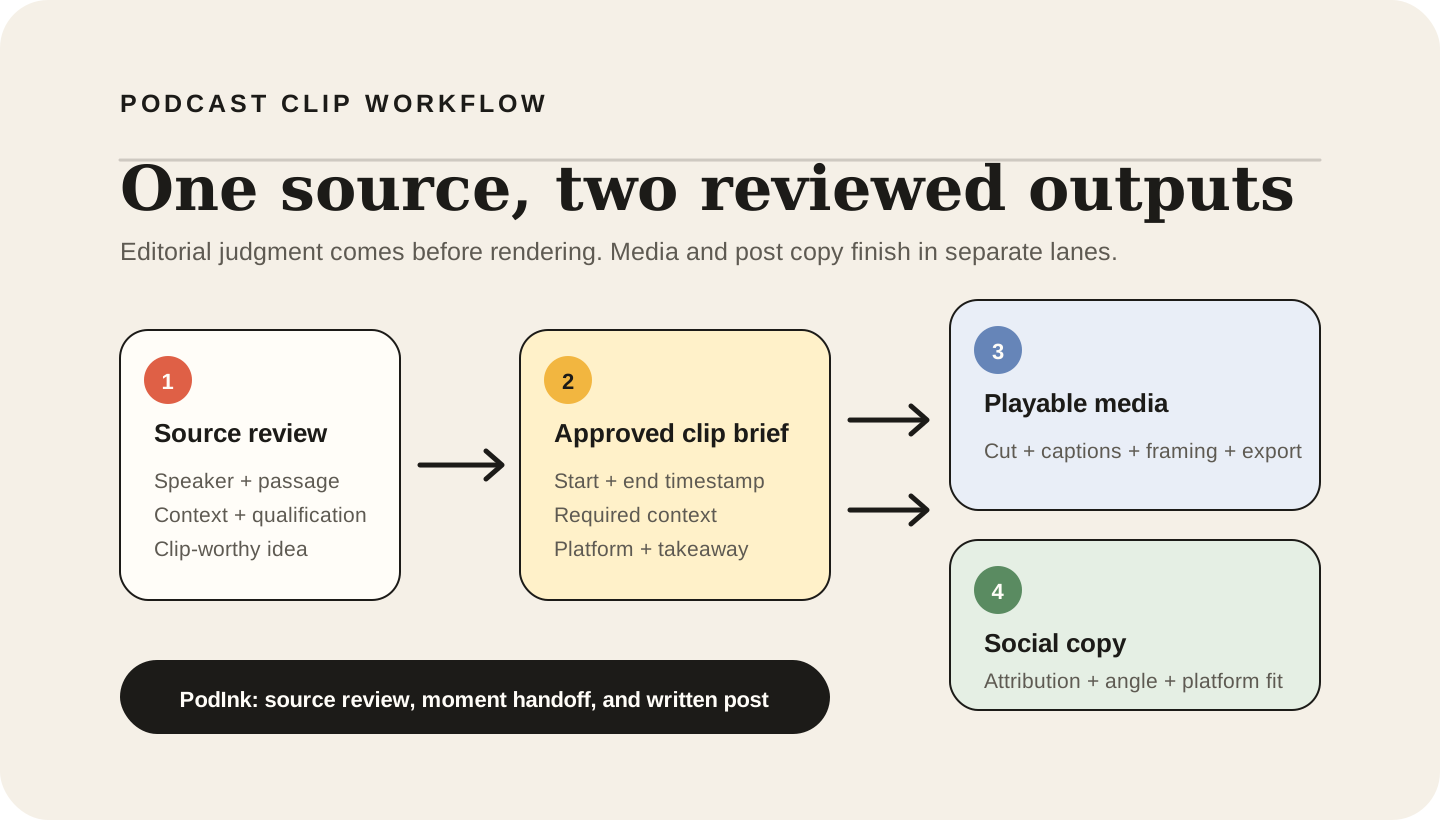
Compare how the approved core changes in the LinkedIn workflow and the X workflow.
Separate the checks
Removing the video and muting it test different things
| Test | What it can reveal | What it cannot establish |
|---|---|---|
| Hide the player | Whether the independent post carries its point, source idea, author contribution, and limits. | Whether the video or its caption track is accurate. |
| Mute the actual media | Whether a viewer can follow the audio content through the timed captions and relevant visible cues. | Whether caption timing or all wording matches the recording; compare with audio too. |
| Read A with the final export | Whether the attached copy introduces what that specific media version actually contains. | Whether a different cut will preserve the same meaning. |
| Open the source link | Whether the reader can return to the original discussion. | Whether the post has already explained enough to stand alone. |
- The request distinguishes timed captions from the post’s attached text.
- The attached copy promises only what the intended media must contain.
- The independent post explains its point without requiring playback.
- The writer’s new application is distinguished from the source idea.
- Media-dependent context is listed in the brief, not assumed to survive any cut.
- Timed captions and the actual export have their own review status.
Deliverable status
What is ready for review, and what still needs media work
- The public transcript supplies the teaching source. No recording, delivery, clip boundary, or timed caption was checked for this article.
- Draft A describes a proposed future media package. It is not approved to accompany an arbitrary excerpt from the episode.
- Draft B contains an original, untested application. Neither draft provides evidence of reach, engagement, time savings, or improved communication.
- The tests here separate writing and media responsibilities. They are not a complete accessibility assessment or a guarantee of platform compatibility.
Human review remains necessary. No repurposing workflow can turn weak evidence into a strong claim.
FAQ
Frequently asked questions
Are video captions and a social post caption the same thing?
No. Timed captions follow the audio inside the media; the post caption is surrounding written copy. A request for captions should specify which deliverable is needed and how it will be reviewed.
Does attached copy always have to be shorter?
No fixed length defines the job. Attached copy can be detailed, and a standalone point can be brief. Ask what information the writing leaves to the media instead of using word count as the deciding rule.
Can I paste the clip transcript as the standalone post?
A transcript can supply source wording, but it may not give the reader a clear point or explain what you are adding. Rewrite for the intended reader while preserving the source’s meaning and separating your interpretation.
Does a complete written post remove the need to review captions?
The two reviews answer different questions. A complete argument in the post does not tell you whether the media’s caption track represents its audio correctly. Assess the actual media and its accessibility needs separately.
Evidence
Sources and comparison pages
- Are You Listening? How to Stay Open and Curious to Other People’s IdeasStanford Graduate School of Business — Think Fast, Talk Smart
- Captions/SubtitlesW3C Web Accessibility Initiative
- Understanding Success Criterion 1.2.2: Captions (Prerecorded)W3C Web Accessibility Initiative