
Podcast interview attribution
How to attribute a podcast interview in a social post
To attribute a podcast interview in a social post, name the person responsible for each source idea and preserve what that person was doing: asking, proposing, answering, qualifying, or disagreeing. Label your own interpretation and advice separately. A link to the episode does not make every sentence in your post the guest’s opinion.
A polished post can make two interview participants sound as if they agreed when one was pushing back. Review who owns each sentence before you smooth the dialogue into one voice. The worked example below preserves a host’s premise, a guest’s qualified disagreement, and an original writer suggestion.
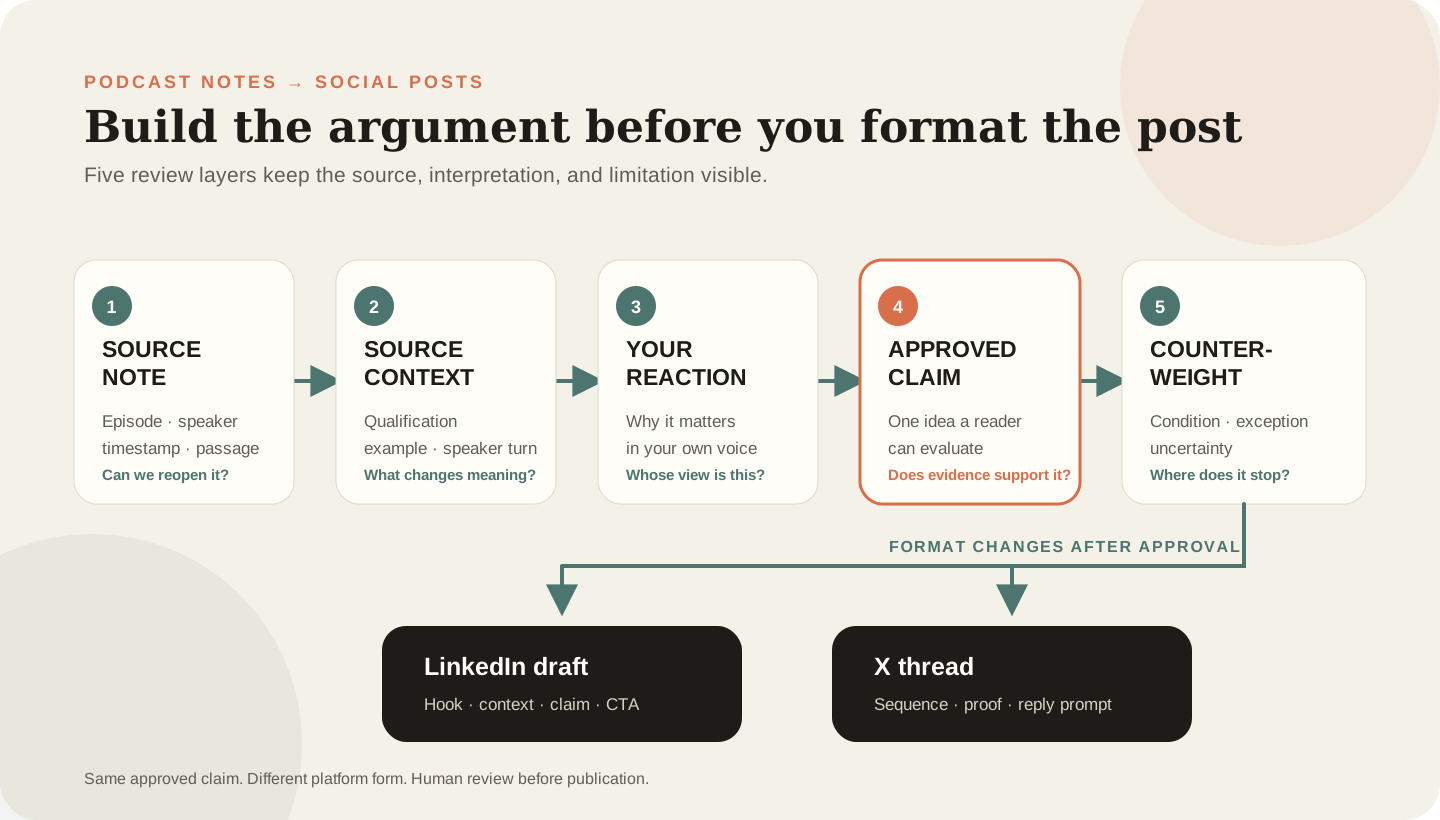
Record the speaker’s role, not only the speaker’s name
A host can ask whether an idea is true without endorsing it. A host can also put a premise inside a question. A guest may accept that premise, reject it, or answer only part of it. Mark both the proposition and the response relationship before turning the exchange into a smooth paragraph.
Purdue OWL explains that signal phrases introduce borrowed material and that their verbs should match the nature of a quotation or paraphrase. Use the same discipline for an interview: asks, proposes, and partly disagrees describe different contributions. A more forceful verb is an additional claim about the speaker’s stance. Source: Purdue OWL on signal phrases.
Attribution follows a sentence’s owner, not the paragraph’s most famous name. If you write a guest’s name once and then add your recommendation, give the recommendation its own subject. Otherwise the guest can appear to be endorsing a step that you invented.
Source case: a host’s premise meets a qualified disagreement
The example uses Stanford GSB’s Think Fast, Talk Smart interview with Burt Alper, hosted by Matt Abrahams and published on 12 March 2020. Source: official interview and transcript.
In the transcript, find the exchange after the comparison of emotional and logical objections. The host introduces a premise; Alper’s next substantive turn begins a partial disagreement. Follow Alper’s explanation and the next discussion of preparation. The example below paraphrases this exchange.
Review status: transcript-only. No recording was listened to, and no audio timestamp is supplied here. The turn sequence locates the passage; it does not establish tone, exact clip boundaries, or how the advice would work in a particular workplace.
The following complete post is an unpublished AI-assisted teaching example. The first-person interpretation and proposed habit belong to the illustrative writer. They are not a personal experience, a customer result, or a method that the interview participants tested.
| Faulty draft line | Why it fails | Corrected attribution |
|---|---|---|
| Abrahams and Alper recommend using logic to answer emotional objections. | Invents a shared prescription and removes the guest’s condition. | Abrahams frames the premise; Alper partly disagrees and allows a logical response only as a conditional option with permission. |
Complete illustrative social post
On Stanford’s Think Fast, Talk Smart, Matt Abrahams frames an emotional objection as needing a different response before logic. Burt Alper partly disagrees: with permission, a logical response can sometimes be an option, and the audience’s reaction may call for a change of approach.
I read that exchange as a reason to check what the other person is ready to consider, rather than assign a fixed response to an objection.
My proposed preparation habit is to write a question that asks whether an example would help before drafting the example itself. That habit is my application; neither speaker prescribes it in this passage. I have not tested the habit or measured its effect.
Source: Stanford GSB interview with Burt Alper, 12 March 2020; transcript-only reading. Source: read the original exchange.
Reusable attribution worksheet
Copy this sheet for each social draft
Complete the source-level fields once. Repeat the sentence row for every factual statement, interpretation, and recommendation in the draft. Keep working notes outside the publishable post.
SOURCE RECORD
Episode / publisher / publication date:
Original source URL:
Host(s) / guest(s):
Passage locator: timestamp if verified, otherwise section + speaker-turn sequence
Review state: transcript-only / recording-reviewed / unresolved

REPEAT FOR EACH SENTENCE
Draft sentence number and exact proposed text:
Idea owner: host / named guest / another quoted person / writer
Speech act: question / premise / answer / qualification / disagreement / writer proposal
Supporting turn and what comes immediately before and after:
Response relationship: accepts / partly accepts / rejects / does not answer / unclear
Conditions that must remain attached:
Pronouns: who does I, you, or we mean in the source and in this sentence?
Final attribution wording:
Decision: keep / revise / reopen source / hold

FINAL OWNERSHIP CHECK
Does any later sentence look like the guest’s advice because of the name above it?
Which statements are my own, and do I actually endorse them?
Can a reader recover the interview and the relevant turn?
Attribute the whole draft
Move from interview turns to accountable sentences
Separate the question from its premise
Write down what the host asks and any assumption embedded in the question. A question about how to do something can assume that it should be done. Do not give that assumption to the guest before checking the response.
Read the response as a relationship
Mark whether the guest accepts, narrows, or disputes the host’s premise. Read beyond a brief acknowledgment. A polite opening or short agreement does not settle the scope of the next substantive answer.
Assign every sentence an owner
Assign the idea in each draft sentence to the host, guest, another source, or you. Split a sentence if it mixes what the guest says with what you recommend. An author reaction can be useful, but it needs its own subject and a clear boundary from source material.
Translate perspective without inventing experience
When a speaker uses I, a paraphrase in your post usually names that speaker instead. Do not copy a speaker’s first-person experience into your own voice. Resolve whether we refers to the host and guest, a research team, an organization, or people generally; if the referent is unclear, hold that wording.
Check the ownership of the final sentence
Read the hook and closing recommendation separately from the source link. Ask who a reader would understand to be making each point. Then compare the complete post with the worksheet, including any edits made for a platform version.
Sentence ownership map
Whose statement is each sentence?
S1 and S2 are the two sentences in the opening paragraph. S3 is the writer’s reading; S4–S6 are the proposed habit and its limits. S7 is the final source line. The map accounts for the complete example, not only the borrowed idea.
| Sentence | Responsible voice | What the editor must preserve |
|---|---|---|
| S1 · Host framing | Matt Abrahams’s premise, paraphrased. | The host is named as the person framing the problem. The sentence does not say the guest agrees.Source: Stanford interview |
| S2 · Guest response | Burt Alper’s qualified disagreement, paraphrased. | Keep the partial disagreement, permission condition, and possibility of adjusting the response together. Do not turn this into a universal instruction.Source: Alper’s response and elaboration |
| S3 · Writer reading | The illustrative writer’s interpretation. | The first-person subject marks a reading of the exchange. It is not a new quotation, a summary of both speakers, or a finding from an experiment. |
| S4 · Writer action | The illustrative writer’s proposed habit. | The action has its own author. It must not inherit Alper’s authority merely because his name appeared earlier. |
| S5 · Ownership limit | The writer clarifies the scope of the source. | The boundary keeps the new habit from being presented as either interview participant’s prescribed method. |
| S6 · Evidence limit | The writer discloses that the habit is untested. | Keep this sentence when adapting the example. Do not replace it with an invented personal success story. |
| S7 · Provenance | The editor supplies the recovery trail. | The date and link identify the public source. Transcript-only describes the review performed, not permission to imply audio verification. |
Ownership test:
“A guest’s name at the top of a paragraph does not make the guest responsible for the writer’s recommendation at the bottom.”PodInk editorial rule for interview attribution
The ownership map has two separate questions: who is responsible for the underlying idea, and who is responsible for this wording? In a paraphrase, the interview participant owns the idea being represented while the post author is responsible for representing it faithfully. For the proposed habit, the idea and wording are the illustrative writer’s.
Try replacing the first two sentences with a statement that the host and guest agreed. The edit would erase the response relationship even if both names and the source link remained. Attribution therefore needs more than a credit line: the sentence must preserve agreement, disagreement, and scope.
Try removing the first-person subject from the proposed habit and starting with a direct command. The advice could now look like the next part of the guest’s answer. A writer can choose an imperative, but should first make authorship explicit, for example by introducing the action as their own proposal.
The passage and attribution map have had an AI-assisted editorial review. Human publication is approved. Adapt the first-person passages only if you endorse them, and reopen the source if your changes alter the interpretation.
Compare how the approved core changes in the LinkedIn workflow and the X workflow.
Attribution repairs
Catch changes of speaker, stance, and perspective
| Draft move | What it changes | Repair |
|---|---|---|
| Question becomes belief | A host asking whether a claim holds is rewritten as the host asserting it. | Use asks whether unless the host separately commits to the premise. |
| Partial answer becomes agreement | A guest answers one part of a question; the post says the guest confirmed the whole premise. | Name the part answered and retain the unresolved part as unresolved. |
| Two voices become they | The draft merges different positions into a supposed shared recommendation. | Name each participant and the relationship between their turns. |
| Guest’s I becomes writer’s I | A source anecdote appears to be the post author’s own experience. | Name the original speaker or remove the anecdote; do not claim to have lived it. |
| Broad you becomes a specific promise | A general example is rewritten as advice guaranteed to apply to the reader. | Keep the original scope and label your own application as a proposal. |
| Source link absorbs writer advice | A closing link makes an original recommendation look source-backed. | Put an explicit writer subject before the recommendation and name its evidence limits. |
- Every substantive sentence has a named source owner or an explicit writer role.
- Questions, premises, and answers are recorded as different speech acts.
- A partial agreement or disagreement remains visible after compression.
- Conditions stay attached to the statement they limit.
- First-person experience belongs to the person who actually had it.
- The source locator identifies a recoverable turn without inventing a timestamp.
- The post’s hook and closing advice do not assign the writer’s new claim to the guest.
Evidence status
What this review establishes
- This example is based on the official transcript only. The recording, tone, speaker overlap, and precise clip boundaries were not reviewed.
- Attribution identifies who made a statement; it does not establish that the statement is true or effective. The communication advice in this historical interview was not independently tested for this article.
- The complete post is an unpublished AI-assisted teaching example. Its proposed habit is original and untested; it is not an interview excerpt or customer case study.
- If a speaker label, pronoun referent, or answer boundary remains ambiguous, reopen the recording or hold the claim. Do not resolve uncertainty by choosing the best-sounding attribution.
Human review remains necessary. No repurposing workflow can turn weak evidence into a strong claim.
FAQ
Frequently asked questions
Is naming the podcast enough attribution?
Name the speaker responsible for the idea near the sentence that uses it. The podcast title and link let readers recover the source, but they do not show which participant held a view or which recommendation you added.
Can I say the guest agreed if the answer starts with yes?
Read the rest of the answer and the turn that prompted it. A short acknowledgment can precede a qualification or a narrower response. Describe the guest’s substantive position instead of relying on the opening word.
Can I write we when the host and guest discuss the same topic?
Only use a shared subject if the passage supports a shared position. Discussing the same topic is not the same as endorsing the same recommendation. Otherwise name the participants separately.
What should I do when the transcript has no timestamps?
Save the original URL and a section or speaker-turn sequence that lets a reviewer find the passage. Mark it transcript-only. Do not invent a time or treat a text locator as a verified media boundary.
Evidence
Sources and comparison pages
- From Monologue to Dialogue: How to Handle a Skeptical AudienceStanford Graduate School of Business — Think Fast, Talk Smart
- Signal and Lead-in PhrasesPurdue OWL