
Podcast writing guide
Podcast notes to social posts: build the argument before you draft
Turn podcast notes into a source-grounded social media post by choosing one defensible claim, attaching the exact source passage that supports it, writing your own reaction separately, and recording the limit that keeps the claim honest. Only then should you adapt the approved argument for LinkedIn, X, or another platform.
Raw notes are retrieval aids, not finished ideas. This guide covers the narrow handoff from one recoverable note to one defensible post; the broader podcast-to-social guide covers turning a complete episode into several assets.
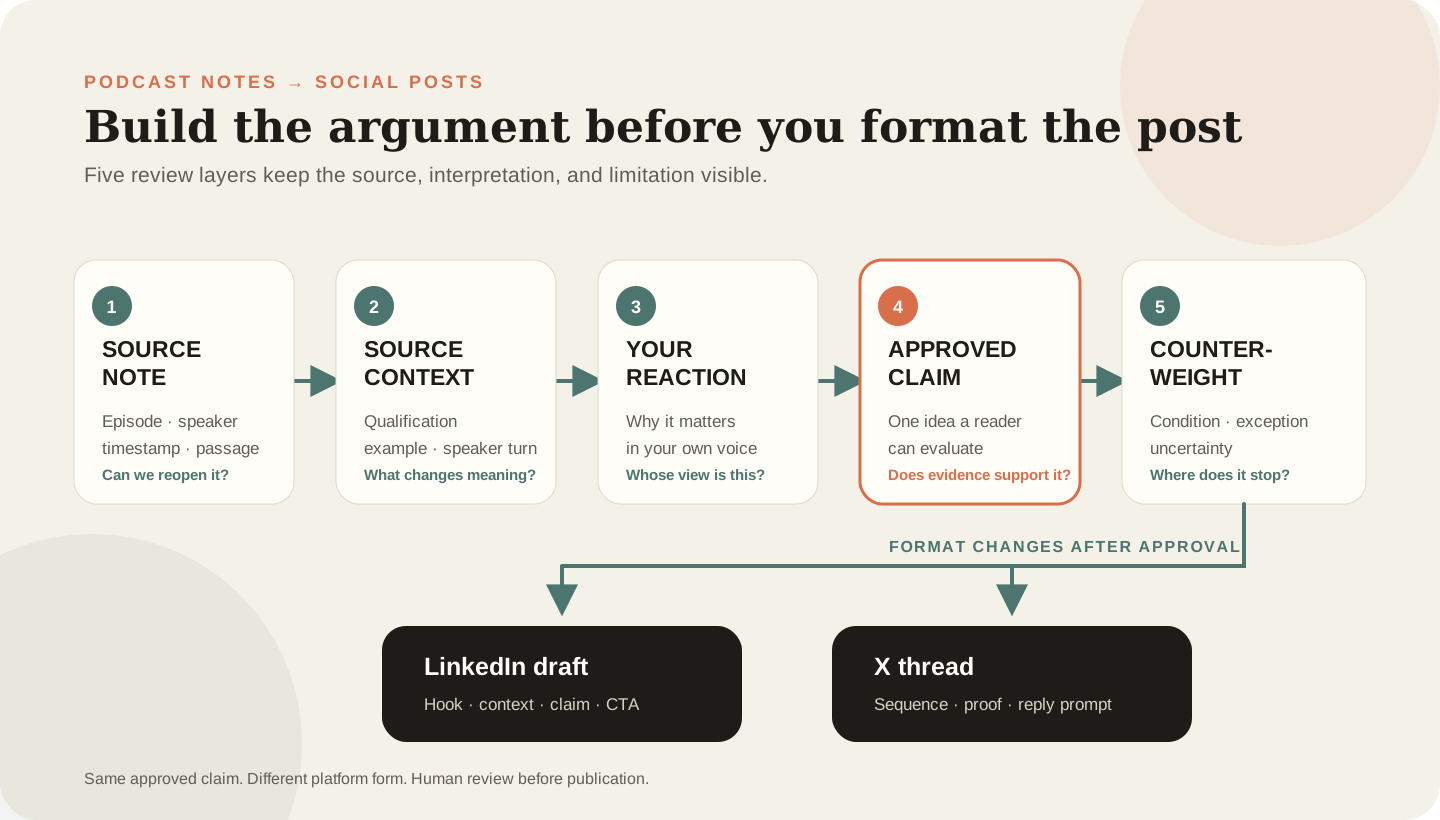
The argument packet
How to turn podcast notes into a defensible social media argument
Collect a recoverable source note
Save the episode, speaker, timestamp, short passage, and the reason the moment caught your attention. Do not polish the wording yet. The note's first job is to reopen the source.
Reopen the surrounding source context
Read or listen before and after the marker. Preserve any qualification, hypothetical framing, disagreement, example, or speaker change that affects what the selected passage can support. Source: PodInk methodology.
Write your editorial reaction separately
Explain what surprised you, what you disagree with, or what the moment changes in practice. Label the reaction as yours so a reviewer can distinguish the speaker's statement from the writer's interpretation.
Draft one claim and one counterweight
Compress the source and reaction into one sentence a reader can evaluate. Then add the strongest condition, exception, or uncertainty that prevents the claim from saying more than the episode supports. Source: Castmagic's one-idea-per-post guidance.
Run a source check
Reopen every timestamp used for a quotation, number, name, or causal claim. A source-grounded map can organize the material, but the editor remains responsible for deciding what the source supports. Source: Google Cloud's NotebookLM grounding documentation.
Adapt the approved argument for each platform
Keep the claim, evidence, and counterweight stable while changing the entry point, pacing, length, and call to action. LinkedIn and X versions are separate documents built from the same approved packet, not long and short copies of one draft. Source: Voxplit's platform-specific repurposing workflow.
Public transcript case
A real timestamped note from Pendo's Hard Calls podcast
Pendo's public transcript for Hard Calls episode 16 records Jeff Lash discussing reversible product decisions at 00:07:00–00:09:00. At 00:10:00–00:12:00, he adds that B2B experiments can affect account teams, renewals, marketing, support, legal, finance, and customer expectations, not only the code path.
| Review layer | Working text | Completion test |
|---|---|---|
| Source note | Episode 16, Jeff Lash, 00:07:00–00:09:00: judge a decision partly by how difficult it would be to reverse; use controlled tests to gain confidence. | Complete when a reviewer can reopen the exact passage on Pendo's transcript.Source: Pendo transcript at 00:07:00 |
| Source context | At 00:10:00–00:12:00, Lash says B2B experiments also touch client teams, renewals, marketing, support, legal, and finance. | Complete when the note preserves the organizational constraint as well as the technical option.Source: Pendo transcript at 00:10:00 |
| Editorial reaction | A feature flag can make code reversible without making a customer promise reversible. | Complete when the sentence is clearly labeled as the writer's interpretation rather than Lash's wording. |
| Approved claim | Treat an experiment as reversible only when both the product change and the customer commitments around it can be undone. | Complete when each part maps to the two checked transcript passages. |
| Counterweight | A small test can still move quickly when exposure is limited and affected teams know what is changing. | Complete when this limitation remains attached to the claim in the final post. |
“A feature flag can make code reversible without making a customer promise reversible.”PodInk editorial reaction to the checked passages
The approved claim is an editorial synthesis, not a quotation attributed to Lash. It now has a source location, a separately labeled interpretation, and a limit, so platform formatting does not need to invent a new thesis.
Compare how the approved core changes in the LinkedIn workflow and the X workflow.
Source check
What to verify before platform formatting
- Confirm that the episode, speaker, and timestamp reopen the exact passage used by the post.
- Read enough surrounding material to preserve qualifications, examples, uncertainty, and speaker changes.
- Use quotation marks only for wording checked against the recording or a reliable transcript.
- Label the writer's reaction as an interpretation rather than attributing it to the guest.
- Map every factual part of the approved claim back to the checked source context.
- Keep the counterweight in every platform version when it materially limits the claim.
Boundaries
What an argument packet does not prove
- A timestamp makes a passage recoverable; it does not prove that the speaker's external claim is true.
- A transcript can contain recognition errors, incorrect speaker labels, or missing visual context, so quotations still need to be checked against the recording.
- An editorial reaction must remain visibly separate from the speaker's words and should never be placed inside quotation marks.
- One argument packet can support several platform versions, but a materially different claim needs a new packet and a new source check.
- PodInk prepares reviewable drafts and does not publish them without a human decision.
Human review remains necessary. No repurposing workflow can turn weak evidence into a strong claim.
FAQ
Frequently asked questions
Can podcast show notes become a social post?
Yes, but show notes usually summarize the episode while a social post needs one clear idea. Choose one note, reopen its source, add your reaction, and turn the result into a single defensible claim instead of compressing the whole episode.
Should a podcast social post use a direct quote or a paraphrase?
Use a direct quote only after checking the exact wording against the audio or a reliable transcript. Use a paraphrase when the precise wording is not important, but preserve the speaker's certainty, scope, and conditions.
Can AI turn podcast notes into an argument?
AI can group notes, propose claims, and adapt approved material for a platform. A human still needs to choose the idea, distinguish the speaker's words from the writer's interpretation, verify the source, and approve the limitation.
How many posts should one argument packet create?
One argument packet can support several platform versions when they preserve the same approved claim and evidence. Create another packet when a second post makes a materially different claim.
Evidence
Sources and comparison pages
- How to Repurpose Content: A Guide for CreatorsDescript
- Turn Long-Form Transcripts Into Social Content With AICopper Sun AI
- What is Gemini Notebook Enterprise?Google Cloud Documentation
- Podcast to LinkedIn PostsCastmagic
- How to Repurpose a Podcast Episode Into Social Media PostsVoxplit
- How to Turn One Podcast Episode Into Show Notes, a Newsletter Intro, and 3 Social Posts With NotebookLMPromptedWork
- This Decision Framework Leads to Better Product ExperimentsPendo Hard Calls
- How PodInk Keeps Podcast Posts Grounded in SourcesPodInk