
Podcast source-checking guide
How to pull quotes from a podcast transcript without inventing them
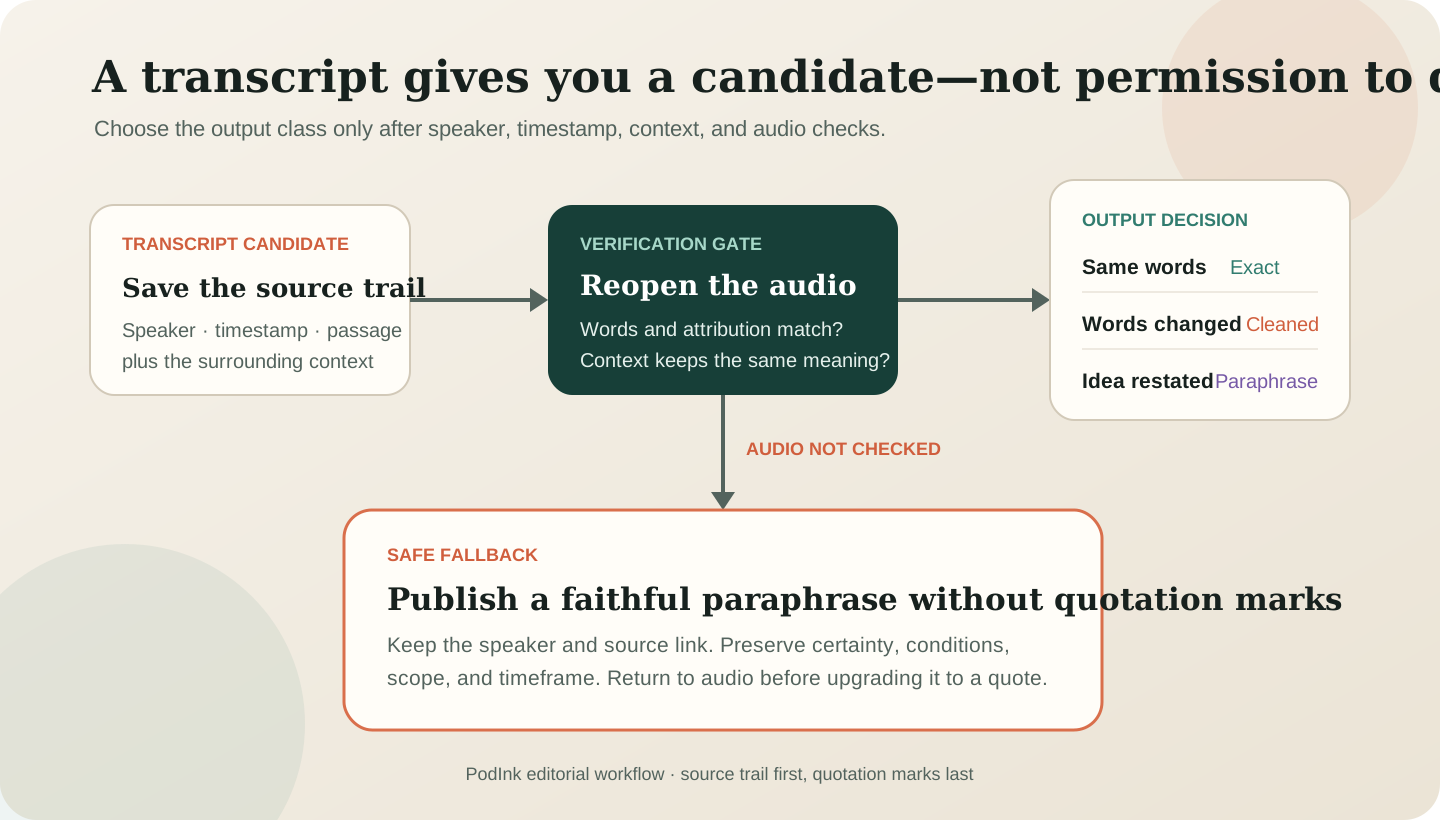
To pull quotes from a podcast transcript, use the transcript to find a candidate passage, then reopen the audio and verify the speaker, wording, timestamp, and surrounding context. Publish it as an exact quote only when the audio matches. If you remove or rearrange words, label it as an edited quote; if you restate the idea, remove quotation marks and call it a paraphrase.
Choose the output class after verification, not before. A polished transcript is a locator and working record, not automatic permission to put words inside quotation marks.
AI extraction prompt
Ask for candidates, not finished quotation cards
Use AI for retrieval and triage, then keep approval as a separate human step.
Return candidate passages only.
For each candidate, include:
- speaker
- start and end timestamp
- transcript wording
- one sentence of context before and after
- possible missing qualifier
- status: audio not checked

Do not clean, combine, or rewrite the wording.
Do not label any passage exact until a human checks the audio.
Verification workflow
How to pull an accurate quote from a podcast transcript
Save the episode, speaker, and timestamp
Copy the smallest complete passage that contains the idea, but keep its source trail attached. Retaining the utterance text, start time, end time, and speaker lets a reviewer return to the evidence instead of trusting a detached sentence. Source: AssemblyAI timestamped transcript guide.
Read the question and answer around the passage
Check whether the speaker is describing a fact, prediction, example, personal experience, joke, or hypothetical. Begin with a 90-second listening window and expand it when a qualification begins earlier or the speaker corrects the claim later. Source: Podscan context-preserving workflow.
Replay the audio at normal speed
Compare every word, proper name, number, negative, and pronoun with the recording. Confirm that the transcript has not joined two speakers or dropped words such as not, might, or in this case. Source: W3C transcript guidance.
Mark every editorial change
If only punctuation changed, the passage may remain exact. If words disappeared or moved, classify it as cleaned and disclose the edit. If you rebuilt the sentence around the idea, classify it as a paraphrase and remove quotation marks. Source: GoTranscript quote-safety guide.
Test whether the shorter version keeps the same claim
Check the subject, action, certainty, conditions, population, and timeframe. Restore a qualifier whenever deleting it would make the speaker sound more certain or universal. Source: TicNote transcript cleanup guide.
Publish the source trail with the words
Name the speaker, episode, canonical source, and timestamp. Keep an internal record of the checked passage and approved output class. If the audio cannot be reopened, use a faithful paraphrase or hold the line.
Public transcript example
One transcript passage, three possible outputs
Lex Fridman Podcast #490, State of AI in 2026, was published on January 31, 2026 with a public, human-generated transcript that includes speaker labels and clickable timestamps. At 00:24:27, Sebastian Raschka discusses why building and running code can expose misunderstandings that remain hidden in static explanations. The transcript page warns that it may contain errors, so the first two outputs remain blocked until the recording is checked.
| Proposed output | Classification | Publication decision |
|---|---|---|
| Transcript candidate | “And with code, what's nice is you can verify it.” | Candidate for an exact quote. Hold until the audio confirms every word and the speaker.Source: Lex Fridman transcript |
| Cleaned quote | “With code, you can verify it.” | Words were removed. Use only after audio review and with an edited-for-clarity disclosure. |
| Faithful paraphrase | Raschka argues that executable code makes some misunderstandings easier to expose than static explanations. | Publishable without quotation marks when linked to the source and kept within this context.Source: Source video at 00:24:27 |
“A transcript supplies a quote candidate. The audio and context supply permission to use quotation marks.”PodInk editorial rule
The faithful paraphrase is the release-ready option here because the public transcript and timestamp were inspected but the audio wording was not independently confirmed. Recording that status prevents an available transcript from masquerading as verified speech.
Compare how the approved core changes in the LinkedIn workflow and the X workflow.
Verification checklist
What to check before using quotation marks
- Save the canonical episode URL and final media version.
- Confirm that the named speaker matches the voice in the recording.
- Make the timestamp open the beginning of the relevant passage.
- Compare every quoted word, proper name, number, and negative with the audio.
- Check that the question, qualification, correction, and nearby context preserve the apparent meaning.
- Make sure deleted fillers or false starts do not change emphasis, tone, or certainty.
- Give every cleaned quote a visible editorial disclosure.
- Remove quotation marks from paraphrases while keeping the source attribution.
- Keep the published claim within the speaker's population, timeframe, and conditions.
- Record the approved wording and verification status for later review.
Do not publish
When a transcript passage should not become a direct quote
- A transcript can contain recognition errors, merged speakers, missing qualifiers, or editorial cleanup.
- A timestamp is a locator, not proof that the surrounding context preserves the apparent meaning.
- If the audio cannot be reopened, use a faithful paraphrase without quotation marks or hold the passage.
- A source-fidelity review does not prove that the speaker's underlying claim is true; factual claims still need independent checking.
- Overlapping voices, translations, private material, and uncertain consent may require the quote to be withheld entirely.
Human review remains necessary. No repurposing workflow can turn weak evidence into a strong claim.
FAQ
Frequently asked questions
Can I quote directly from a podcast transcript?
Use the transcript to locate the passage, then verify the words, speaker, timestamp, and context against the audio before publishing it as a direct quote. If the audio cannot be checked, use a faithful paraphrase without quotation marks or hold the passage.
Can I remove um and repeated words from a podcast quote?
You may remove fillers when the edit does not change meaning, emphasis, certainty, or tone, but the result is a cleaned quote rather than a strictly exact one. Disclose the edit with wording such as edited for clarity.
How much context should I check around a podcast quote?
Begin with the question and surrounding answer. A 90-second listening window is a useful minimum for triage, but expand it whenever a qualification, correction, or conclusion sits outside that window.
Can AI find accurate quotes in a podcast transcript?
AI can find candidate passages and preserve speaker and timestamp fields. A human should still compare the final wording and context with the audio before labeling any result an exact or cleaned quote.
What is the difference between a cleaned quote and a paraphrase?
A cleaned quote keeps the speaker's original wording but removes limited verbal clutter and carries an edit disclosure. A paraphrase restates the supported idea in new wording, uses no quotation marks, and still attributes the source.
Evidence
Sources and comparison pages
- Extract Transcript Quotes with LLM GatewayAssemblyAI
- Publishing Quotes Safely: Prevent Re-Identification and Keep the Right ContextGoTranscript
- Pull the Best Quotes from Podcasts Using AITinkering With Ideas
- The Podcast Quote Trap: Keep Context Intact When You Source AudioPodscan
- How to Transcribe a PodcastTicNote
- TranscriptsW3C Web Accessibility Initiative
- State of AI in 2026 Transcript, Podcast #490Lex Fridman
- State of AI in 2026 at 00:24:27YouTube