
Review the claim before publishing
A Podcast Repurposing Fact-Check Checklist
A podcast repurposing fact-check checklist should test each factual claim in the finished social draft. First check what the episode actually says. Then check the evidence for what the post asks readers to believe. Matching a transcript shows that your wording fairly represents the reviewed source; it does not, by itself, establish that an event happened or a statistic is true.
Use this review after the post has a hook, body and takeaway. Include image text and any claim in the call to action. The worked example below catches a particular reuse error: turning a historical launch announcement into a statement that the launch already happened on the announced date.
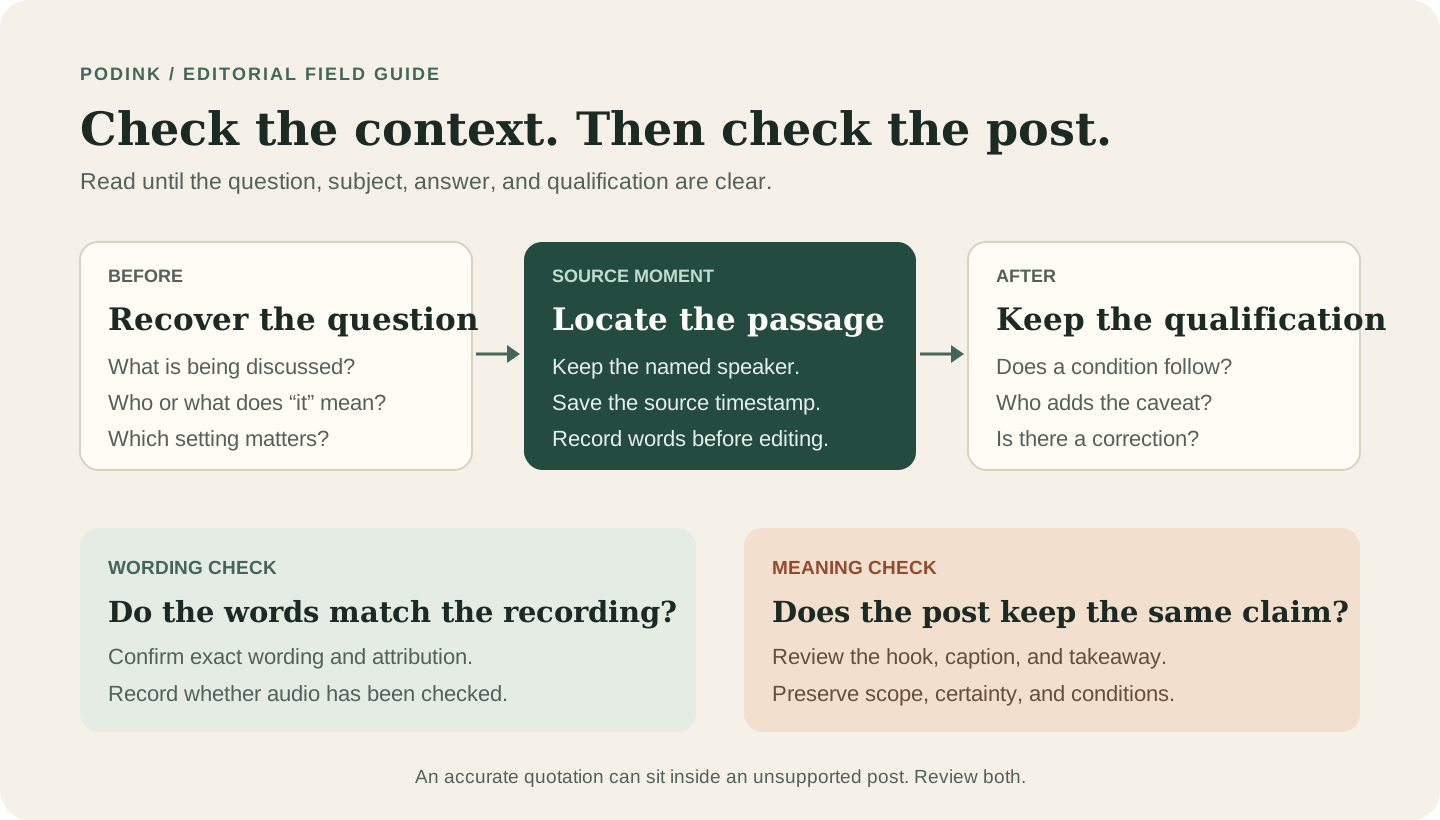
Separate what was said from what is established
A transcript is evidence of the published text. A recording can help check spoken words, speaker identity and delivery. Neither becomes independent evidence for every factual assertion inside the conversation. Open the underlying study, dataset, event record or specification when the post presents an assertion as established fact.
For a historical episode, keep the information date separate from the event date. A forecast may fairly represent what was expected then, while being unsuitable as a statement of what later happened. A correction to your reuse draft does not necessarily mean the original announcement was wrong.
| Question | Evidence to inspect | What the result supports |
|---|---|---|
| Did the source say this? | Named speaker, source version, relevant passage and nearby qualifications. | An attributed account of the reviewed source; record whether it was text or recording. |
| Is this factual assertion supported? | The original evidence for this exact event, number, population or definition. | Only the claim and scope actually established by that evidence. |
| Does the recommendation follow? | The bridge from the factual premise to the author’s advice or causal claim. | A labeled author judgment, or a separately supported effect claim. A fact does not automatically prove a recommendation. |
Use a claim checklist that can stop publication
Copy every checkable assertion into a review record. Split a sentence when its clauses need different evidence. Start with claims that change the reader’s conclusion: dates, quantities, comparisons, causal language, categorical promises and the hook. A polished sentence can contain several separate claims to verify.
A source URL is a starting point. Record the passage or table you opened, what it establishes, and what it does not. A search snippet, another summary of the same interview or an AI verdict without inspectable support cannot close a missing-evidence check.
| Check | Record before approving | Hold or revise when |
|---|---|---|
| Speaker and wording | Who owns the claim; quotation or paraphrase; text/audio evidence actually checked. | A host’s introduction becomes the guest’s claim, or uncertain wording carries the argument. |
| Dates and status | Publication date, event or measurement date, and planned / ongoing / completed status. | An old forecast becomes a completed event or a current fact. |
| Numbers and denominator | Unit, numerator, denominator, population, period, exclusions and the relevant table or method. | Messages become people, a subgroup becomes everyone, or a percentage loses its base. |
| Definitions and comparisons | What each term measures and whether the compared groups use the same definition. | A vague label or a changed baseline does the work of the claim. |
| Cause and certainty | Evidence for the claimed relationship and any material uncertainty. | A sequence of events becomes proof of causation, or a possibility becomes a guarantee. |
| Independent support | A relevant primary record beyond the fact that a speaker said it; source provenance and conflicts. | Several pages repeat the same unverified assertion, or sources disagree in a way you cannot resolve. |
| Whole-post meaning | Hook, body, image text and call to action checked as one version. | A cautious paragraph sits under a stronger headline or ends with unsupported advice. |
A real case: a planned date and the event record
NASA’s Curious Universe episode published December 14, 2021 features Rudi Albat. Its closing announcement is spoken by Noelia Gonzalez. The locator is her final invitation to watch NASA TV, before the production credits. The official transcript was read; no recording was reviewed. Source: A: official podcast transcript.
ESA’s separate launch report is dated December 25, 2021 and records liftoff that day. It is an operational event record beyond the interview text. NASA and ESA are mission partners, so this is not an unaffiliated investigation of the mission. Source: B: official launch event report.
The draft below deliberately introduces mistakes for teaching. It is not a real AI response, an actual social post or a claim that NASA published a false historical report. The source announcement concerns a plan; the reuse draft incorrectly converts it into a completed event.
Filled fact-check handoff
Keep the checked version and unresolved claims together
The filled record below lets another editor reopen a disputed claim without rebuilding your research. For another post, replace the entries and add one record for each claim. Keep the review attached to its exact version.
POST / VERSION: FC-01 A rejected; FC-01 B revised teaching draft below.
SOURCE A: https://www.nasa.gov/podcasts/curious-universe/webb-space-telescope-go-for-launch-with-esas-ariane-5-expert/
A LOCATOR: Final Noelia Gonzalez announcement, immediately before the production credits.
SOURCE B: https://www.esa.int/Newsroom/Press_Releases/Webb_liftoff_on_Ariane_5_to_unlock_secrets_of_the_Universe
B LOCATOR: Opening launch paragraph; later paragraph on instrument testing and routine observations.
CLAIM RECORD: Exact wording / source fidelity / external evidence / scope / decision / correction.
C1-C2: Revise date/status and speaker attribution; retain the historical announcement as an announcement.
C3: Remove the premature operational-readiness claim.
C4: Hold the causal guarantee; remove it from version B.
RECHECK: Version B compares the announcement and event records, then labels an editorial recommendation.
METHOD: Official text only; no recording, clip or social-platform test.
REVIEW: AI-assisted editorial review; human publication approval pending.
AFTER ADAPTATION: Record the final version, reviewer, review date and remaining checks.
Fact-check workflow
Check the final draft as a set of claims
Save the complete proposed post
Keep the exact text and any image wording before editing. Give the version an ID. A source note may already be checked, but a new hook or conclusion creates a new claim to review.
Assign evidence to each claim
Record whether the claim is a source report, external fact, prediction or author judgment. Match the source passage first; then open the primary evidence needed for the asserted fact. Distinguish an announcement from a result and a reported number from the population it describes.
Compare dates, definitions and scope
Read the supporting passage, table notes and methods rather than searching only for a matching number. Confirm that the evidence concerns the same event, unit, population and period as the draft. If the source is historical, do not silently present it as current.
Resolve discrepancies or leave a hold
If sources differ, identify whether the difference is timing, definition, revised data or a real contradiction. Record the missing document or unresolved point by name. Revise to the supported claim, remove the unsupported part, or pause the draft when that part is essential to its point.
Read the corrected post again
Check the revised text against the records and read it without the private review notes. A material limitation belongs beside the claim readers see. Confirm that the headline and call to action no longer make the claim you removed.
Worked claim review
Reject a fluent draft, then repair only what the evidence supports
FC-01 A — complete invented teaching draft; no image text: Webb launched on December 22, 2021. ESA’s Rudi Albat confirmed that date in NASA’s podcast. Successful liftoff meant it was ready for routine science that day. Proof that a checklist eliminates launch risk.
| Claim ID | Check against the records | Decision |
|---|---|---|
| C1 · event date | A announces a planned December 22 launch. B records the actual December 25, 2021 liftoff. | CHECK → REVISE. Keep announcement and actual-event dates separate; do not convert future tense into a historical result. |
| C2 · speaker | A labels the closing date announcement as Noelia Gonzalez’s turn, not Rudi Albat’s. | REVISE attribution. Correct identity alone would still leave C1’s plan/result error unresolved. |
| C3 · milestone | B describes instrument testing as still ahead and routine science as expected after half a year. | REMOVE the readiness claim. B reports a completed launch but describes later operations as future work; it does not establish when those operations actually began. |
| C4 · causal guarantee | Neither reviewed document provides a controlled comparison establishing the draft’s causal promise. | HOLD the guarantee; omit it from the revision. Do not replace an unsupported effect with a softer effect claim. |
The important distinction
“The old date is easy to find in the transcript, which can make the rejected draft feel checked. The missing question is whether the post reports a plan or a completed event. A faithful account of the announcement keeps that difference visible.”PodInk editorial analysis of the rejected draft
FC-01 B — complete revised teaching post, with its source links:
An archive check needs an event check. In NASA’s December 14, 2021 Curious Universe episode, Noelia Gonzalez announces a launch planned for December 22. Source: Podcast announcement.
ESA’s event report records Webb’s liftoff on December 25, 2021. Those are different information states: a plan and a completed event. Source: Launch record.
My editorial recommendation: preserve the original announcement’s context, but check the event record before writing a historical result. A source match is the beginning of that review.
Recheck: version B distinguishes the archived plan from the later event, assigns the announcement correctly and removes both the readiness claim and the causal guarantee. Its recommendation is the writer’s editorial advice; no publishing outcome was tested.
Review outcome: the revised text has support for the bounded comparison shown here. Recording review and human publication approval remain separate. No result from this example approves a quote card, clip or different post version.
Compare how the approved core changes in the LinkedIn workflow and the X workflow.
Decision record
Choose the next action for each claim
| Decision | Use when | What closes the task |
|---|---|---|
| Check / verified for stated scope | You opened evidence that supports the exact factual claim, including its limits. | Save the evidence location and method; a passed fact check still needs the publication decision. |
| Revise | Evidence exists, but the draft changes speaker, date, status, unit or meaning. | Save a corrected version and check that version again. |
| Hold | A material assertion depends on missing, contradictory or unclear evidence. | Obtain the missing evidence, narrow the claim, or remove it. Do not publish an essential unresolved assertion as fact. |
| Remove / out of scope | A claim is unnecessary or requires evidence unavailable for this draft. | Delete the claim and any hook or recommendation that still depends on it. |
- The exact post version, hook, image wording and call to action are included in review.
- Every retained factual claim has an inspectable record and an explicit scope.
- A source-fidelity check is not mislabeled as external factual verification.
- Publication, measurement and event dates remain distinct; planned and completed states are not exchanged.
- Units, populations, denominators and definitions travel with claims that need them.
- Unsupported causal language and guarantees have been removed or held.
- The revision was checked again, with remaining evidence and publication decisions recorded.
Scope of this check
What remains outside the evidence
- The example checks a bounded historical date/status comparison. It does not independently audit every technical statement in the podcast or the mission’s wider scientific outcomes.
- The official transcript and event report were read as text. No audio, video, speaker delivery or exact clip timing was verified.
- An official event report is appropriate evidence for the recorded launch here. Its authority would not automatically establish an unrelated causal claim; a press release cannot replace a relevant study or dataset when those are needed.
- These are unpublished teaching drafts and an editorial procedure, not a measured accuracy benchmark or a guarantee that every error will be found.
Human review remains necessary. No repurposing workflow can turn weak evidence into a strong claim.
FAQ
Frequently asked questions
If the guest said it, can I publish it as a fact?
An accurate source report can establish what the guest said. To present the underlying assertion as established fact, inspect evidence that supports that assertion. Attribution does not turn a disputed or unverified claim into a verified one.
Does a newer source always replace an older one?
No. Check whether the sources answer the same question. A later event record can establish what happened without making an earlier forecast a false account of the plan at that time. Preserve dates and information states.
Can AI complete the checklist for me?
AI can propose a claim list and possible sources. Treat the list as a draft: open the evidence, check its scope and review omissions. A confident verdict without the inspected source record cannot close a factual check.
Evidence