
Podcast summary review
How to review an AI podcast summary before publishing
To review an AI podcast summary, check every sentence against the source, then check the source for important material the summary left out. Match the speaker, scope, and strength of each claim. Record corrections and unresolved evidence before deciding whether the draft is ready for approval.
Use this workflow when you already have a draft recap for an episode page, newsletter, or research note. A polished paragraph can feel ready to share before you have checked what it leaves out. The review gives you a way to explain why the recap is ready—or exactly what still needs work.
Define what the summary promises to cover
Write the intended scope before editing. Is this a brief overview of the whole discussion, a recap of one topic, or a list of practical takeaways? A topic-specific summary may omit unrelated sections if its label makes that limit clear. An episode overview needs to account for the main themes, even when examples and closing remarks are compressed.
Save the draft and the exact source version together. Record the episode URL, transcript origin, speaker labels, and any gaps. If your transcript ends halfway through the episode, you cannot use it to approve a full-episode overview. Narrow the promise or obtain the missing material.
| Question | What to inspect | What a match establishes |
|---|---|---|
| Source fidelity | Does the source actually support the summary sentence, including who said it and under what conditions? | The sentence fairly represents the reviewed source. |
| Coverage | Does the summary include the main material required by its stated scope? | The selection does not conceal a major theme, dispute, or reversal. |
| External truth | Is an episode claim independently supported by the underlying evidence? | Only a separate check of that evidence can establish this. |
Give every sentence a source record
Number the draft sentences in a working copy. Split a sentence if it bundles claims with different support. For each claim, record the source location, speaker, nearby qualification, and your decision. A link to the episode homepage is useful attribution, but it does not tell the next editor which passage supports the claim.
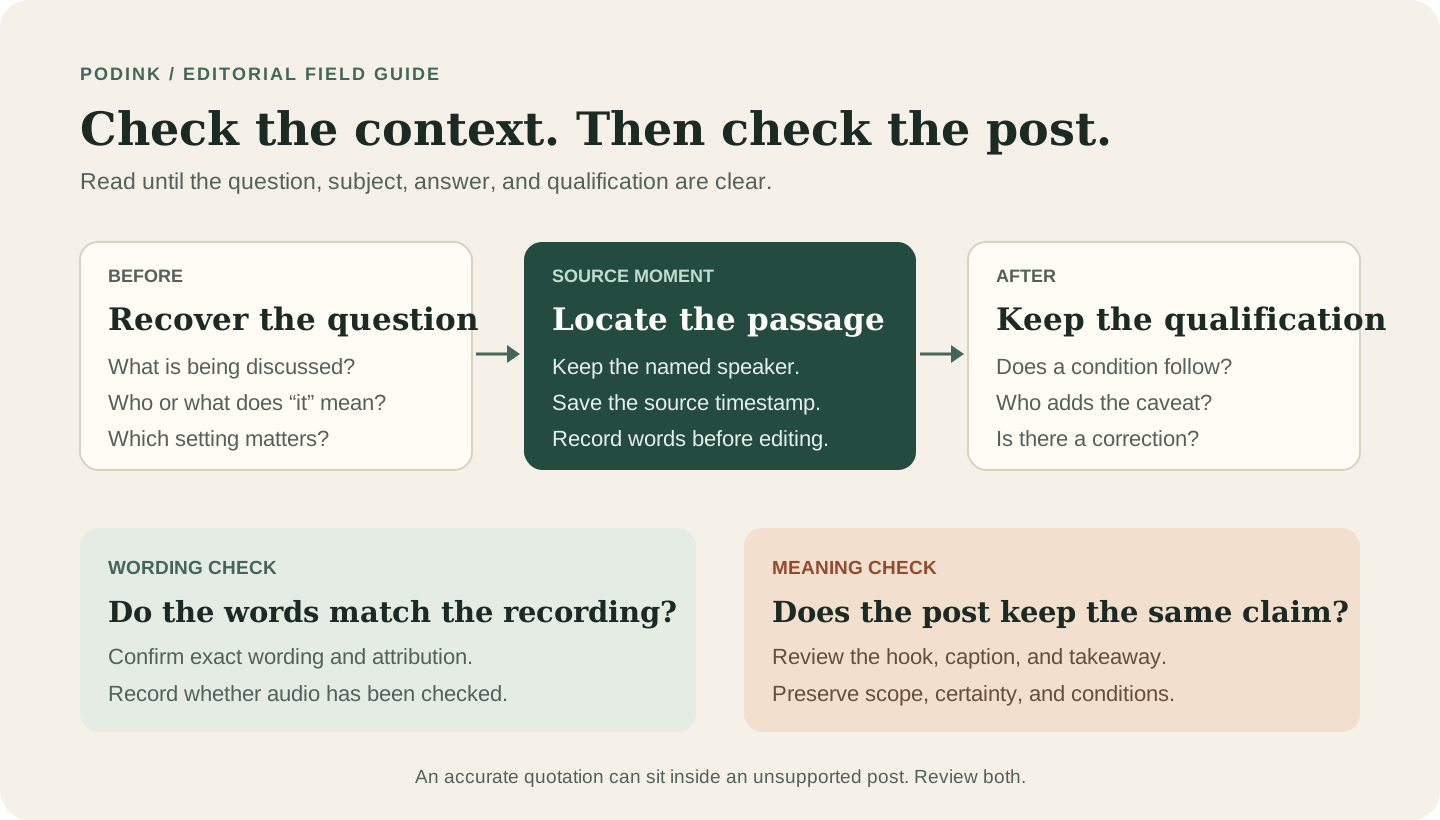
Read around a search hit. Look for questions, hypotheticals, objections, later corrections, and conditions such as audience or setting. Check whether the draft turns possibility into certainty, experience into a general rule, or association into a cause. For a figure, preserve what was counted, who or what it describes, and the time period.
AP’s own standards require disputed material to be attributed and internet information to be vetted and credited to its original source. Use that distinction here: reporting what a guest claimed is different from verifying the claim itself. Source: AP: attribution and accuracy.
| Field | Record | Action if unresolved |
|---|---|---|
| Sentence / claim ID | Exact draft wording; split compound claims when needed. | Do not hide an unsupported clause inside a supported sentence. |
| Source / location | Version, speaker, paragraph or transcript block; nearby context. | Mark unsupported by the reviewed source. Check the wider passage and source version; then remove, revise, or hold the claim. |
| Meaning / strength | Scope, conditions, uncertainty, disagreement, and corrections. | Revise the wording or restore the missing qualification. |
| Evidence status | Text checked; recording checked; or external evidence checked. | Keep these statuses separate and say what remains unresolved. |
Check coverage from the source back to the draft
Read through the source independently of the draft and write a short topic outline. Map each important topic to a summary sentence, or record why it is outside scope. This reverse pass can reveal an omission that a sentence-by-sentence check misses: a draft may contain only supported statements while excluding a main counterargument.
Do not give every section equal space. Keep material whose removal changes the reader’s understanding of the main argument, its limits, or its balance. Repeated illustrations may be compressed. A late correction that reverses an earlier claim usually cannot. If the required coverage will not fit, expand the summary or label it as a narrower topic recap.
A short recap is also not a substitute for a transcript. W3C describes transcripts as text versions of speech and meaningful non-speech information, with necessary visual information added for descriptive transcripts. Keep a summary and an accessibility transcript clearly labeled. Source: W3C: Transcripts.
A worked review with a real source
Source A: Stanford GSB’s May 29, 2024 episode, Communicating Through Conflict: How to Get Along with Anyone, hosted by Matt Abrahams with Amy Gallo. The complete official transcript was read. Stanford says it is machine-generated and lightly human-edited; errors may remain. No recording was reviewed. Source: Official episode and complete transcript.
The draft below is an original teaching example with deliberately introduced errors. It is not an output captured from an AI tool, a real model test, or a vendor comparison. The review asks whether the recap fairly represents the main workplace discussion, not every anecdote or closing interview prompt.
Rejected draft: Amy Gallo says conflict always improves teams. Matt Abrahams gives a guaranteed method for making colleagues agree. The discussion covers only difficult workplace relationships.
Copyable worksheet
Use this review worksheet on your next summary
Copy these fields into your review notes and fill them against the source. If AI rewrites the summary afterward, review that new version before approval.
SUMMARY VERSION / DESTINATION:
PROMISED SCOPE / AUDIENCE:
SOURCE URL / VERSION / TRANSCRIPT ORIGIN / GAPS:
DRAFT SENTENCE ID / EXACT WORDING:
SUPPORT LOCATION / SPEAKER / NEARBY QUALIFICATION:
FINDING: supported / revise / unsupported / unresolved
REPLACEMENT WORDING / RECHECK RESULT:
SOURCE TOPIC → SUMMARY SENTENCE OR REASON FOR OMISSION:
RECORDING CHECK / EXTERNAL FACT CHECK: completed details or not done
FINAL VERSION / REVIEWER / STATUS / NEXT ACTION:
Review method
Review the draft, then review what it leaves out
Preserve the input
Save the original summary before changing it. Confirm the source identity and whether the available transcript covers the scope you promised. Give the draft a version label so the approving editor can distinguish checked wording from a later rewrite.
Check the individual claims
Read the passage for every sentence and record the actual support. Correct attribution, conditions, and certainty. Remove a claim you cannot support, or hold it for further checking; an AI confidence score is not a substitute for this record.
Audit omissions
Outline the source without copying the draft’s structure. Compare that outline with the summary. Restore essential themes or qualifications, and explain any deliberate exclusions in the review notes.
Recheck the rewritten summary
Review the corrected version as a whole. Shortening one sentence can detach a condition from another. Check the headline and description too: they must not make a stronger promise than the approved text.
Record the decision
Name the reviewed version, the reviewer, and any unresolved checks. Publish only the version that was approved for its stated use. If a source correction appears later, reopen the affected claims and their coverage decisions.
Worked review
Reject the draft, then repair the recap
Use the official transcript’s displayed time labels as block locators and follow the linked episode page above to read those blocks. They are not exact audio boundaries. The findings below concern text support, not measured errors from a particular AI system.
| Draft sentence | Source location | Review finding |
|---|---|---|
| First sentence | [01:00], [02:39] | Conditions, not a blanket benefit. |
| Second sentence | [04:45], [06:42]–[08:14], [09:06] | Guest’s framework; no control guarantee. |
| Third sentence | [11:56]–[16:16] | Positive relationships also receive substantial attention. |
Editorial review rule
“A summary is ready for approval only when its claims are supported and its selection fits the promised scope.”PodInk editorial rule
Revised summary: Amy Gallo discusses constructive disagreement and preparation for difficult conversations with host Matt Abrahams. Her advice depends on how disagreement is handled; it cannot control another person. The conversation also covers workplace friendships, including respect and boundaries. Source: Source A: full transcript.
Coverage record: disagreement and preparation → revised sentences one and two; positive relationships → sentence three. Repeated examples and the closing interview prompts are omitted under the stated scope.
Filled handoff: version = revised summary above; destination = short episode overview; scope = main workplace discussion; evidence = complete official transcript; recording = not checked; external studies = not checked or repeated; reviewer = AI-assisted editorial review; decision = ready for human editorial approval as a transcript-based paraphrase, not yet approved for publication.
The repaired paragraph is intentionally modest. It does not repeat study findings or quote a speaker. A request for an exact quotation, a stronger factual claim, or a complete episode synopsis would require a new evidence and coverage review.
Keep the rejected draft, corrected text, and review notes together. Another editor can then trace each change without rebuilding the source review from scratch.
Compare how the approved core changes in the LinkedIn workflow and the X workflow.
Publication decision
Choose an explicit review status
| Status | Use when | Next action |
|---|---|---|
| Ready for approval | The reviewed source supports the wording; required coverage is present; any limits are explicit. | A named editor approves the exact version for the stated use. |
| Revise | The evidence is available, but wording, attribution, emphasis, or coverage needs correction. | Change the draft and repeat the affected checks. |
| Hold | A consequential claim depends on missing source material, unclear speech, or unresolved evidence. | Obtain the evidence, remove the claim, or narrow the scope before approval. |
- The summary’s title and label match the scope actually reviewed.
- Each retained claim has a usable source location and the correct speaker.
- Qualifications, disagreement, and later corrections survive the compression.
- A reverse coverage pass accounts for the main material within scope.
- Source fidelity is not presented as independent verification of a guest’s claim.
- The exact final version, reviewer, unresolved checks, and next action are visible to the approving editor.
Evidence boundaries
What this review does not establish
- The summary-review workflow is an editorial workflow, not a measured accuracy benchmark or a promise that every error will be found.
- The worked example uses the published transcript only. It does not certify exact spoken wording, delivery, timing, or visual context.
- When unclear transcription could change a consequential claim, check the recording or hold that claim. A transcript link alone cannot resolve the ambiguity.
- A source can accurately report an unverified claim. Consult the underlying evidence before presenting that claim as independently established.
- The worksheet does not approve reuse of somebody else’s recording, images, or transcript. This example reproduces no media.
Human review remains necessary. No repurposing workflow can turn weak evidence into a strong claim.
FAQ
Frequently asked questions
Can I ask AI to fact-check its own summary?
You can ask it to propose a sentence-to-source map or identify possible omissions. Treat that output as another draft. Open the passages yourself, check the surrounding context, and independently compare the source outline with the summary.
What if every sentence is accurate but a main topic is missing?
Revise the coverage or narrow the label. Accuracy of the included sentences does not establish that an episode overview fairly represents the discussion. Record why each important source topic is included or omitted.
Must a short summary mention every story?
No. Choose details according to the stated scope. You can compress repeated illustrations, but keep qualifications, reversals, and major themes whose omission would change the reader’s understanding.
Can a transcript-only review approve a paraphrase?
A transcript-only review can support a clearly scoped paraphrase of the reviewed text when the meaning is clear. Record that the recording was not checked. If a consequential claim turns on uncertain words, speaker identity, tone, or visuals, resolve that uncertainty before approval.
Evidence
Sources and comparison pages
- Communicating Through Conflict: How to Get Along with AnyoneStanford Graduate School of Business / Think Fast, Talk Smart
- Telling the Story: attribution and quotationsThe Associated Press
- TranscriptsW3C Web Accessibility Initiative