
Podcast sourcing for X
How to Cite a Podcast in an X Thread
To cite a podcast in an X thread, put the speaker, show, a passage locator and a source link beside each borrowed claim. A passage locator tells readers which question or exchange to find. Use a final source reply for the full episode details, and label your own interpretation so readers can distinguish it from the guest’s view.
The task here is citation placement after you have chosen an argument. A reader opening a middle post should be able to identify the borrowed idea and reach its source without reconstructing the entire thread. The example below tests that handoff, using a real public transcript and unpublished teaching copy.
A final source reply is an index, not a substitute for nearby attribution
A source list tells the reader which material informed a thread. It does not necessarily show which speaker supports a particular sentence. Decide separately whether a post borrows a claim, quotes wording, or proposes something of your own.
Our editorial test is simple: copy a post into a blank document. Hide the opener, neighboring posts and final source reply. Check whether the remaining text identifies the speaker and lets the reader find the relevant passage. This is a test of your copy, not a claim about how X distributes threads.
| Post content | Keep in that post | What the source reply can add |
|---|---|---|
| A borrowed claim or paraphrase | Speaker and show, source URL, and a usable passage locator. Retain any condition needed to understand the claim. | Full episode title, date, hosts, and a compact map of which posts use which source. |
| A direct quotation | The quoted speaker, exact checked wording, source URL and locator. A shorter excerpt must still mean what the speaker meant. | Additional bibliographic detail; it cannot repair a misleading quotation. |
| Your proposal or interpretation | An explicit ownership label. If the proposal depends on a borrowed factual premise, cite that premise locally too. | Background reading, without implying the guest endorsed your proposal. |
| An index-only source reply | A recognizable source identity and working URL. Treat it as a supplement. | A list of episodes is useful, but is not a claim-by-claim attribution system. |
Budget for the source link before deleting useful credit
X’s documentation describes a 280-character post limit and counts each URL as 23 characters through t.co, regardless of the original URL’s length. A long transcript address can therefore occupy less of the posting budget than its visible text suggests. Source: X character-counting documentation.
The example uses plain ASCII text, one known URL at most per post, and no mentions or media. Its local budget is non-URL characters plus the documented URL allowance. This is a narrow calculation, not an implementation of X’s complete parser or a test in the composer. Recheck edited copy with twitter-text or the actual composer before posting. Source: X counting implementation guidance.
| Post | Raw characters | Local posting budget |
|---|---|---|
| 1 | 317 | 226 |
| 2 | 288 | 197 |
| 3 | 175 | 175 |
| 4 | 296 | 205 |
Copyable review note
Keep a source map with the thread draft
This filled review note accompanies the complete thread below. Use it to catch a moved or deleted citation after editing. The note stays with the draft; the reader-facing posts must still carry their own useful credit.
THREAD: Unpublished teaching example in this guide
SOURCE URL: https://www.ted.com/podcasts/ted.com/podcasts/how-to-learn-from-your-mistakes-with-robert-cujo-teschner-transcript
POST 1: Source-dependent paraphrase; locator is inside the post.
POST 2: Source-dependent paraphrase; different locator inside the post.
POST 3: Author proposal; no result claimed.
POST 4: Episode index; supplements the links in posts 1 and 2.
SOURCE CHECK: Official transcript read; no recording review or exact media timestamps.
DETACHED TEST: Copy each post alone; recover its speaker, source and passage where applicable.
BEFORE POSTING: Recheck the final text, links and platform count.
FINAL DRAFT VERSION: To be recorded after adaptation.
PUBLICATION REVIEWER / DECISION: Pending.
Citation placement
Place the citation before trimming the post
Mark the borrowed sentences first
Read the thread as a list of separate claims. Mark each sourced sentence with its speaker and passage in your editing notes. Do not let a post number stand in for attribution. If a post combines different speakers or episodes, identify each source or split the claims.
Choose a destination that contains the evidence
Link to the episode or transcript page that actually contains the passage, rather than a show homepage. Use a verified timestamp only when you have checked that location. For an untimed transcript, name a recognizable question or exchange, then open the page and use text search to confirm the locator finds it. Do not invent a timestamp.
Keep the qualification with the claim
Attribution identifies who said something; it does not excuse removing the condition that made the statement accurate. If necessary context and a usable citation cannot fit, narrow the claim or give it a longer destination. Do not leave a misleading headline in one post and hope a later correction rescues it.
Give the source reply a limited job
Collect full episode details in the final reply, then verify that the borrowed-claim posts still work when that reply is hidden. In an unpublished draft, write out the real episode URL. Do not invent a future X post URL as a source placeholder.
Recheck after the last edit
Any rewrite can remove a speaker, locator or caveat. Repeat the detached-post test on the exact final copy, then check its character budget and links. If the text is copied into a new standalone post, carry over its source credit as part of the text.
Complete teaching thread
A complete thread with two independently recoverable source claims
The following is original teaching copy based on a TED Fixable transcript. It is not actual AI output, a customer example or a published thread.
The transcript is untimed. TED cautions that production edits may leave it different from the final audio; this example has not been checked against a recording. Source: Official transcript and its production notice.
| Post | Job | Copyable draft |
|---|---|---|
| 1 | Source claim A | 1/4 On Fixable, Robert Teschner places the mission, objectives, plan and learning mindset before debrief fact-finding. Transcript paraphrase; locator: Anne's step-one question and the pre-step exchange. https://www.ted.com/podcasts/ted.com/podcasts/how-to-learn-from-your-mistakes-with-robert-cujo-teschner-transcript |
| 2 | Source claim B | 2/4 Robert Teschner recommends logging actions as they happen instead of reconstructing them from memory. Fixable transcript paraphrase; locator: Anne asks about truth data. https://www.ted.com/podcasts/ted.com/podcasts/how-to-learn-from-your-mistakes-with-robert-cujo-teschner-transcript |
| 3 | Author proposal | 3/4 My proposed experiment: compare a project's plan and debrief notes; list what neither record explains. My adaptation, not a tested result or the guest's prescribed method. |
| 4 | Optional source index | 4/4 Source index: Fixable, Aug 24, 2026. Episode: How to learn from your mistakes with Robert "Cujo" Teschner. Hosts: Anne Morriss and Frances Frei. Transcript only; no audio check. https://www.ted.com/podcasts/ted.com/podcasts/how-to-learn-from-your-mistakes-with-robert-cujo-teschner-transcript |
Why a source-only reply fails this test
“Rejected alternative: “2/4 Write it down while it happens. Source in the final reply.” The detached reader has an instruction but no speaker, episode or passage to check. The repair is in post 2 itself: its credit travels with the advice when the rest of the thread is hidden.”Editorial comparison, not a guest quotation
The repaired source posts each supply a guest, show, direct transcript URL and different text locator. Removing the index reply leaves both source trails intact. The third post identifies its proposal as the writer’s own; it does not turn that proposal into the guest’s method.
For a standalone reuse of a source post, remove its thread numbering if desired, then retain the attribution, locator and URL. The whole episode title can stay in the optional index as long as the source post itself still has a recognizable identity and a direct route to the evidence.
The final reply supplies bibliographic detail. The local citation supplies the path from an individual claim to its evidence. Keeping those jobs separate is the point of this example.
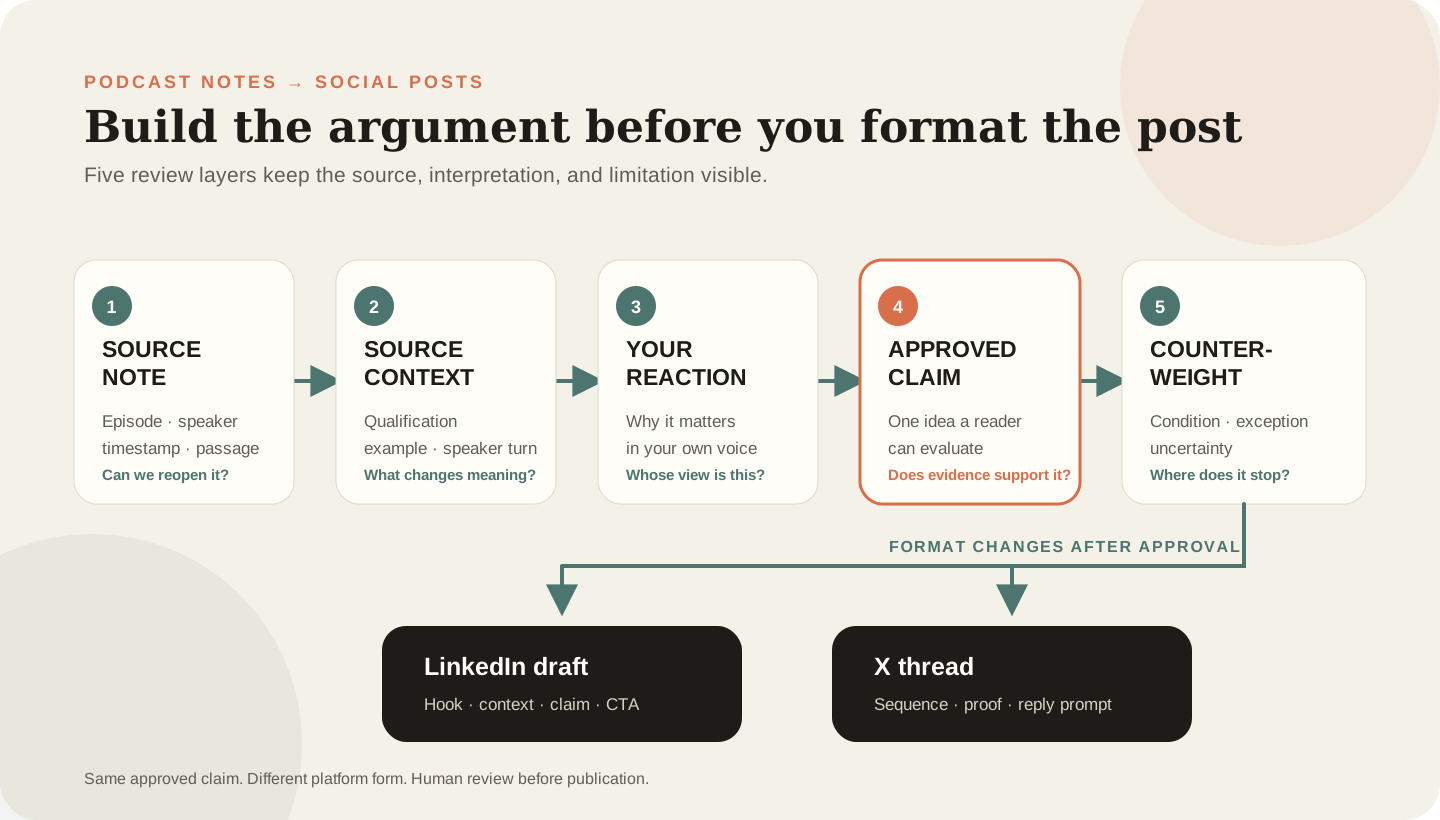
Compare how the approved core changes in the LinkedIn workflow and the X workflow.
Detached-post test
Review the thread with its neighbors removed
| What is hidden | Result for this example | Reason / next action |
|---|---|---|
| Opener and index hidden; post 2 alone | Pass: speaker, show, direct link and a distinct locator remain. | Open the linked transcript and find the host’s question identified in post 2. No guessed timestamp is needed. |
| Index reply removed | Pass for source recovery in posts 1 and 2. | The episode’s full bibliographic line is no longer present, but each borrowed claim retains its own source path. |
| All source posts hidden; post 3 alone | Pass for ownership, not for proof of effectiveness. | It labels an author experiment and does not report a completed test. A later results claim would need new evidence. |
| A link fails or the passage disappears | Stop and repair before posting. | Use another verified source destination or remove the unsupported claim; an index alone does not restore missing evidence. |
- Each borrowed claim names the correct speaker and links to the material that supports it.
- Each passage locator works without assuming the reader has seen another post.
- A proposal is visibly the author’s proposal, with no invented outcome or endorsement.
- The source reply adds detail instead of carrying all the attribution.
- The final copy has been checked after edits, including all source links and any required qualification.
Evidence limits
What has and has not been checked
- The teaching thread is a citation-layout exercise using a public transcript. It does not establish the accuracy of every claim in the episode, and no recording, clip boundary or speaker voice was checked.
- The local character budgets cover only the displayed ASCII drafts and their exact URLs. They do not validate other Unicode text, URL detection edge cases, account features or actual posting acceptance.
- The detached-post review is an editorial exercise. No reach, ranking, engagement, algorithm behavior or reader experiment was measured.
- Source credit is not permission to reuse audio, video or other protected material. This example does not include those media.
Human review remains necessary. No repurposing workflow can turn weak evidence into a strong claim.
FAQ
Frequently asked questions
Can I cite the podcast only in the last post?
You can use a final source index for full episode details. Under this guide’s detached-post test, a borrowed claim also needs enough local credit to identify its speaker and recover the passage. That is an editorial standard for this workflow, not a rule attributed to X.
Do I need a timestamp?
Use a timestamp when it is real and checked. For an untimed transcript, use a recognizable question or exchange as the locator and label the evidence as transcript-based. Do not invent media timing.
Does every post need the same link?
Inspect what each post asks the reader to believe. In this example, the two borrowed-claim posts need direct source paths. A clearly labeled original proposal does not need a link solely for appearance, but any borrowed premise inside it still needs attribution.
Evidence
Sources and comparison pages
- Fixable: official episode transcript used in the teaching exampleTED
- Counting CharactersX Developer Platform