
Podcast editorial brief template
Podcast social media brief template: give a writer a clear assignment
A podcast social media brief template should tell a writer who the post is for, what response it should invite, what angle to develop, and which claims the source supports. Attach the evidence, define the deliverable, and state what would make the draft unacceptable.
Use this brief before commissioning a post. A source note preserves material; the brief turns that material into an assignment. Below are a blank form, a filled example using a public interview, and a complete draft that shows how the assignment shapes the writing.
Decide the assignment before deciding every sentence
Asana’s creative-brief guidance brings together the audience, intended response, assets, stakeholders and timing. For a podcast post, add a boundary between what the source supports and what the writer is being asked to contribute. Source: Asana on creative-brief requirements.
Give the writer a direction without prescribing every sentence. Adobe describes a brief as a framework for creative work and warns against making it overly prescriptive. In the template below, the reader’s task and source boundaries are fixed; the opening and wording remain choices. Source: Adobe on direction and creative freedom.
Decide which unanswered questions block the assignment
A brief can leave creative choices open. It should not leave the writer guessing about the reader or filling a gap in the evidence. Classify an unanswered question before passing the assignment on.
If the uncertainty changes the central claim, resolve it before asking for a complete draft. If it changes only the opening or sentence order, let the writer make the choice within the brief.
| Open question | Can the writer proceed? | Next action |
|---|---|---|
| Which opening or paragraph order? | Yes, if the reader and angle are already clear. | Let the writer propose wording that meets the brief. |
| Who is the intended reader? | Pause the assignment; the answer changes what needs explaining. | Ask the editor for a reader and situation, with assumptions labeled. |
| Does the source support the proposed result? | Only with a supported angle; do not fill the gap with confidence. | Remove the result claim or ask for evidence before drafting around it. |
Blank brief, filled example and resulting draft
Copy the brief before asking for copy
The filled version is a teaching assignment, not a completed client handoff. Its unassigned roles and dates remain open; the example draft demonstrates the writing choices without claiming anyone accepted or published them. Before assigning a real writer, fill in the owner and due date and resolve any question that changes the angle.
BLANK PODCAST SOCIAL MEDIA BRIEF
Assignment: [working title; brief version]
Reader and situation: [who is facing what decision; research or editorial assumption]
Desired response: [one thing the reader should consider or do]
Angle and writer contribution: [point to develop; example/question/analysis the writer adds]
Source packet: [episode URL; speaker; passage locator; text-only or recording-reviewed]
Supported claim and limit: [supported point; qualification that must remain]
Exclusions: [unsupported claim; unrelated theme; assets outside this assignment]
Deliverable: [destination; format; required credit/link; what to return]
Open choices: [what the writer may decide without changing the assignment]
Review checks: [how the editor can judge the draft against the brief and source]
Assignment details: [writer; editor; due date; unresolved question owner]

FILLED TEACHING BRIEF — FEEDBACK-PREP / version A
Reader and situation: New manager preparing a feedback conversation; editorial audience assumption, not a researched segment.
Desired response: Before the conversation, write down one specific offer of help.
Angle and writer contribution: The manager should prepare what they can contribute, not only what they want corrected. Add a preparation question in the writer’s own voice.
Source packet: Stanford interview linked below; locate the question containing “six-step framework,” then read Dodson’s answer and Abrahams’s response before the 360-review topic. Transcript-only.
Source URL: https://www.gsb.stanford.edu/insights/give-it-me-straight-power-honest-constructive-feedback
Supported claim and limit: Dodson includes obstacles and support within a broader feedback structure. These elements are not the whole method.
Exclusions: No claim of guaranteed improvement, no personal client story, no invented quotation, no clip or audio-verification claim.
Deliverable: One LinkedIn text draft with the source URL. Return the complete draft and a note identifying the source paraphrase and the writer’s added question.
Open choices: Writer chooses the opening, paragraph breaks and final question; keep the audience, source limit and task unchanged.
Review checks: Reader situation is clear; support is a preparation prompt rather than an outcome promise; guest and writer are distinguishable; source is recoverable.
Assignment details: Writer unassigned; editor unassigned; due date unassigned. Teaching example only; no publication scheduled.

COMPLETE EXAMPLE DRAFT — unpublished teaching copy
Before your next feedback conversation, prepare your side of the work too.
David Dodson’s discussion on Think Fast, Talk Smart places asking about obstacles and offering support within a broader feedback structure.
My suggested preparation question: if the person identifies an obstacle, what specific help can I realistically offer?
Write down an answer before the meeting. Treat it as preparation for a conversation, not a promise that you already know how to solve the problem.
What help could you put on the table?
Source: https://www.gsb.stanford.edu/insights/give-it-me-straight-power-honest-constructive-feedback

NOTE RETURNED WITH THE DRAFT
Source paraphrase: Paragraph naming Dodson. Editorial additions: The opening, exercise and questions. Recording and LinkedIn composer unchecked.
Before writing
Turn a source packet into an assignment
Name a reader in a situation
Describe the decision or problem the reader faces. Replace a broad group such as leaders with a situation such as a new manager preparing feedback for tomorrow’s conversation. If the audience is an editorial assumption, label it rather than presenting it as customer research. Source: Asana on defining an audience.
Choose the response the post should invite
Ask for an observable next step: write down a question, inspect a source, or compare two choices. Do not promise engagement or invent a conversion target. The requested response helps the writer choose what to explain and what to leave out.
State the angle and the writer’s contribution
An episode topic is not yet a post angle. Name the specific point to develop and the useful thing the writer will add: a question, comparison, worked example or decision rule. Keep that addition in the writer’s voice instead of attributing it to the guest.
Attach a bounded source packet
Include the episode page, speaker and passage locator, then summarize the supported claim and its limit. Record whether the review used text or a recording. Put unsupported interpretations under exclusions so the writer knows which attractive claim they must not build on.
Specify the deliverable and how it will be reviewed
State the destination, text or media format, required source link and return format. Identify the writer, editor and due date when those are real assignments. Leave missing assignments visibly unassigned. Define checks the editor can perform on the returned draft. Source: Adobe on deliverables and responsibilities.
Commissioning decisions
One interview, a narrower writing assignment
The teaching assignment uses a Stanford-published interview. The reader and commission used here are editorial inventions.
David Dodson spoke with Matt Abrahams on Think Fast, Talk Smart, published on 2023-07-18. The passage specified in the brief is part of a broader framework; the example selects a limited point to develop. Source: Stanford transcript: feedback discussion.
| Weak instruction | Usable instruction | Why it changes the draft |
|---|---|---|
| Write something about leadership. | Write for a new manager preparing a feedback conversation. Invite them to identify one concrete form of help they can offer. | The reader and requested response narrow the assignment without inventing audience research. |
| Explain why this method fixes poor performance. | Introduce a preparation prompt inspired by the discussion. Make no promise that it resolves the employee’s problem. | A guest’s advice does not establish an outcome for every workplace. |
| Make an engaging post and a clip. | Return one LinkedIn text draft, its source link and a short claim note. No video, quote card or scheduling task. | The writer can finish a text assignment without pretending that a media file exists. |
“A useful brief leaves room for the writer’s sentences while making the assignment unmistakable.”PodInk editorial principle
The filled brief rejects a performance guarantee and an added clip request before drafting starts. Those are scope decisions made for this teaching example. They are not findings about the interviewee, actual audience behavior or a real editorial team.
The sample post follows the accepted angle: it moves from a source idea to the writer’s preparation exercise. Its opening and closing question are editorial choices. Another writer could choose different wording and still meet the same brief.
When a writer returns a draft, check it against the brief and reopen the source. A draft can follow the format and still overstate the evidence. Keep final publication approval separate from accepting the assignment.
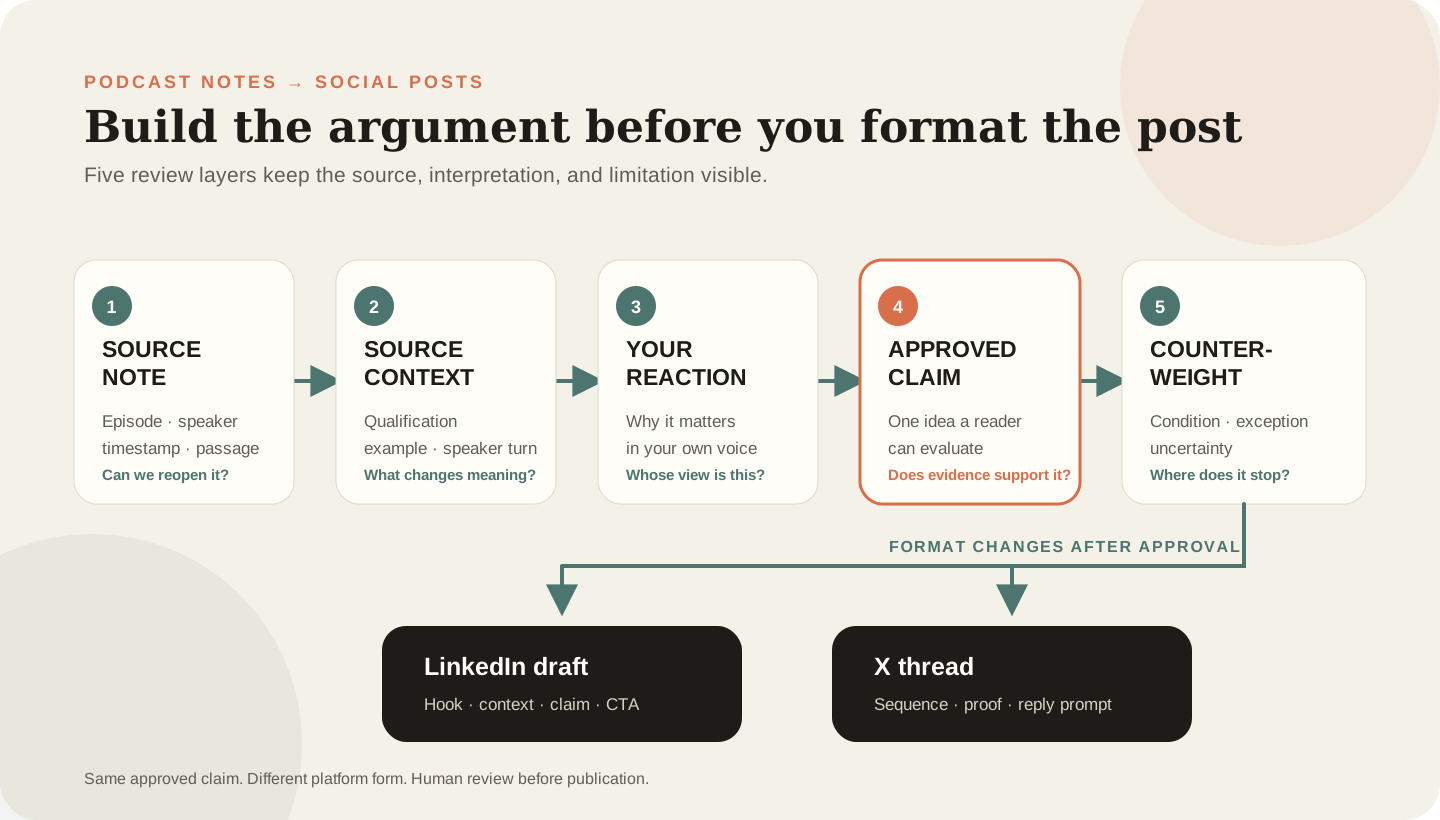
Compare how the approved core changes in the LinkedIn workflow and the X workflow.
Brief acceptance
Check whether the writer can begin
- Can the writer name the reader’s situation and the response this assignment invites?
- Is the post angle narrower than the episode topic, with the writer’s contribution identified?
- Can the writer recover the selected passage and see which claims are excluded?
- Are the deliverable, return format and open creative choices explicit?
- Are real roles and dates assigned, or are missing assignments clearly open rather than invented?
- Will the returned draft receive its own source review and publication decision?
What remains unverified
A complete brief does not approve the post
- The filled brief and resulting post are unpublished AI-assisted teaching examples. The audience, assignment and writing decisions were created for this guide; they are not a client commission or a record of results.
- The source review uses Stanford’s written transcript. No recording was listened to, no timestamp or clip boundary was approved, and no direct spoken quotation is used in the sample post.
- A brief can define what the writer should produce without proving that the proposed advice will work. The sample is not a test of feedback effectiveness.
- The sample has not been tested in a LinkedIn composer. Writing the assignment, reviewing the text and authorizing publication are separate decisions.
Human review remains necessary. No repurposing workflow can turn weak evidence into a strong claim.
FAQ
Frequently asked questions
What belongs in a podcast social media brief?
Include the intended reader, desired response, angle, writer contribution, recoverable source packet, claim limits, deliverable and review checks. Add real assignment owners and timing. Leave unknowns open rather than silently filling them with guesses.
How is a brief different from podcast notes?
Notes preserve source material and your observations. A brief tells a writer what to produce for a particular reader. The same source note can support different briefs, but each assignment needs its own angle and boundaries.
Does a completed brief mean the post is approved?
No. A brief authorizes or requests a writing task only to the extent actually agreed. The completed draft still needs its own source review and explicit publication decision.
Can the same brief ask for a post and a podcast clip?
A brief can request both a post and a clip, with separate deliverables and checks. A text draft does not provide playable media, verified cut points or reviewed captions. Define the clip work explicitly, or keep it outside the assignment.
Evidence
Sources and comparison pages
- Give It to Me Straight: The Power of Honest, Constructive FeedbackStanford Graduate School of Business
- Creative Briefs: What To Include (with Template)Asana
- Creative briefs: How to write, examples, and best practicesAdobe