
Podcast archive reuse guide
How to repurpose an old podcast episode without making it sound new
To repurpose an old podcast episode, keep its original date beside the idea you reuse, identify what depended on conditions at the time, and verify any claim you want to make about the present. Introduce the material as an archive source. Explain your own reason for returning to it instead of presenting the episode as a new interview or new evidence.
A useful old idea does not need a new publication date to deserve attention. The editing task is to separate what the source said then from what you want readers to consider now. That separation matters in the opening line, image caption, and excerpt as well as in the source link.
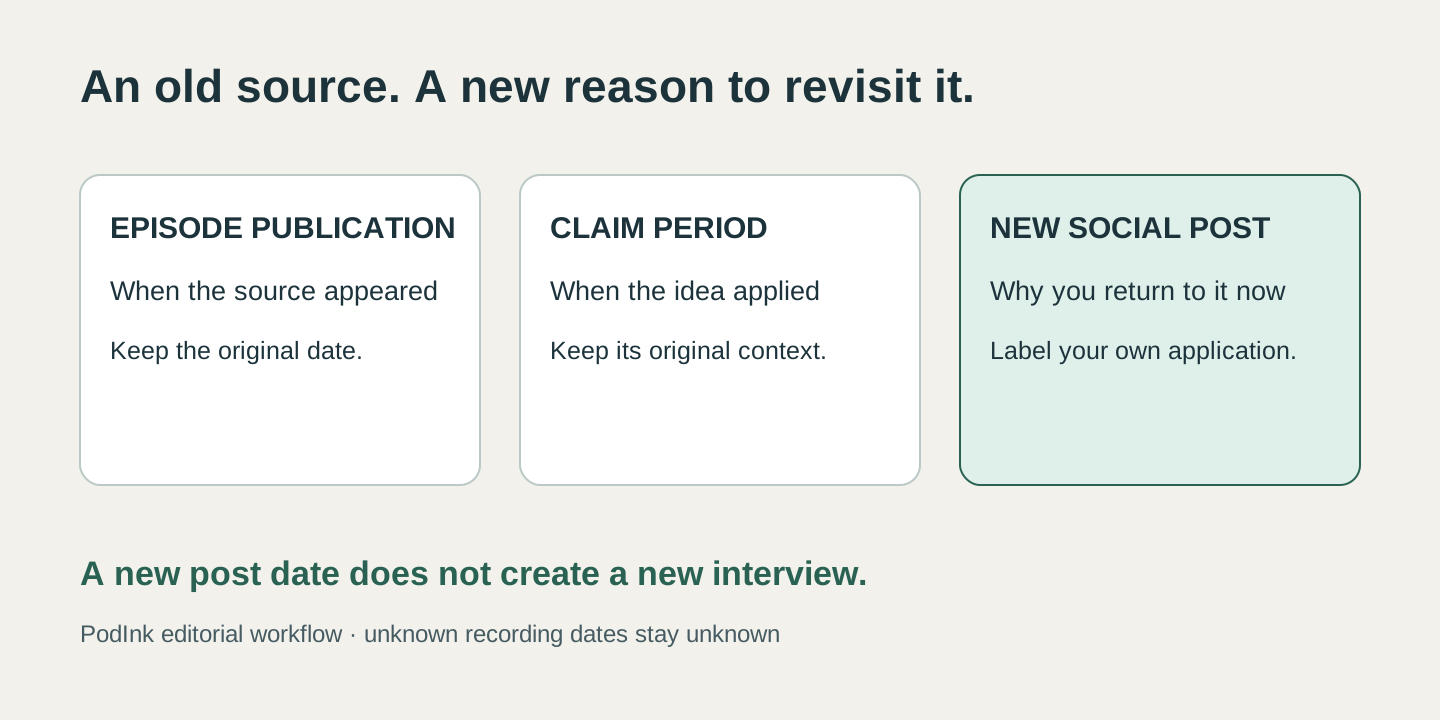
Keep the source date separate from the claim’s time period
Record the episode page’s publication date, any stated recording date, and the period described by the selected passage. Leave unknown dates unknown. A compilation may contain material recorded earlier than the compilation itself; the visible page date cannot settle that question.
A new social post can add a current question or a new application. It cannot silently update a guest’s job title, a product feature, a price, or a forecast. Describe an unverified detail as historical only if that historical detail is supported; otherwise remove it or hold the claim.
| Record | What it tells you | What it does not tell you |
|---|---|---|
| Episode publication | When the source page or episode was published. | When every included remark was recorded. |
| Claim period | The time or situation the passage discusses. | Whether the claim still describes the present. |
| Reuse date | When your new post is scheduled or published. | That the guest has repeated or endorsed the idea today. |
Make the archive label travel with the excerpt
AP’s editorial standards call for archive photos, audio, and video to be identified as archive material. For a social post, use the same practical principle: put the source period where a reader encounters the excerpt, rather than relying on a linked page to reveal its age. Source: AP: archive identification.
SPJ’s code calls for updating and correcting information throughout a story’s life. In this workflow, that means checking a present-tense claim again when you reuse it. These are editorial principles, not a guarantee that a particular post is accurate or legally cleared. Source: SPJ: accuracy and updates.
If your graphic says “new advice” while the caption says “from the archive,” edit the graphic too. Review the hook, image text, alt text, and scheduled caption together. A reader may see only one of those surfaces.
Copyable archive brief
Give the next editor the source period and the new angle
Fill the record before writing a promotional hook so the next editor can tell what is historical and what needs checking now. Use “unknown” where the source does not supply a date.
SOURCE: [episode title, publisher, original URL]
EPISODE PUBLICATION DATE: [as displayed by the publisher]
RECORDING DATE: [verified date, or unknown]
PASSAGE LOCATOR: [speaker turn, section, or supplied timestamp]
ORIGINAL CONTEXT / CLAIM PERIOD: [what was happening or being discussed]
KEEP AS HISTORICAL: [supported point, with the original time frame]
CURRENT CLAIM TO RECHECK: [claim, current primary source, date checked—or none]
OUR NEW APPLICATION: [editorial idea, separate from the guest’s words]
VISIBLE ARCHIVE LABEL: [opening line, image, caption, or all that apply]
PLANNED REUSE DATE: [the new post date, never substituted for the source date]
NEXT REVIEW: [wording, audio, rights, factual checking, or approval still needed]
Archive editing workflow
Decide what to retain, update, or hold
Open the original source before the old social post
Start from the publisher’s episode page and transcript. Record the visible date and selected passage. If you found a repost or search snippet first, follow it back to the source; a repost date is not evidence of the recording date.
Mark words that depend on time
Flag present-tense details such as current, now, this year, latest, and today, plus roles, availability, prices, forecasts, and study dates. Read the surrounding passage to determine whose time frame those words describe.
Choose historical framing, current verification, or a hold
Keep a supported historical claim with its period attached. If the new post needs a claim about current conditions, check a current primary source. Attribute that addition separately. When neither route is supported, drop or hold the claim.
Write your reason for returning to the source
Offer a specific question, comparison, or action readers can consider. State it as your interpretation or proposal. Do not turn your application into advice the guest supposedly gave about a later event.
Check the complete publication package
Read the hook, body, source credit, image text, and scheduling note together. Ask whether any surface suggests a new interview, a fresh result, or a current endorsement. Keep the original episode credit. Name the next review action, such as checking a spoken quotation against the recording.
Transcript-based archive example
Revisit a virtual-communication episode as an archive source
Stanford GSB published “Quick Thinks: How to Shine Online” on April 19, 2021. Matt Abrahams introduces a compilation of advice from earlier guests. Its opening refers to the shift from office meetings to virtual communication. The page date belongs to the compilation, not a newly verified recording date for every contribution.
In the opening transcript turn, Brian Lowery links a change of communication setting to a change in how people understand and experience the speaker. That is the limited source idea used here; the post below adds an editorial application. Source: Stanford official episode and transcript.
| Decision | Keep in the record | Effect on the post |
|---|---|---|
| Source frame | Archive compilation about virtual communication. | Name the episode and its original date before proposing a current use. |
| Our application | Review the opening of an upcoming remote session. | Label this as a suggested exercise, not a new guest recommendation. |
| Unsupported upgrade | A newly proven method for better meetings. | Remove the claim: this example has no fresh study or outcome evidence. |
| Recording status | Written transcript consulted; recording not reviewed. | Use a clearly attributed paraphrase for the teaching example; hold any proposed audio excerpt for review. |
Proposed archive post — teaching example, not a guest quotation
“From the archive: Stanford GSB’s “Quick Thinks: How to Shine Online,” published April 19, 2021, opens with Brian Lowery’s point that changing the communication setting changes how people experience the speaker. My application: before the next remote session, review the opening rather than carrying it over unchanged. What does the audience need to see, hear, or do to understand the point in this setting? I’m revisiting an older idea, not reporting a new interview. Source: the official episode and transcript linked here.”PodInk teaching example; not a guest quotation
The source period appears before the application, so the reader can identify the age of the material immediately. The first-person application belongs to the proposed post author. The source does not establish that the exercise improves an outcome.
If the actual publishing goal requires a claim about today’s working practices or a platform’s current features, this post needs additional evidence. The archive reference alone cannot supply it.
An archive post earns a new angle through the editor’s question or application. It does not need to manufacture a new date, discovery, or endorsement.
Compare how the approved core changes in the LinkedIn workflow and the X workflow.
Before publication
Review the archive framing wherever the excerpt appears
| Finding | Treatment | Required next step |
|---|---|---|
| Old advice with a clear original setting | Frame as an archive idea and explain your application. | Keep the source date and attribution visible. |
| Time-sensitive detail needed in the new post | Separate the historical statement from the current claim. | Verify the current claim with a current primary source. |
| Forecast whose deadline has passed | Treat as a historical forecast. | Check the outcome separately before saying it came true or failed. |
| Unknown recording date | Keep it unknown. | Use only the confirmed publication date; do not invent an interview date. |
| Old clip with unclear wording or speaker | Hold that excerpt. | Review the recording and attribution before reuse. |
- Does the opening show that the episode is older material?
- Are publication date, recording date, and the claim’s time period kept distinct?
- Are words such as now or current attached to the correct period?
- Have I separated the guest’s idea from my new application?
- Can readers reach the original source?
- Do the image and caption use the same temporal framing?
- Are current factual claims supported by current evidence?
- Are recording review, reuse checks, and publication approval recorded honestly?
Evidence limits
What this review does not establish
- The worked example uses the official written transcript. No recording was played, and no exact audio quotation or clip boundary was verified.
- An episode page’s publication date does not establish when each included conversation was recorded.
- The example post is a proposed editorial application, not a published customer result or proof that the advice works today.
- The archive review checks temporal framing. It does not clear reuse rights, verify every underlying claim, or predict reach.
Human review remains necessary. No repurposing workflow can turn weak evidence into a strong claim.
FAQ
Frequently asked questions
Does an old episode need new research before I share it?
The need for new research depends on the claim. You can discuss a supported historical idea as historical material. A statement about current prices, features, roles, or conditions needs current evidence. Do not present an archive reference as that evidence.
Can I change the episode date when republishing it?
Keep the original source date in the credit. Your new post can have its own publication date. If you maintain a guide about the episode, preserve that guide’s original publication date and record substantive revisions separately.
What if the episode is a compilation of older interviews?
Identify the compilation and use its confirmed publication date. Do not infer that all included remarks were recorded together or on that date. Record individual recording dates only when a reliable source supplies them.
Can I call an old idea evergreen?
Use the label cautiously. Explain which part you want to apply and which original conditions mattered. Calling advice evergreen does not verify current facts or prove that the advice works for every audience.
Evidence
Sources and comparison pages
- Quick Thinks: How to Shine OnlineStanford Graduate School of Business
- Telling the StoryThe Associated Press
- SPJ’s Code of EthicsSociety of Professional Journalists