
After-publication editing
How to correct a podcast social media post after publication
To correct a podcast social media post, verify the disputed claim, repair the wording and tell readers what was wrong. Connect the original post, corrected text and correction notice so an earlier reader can follow the change. Then check the other places where the mistake appeared; changing one caption does not establish that every copy is fixed.
This guide starts after publication. The worked package uses an invented source and deliberately faulty post so you can inspect the entire correction. The exercise describes no real guest or episode, and none of its example posts was published.
Is it a correction, a clarification or new information?
FRONTLINE separates substantive errors from text that is accurate but needs clearer detail. Its policy also distinguishes later reporting updates. Those categories are useful when naming your change; they are not a reason to soften an admission that the original post was wrong. Source: FRONTLINE corrections policy.
A wrong name, number or omitted qualification may change the claim. Do not call a false claim a clarification.
| Situation | What to establish | Reader-facing treatment |
|---|---|---|
| The post made a false claim | The correct claim and the evidence that contradicts the published version. | Name the error and supply the corrected information. |
| The claim was accurate but unclear | The underlying fact remains unchanged; the added detail resolves ambiguity. | Explain the clarification without implying that a false claim was only unclear. |
| The facts changed after publication | What was known at publication and what became known later. | Date the update and preserve the distinction between the old situation and the new one. |
| A challenge is still unresolved | The precise disputed claim and the missing evidence. | Do not announce a verified correction yet. Record the uncertainty and decide with the editor how to handle the public post while checking. |
Repair the statement and the public record
AP requires factual corrections to be labeled as corrections and made visible to audiences. Merely replacing the words can leave earlier readers unaware of the change. Source: AP: Corrections/Correctives.
PBS calls for corrected information and an explanation of the mistake. Handling depends on the platform; deletion generally requires a public record or acknowledgment. Source: PBS: Treat Errors Seriously on All Platforms.
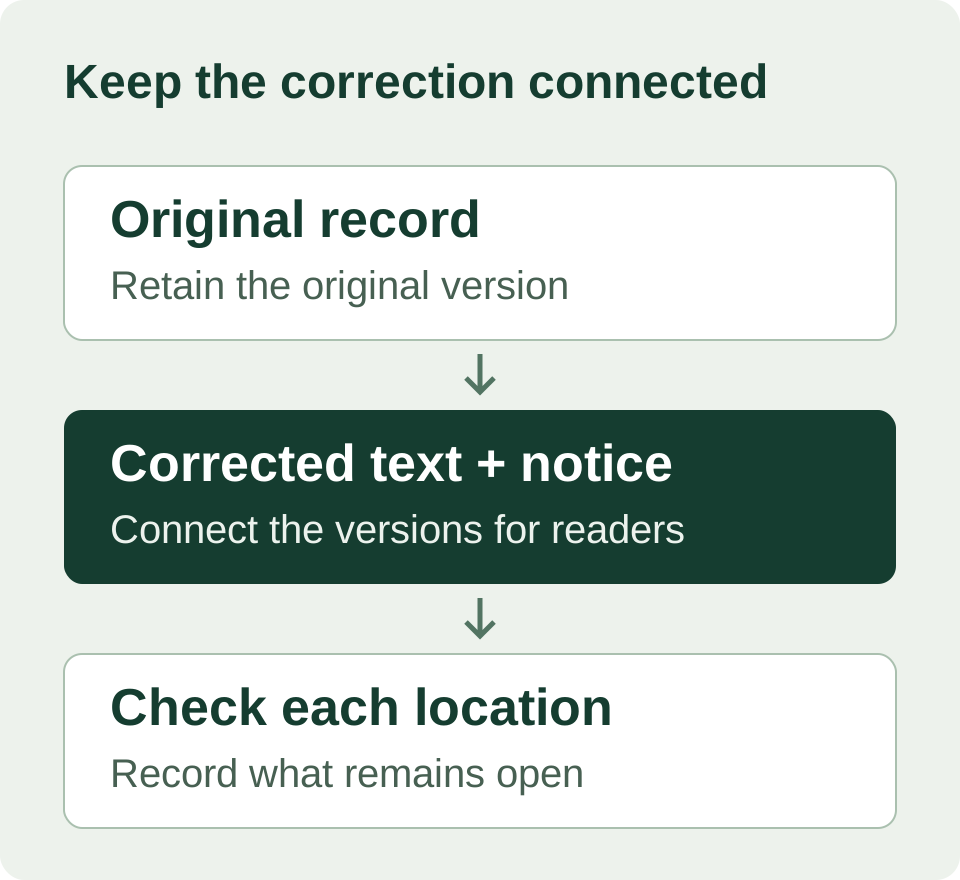
Our practical adaptation is to keep an original record, a revised text and a separate reader notice under one issue ID. Keep the full working record privately; the public notice needs enough detail to identify the mistake without unnecessarily reproducing it. This record structure is an editorial suggestion, not a platform requirement.
The practice source: a limited meeting experiment
All material in this exercise is original, invented teaching text. S-A is a short practice passage, not a real transcript, recording or customer case. A and B are version labels for the posts below. The notice uses simulated publication language to show how it would read; it does not report a real publication action.
Practice source S-A — invented guest: For our trial, a written update replaced the Monday status meeting. We kept design reviews because we still needed them. I am describing our team’s experiment; I do not know whether it suits other teams.
Practice Post A: the deliberately wrong version
Do not publish this teaching error. It changes a limited experiment into a universal recommendation.
Replace every meeting with a written update. The podcast guest says their team stopped meeting and recommends that all teams do the same.
Practice Post B: complete corrected wording
One team’s experiment is not a meeting policy for everyone. The guest describes replacing the Monday status meeting during a trial while keeping design reviews. The guest does not say whether the change suits other teams.
My takeaway: first identify the job a meeting performs before proposing a different format. That is my editorial suggestion, not a recommendation established by the guest’s experiment.
Source for this exercise: invented passage S-A above. Correction: this wording replaces Practice Post A, which overstated both the extent of the change and the guest’s recommendation.
Practice Notice N-A: explain the correction to earlier readers
Simulated notice, not published — Correction to our meeting post: We incorrectly said the guest’s team stopped meeting and that the guest recommended the change to every team. The source describes replacing only the Monday status meeting during a trial; design reviews continued. We have replaced that wording with Practice Post B. Our original recommendation went beyond the source.
Practice references: original wording A; corrected wording B; source passage S-A. For a real notice, replace these exercise labels with the relevant post links, episode URL and passage locator. State whether the original post was edited, replaced or removed only after that action occurred.
A vague note such as wording updated would not explain the change in this case. The reader needs to know that both the account of the experiment and the universal recommendation were wrong. The corrected post remains readable on its own; the notice explains how it differs from the earlier version.
Follow the error across formats
Reuters applies its correction standard across stories, captions, graphics and scripts. For podcast reuse, inspect the affected post and the related assets rather than assuming the text field is the only place carrying the error. Source: Reuters: Corrections.
List the published locations you control and the copies you know about: thread entries, quote-card text, image descriptions, attached media and scheduled reuse. A corrected caption does not change words burned into a video or graphic. Record what you checked and what remains outside your control.
Copyable correction record
Keep an issue record that points to the actual versions
Copy these fields for a real correction and fill them with actual URLs, versions, checks and actions. Leave unperformed actions open. The exercise’s simulated notice is not a receipt that anything was edited or published.
ISSUE
Issue ID:
Reporter / time received / exact disputed claim:
Editorial owner:
Classification: confirmed error / clarification / new information / unresolved
Why the change matters to the reader:

EVIDENCE
Original post URL / publication time / retained text or asset version:
Source URL / source version / speaker / passage locator:
Evidence actually checked: text / recording / independent record
Correct claim / remaining uncertainty:

CORRECTION PACKAGE
Corrected text or asset / version:
Reader notice / version:
Original post URL → corrected version URL → public notice URL, plus source URL/locator:
Chosen handling: edit / replacement / removal with acknowledgment / other
Platform capability checked / evidence of what is supported:

DISTRIBUTION AND CLOSURE
Affected locations and scheduled copies:
Action owner / authorized action / time completed / result URL:
Actual public version inspected / notice visible / evidence captured:
External copies or destinations not verified:
Remaining action / owner / next review point:
Publication approval for this exact package: pending / approved, with approver and scope
Closure decision: what is verified and what remains open
Correction workflow
Move from a confirmed error to a checked correction
Preserve the original and check the challenge
Record the exact wording, asset version and public location before changing the post. Compare the disputed claim with the relevant source and surrounding context. A report of an error is a reason to investigate; it is not itself proof. Pause reuse of the questioned claim while checking it.
Write the narrow correction first
State what the evidence supports, including the original scope and uncertainty. Repair the hook and conclusion as well as the sentence containing the error. If the evidence no longer supports the premise, remove or revise the recommendation that depended on it.
Write the notice for an earlier reader
Name the affected post, say what was wrong and give the correct information. Make the connection to the corrected version easy to follow. Describe completed actions accurately instead of using a prepared notice as evidence that the repair has already happened.
Choose handling that the destination supports
Check the account and content type before relying on edit, reply, link or pin features. If editing is supported, correct the text with visible acknowledgment; otherwise prepare an identifiable replacement. For removal, retain a record and explain the action. Deletion alone is not the correction.
Verify the distributed result
Inspect the final public text, notice and affected assets after the authorized action. Follow their links and record the version you saw. Check each known destination separately. A prepared correction, a submitted edit and a visibly corrected post are different states.
Version record
An honest record of the teaching package
This filled ledger records what exists in this guide. The exercise simulates a post-publication problem but has no real post URLs or platform actions.
| Record | What it contains | State and connection |
|---|---|---|
| Issue C-A | Practice Post A misstates the scope of source S-A and adds universal advice. | Confirmed within the invented exercise by comparing the complete supplied texts; no real-world factual conclusion. |
| Original version A | Complete erroneous text is retained above as a labeled teaching error. | Not published. It remains available for comparison; it has not been overwritten by B. |
| Corrected version B | Complete revised text narrows the account and labels the writer’s own takeaway. | Text prepared. The source reference and correction label point back to A and S-A. |
| Notice N-A | Complete notice explains the two misrepresentations and identifies B. | Simulated wording only. Real post links and action status would be required before use. |
| Distribution record | No account, post, clip, quote card or scheduled copy was changed for this exercise. | Platform capability, publication approval and public-result checks are not performed. |
Editorial reminder
“A correction package is ready to review before it is ready to publish.”Original PodInk editorial reminder
Version B changes the argument, not just the phrasing. Once the universal premise is removed, the original advice no longer follows. The replacement offers a narrower author judgment and keeps it separate from what the practice source says.
Imagine returning to a post you shared and finding a different claim with no explanation. The public notice should resolve that confusion. The private record serves the editor: it retains evidence and action history. Neither record substitutes for inspecting the final public version.
The example texts and record are AI-assisted original teaching material. Source and copy review do not constitute human publication approval. No social post, media file or account was changed.
Compare how the approved core changes in the LinkedIn workflow and the X workflow.
Distribution review
Check the copy readers can still encounter
| Location | Check | Keep open when |
|---|---|---|
| Original post or replacement | Correct claim, visible explanation, connection to the earlier version. | Only the local draft changed, or the notice describes an action that did not occur. |
| Thread and related posts | Later entries do not repeat the wrong premise or depend on the withdrawn conclusion. | One corrected entry leaves another entry carrying the error. |
| Image or video package | On-image or on-video words, accompanying text and descriptions agree with the correction. | The caption changed but the asset still says the original claim. |
| Scheduled reuse and other destinations | Known queued copies and controlled destinations have an explicit decision and checked state. | A destination was missed, is inaccessible, or has no demonstrated repair. |
| Copies controlled by others | Record the known location and any correction request actually made. | A correction request has no confirmed result, or the record assumes that every earlier viewer saw the notice. |
- The issue describes the exact published claim and its consequence.
- The replacement reflects evidence actually checked, with uncertainty retained.
- The notice says what was wrong without disguising a correction as a wording update.
- Original record, revised version and reader notice remain connected.
- Each affected location has a checked state or a named unresolved action.
- Publication actions and human approval are recorded separately from prepared text.
Remaining boundaries
What this guide has not verified
- The meeting passage and all sample posts are invented teaching material, not a real podcast, actual model output or customer incident.
- No audio or video was reviewed. A real quotation or media correction requires checking the relevant recording and version when wording or delivery is disputed.
- No social account was accessed. Editing, pinning, replies, replacement behavior and public visibility depend on the current destination and have not been tested here.
- A corrected post cannot establish that every earlier viewer or third-party copy received the update. This workflow makes remaining gaps visible; it does not guarantee recall, trust or reach.
Human review remains necessary. No repurposing workflow can turn weak evidence into a strong claim.
FAQ
Frequently asked questions
What if the episode itself was wrong?
Separate your account of what the speaker said from evidence that the assertion is true. Check the underlying claim. If the new evidence does not support your published statement, correct that statement and explain the source of the change without claiming you verified more than you did.
Does a correction notice prove the issue is closed?
No. The notice is one artifact. Closure also requires checking the revised public content and the known affected locations, while recording anything that remains unresolved.
Evidence
Sources and comparison pages
- Telling the Story — Corrections/CorrectivesThe Associated Press
- Accuracy — Treat Errors Seriously on All PlatformsPBS Editorial Standards
- Editorial Standards and Ethics — Corrections PolicyFRONTLINE / PBS
- Standards and Values — CorrectionsReuters