
Episode announcement
Announce a podcast episode with a reason to listen
A podcast episode announcement post tells a reader what they can listen to, why that episode may interest them and where to find it. Name the show and episode, offer a specific listening reason, and make the release status accurate. A scheduled episode, a live release and an archive recommendation need different wording.
The announcement does not have to reproduce the whole conversation. Give the reader enough information to decide whether to open the episode. This guide provides a complete archive example, a reusable release template and a check for posts that were written before the episode became available.
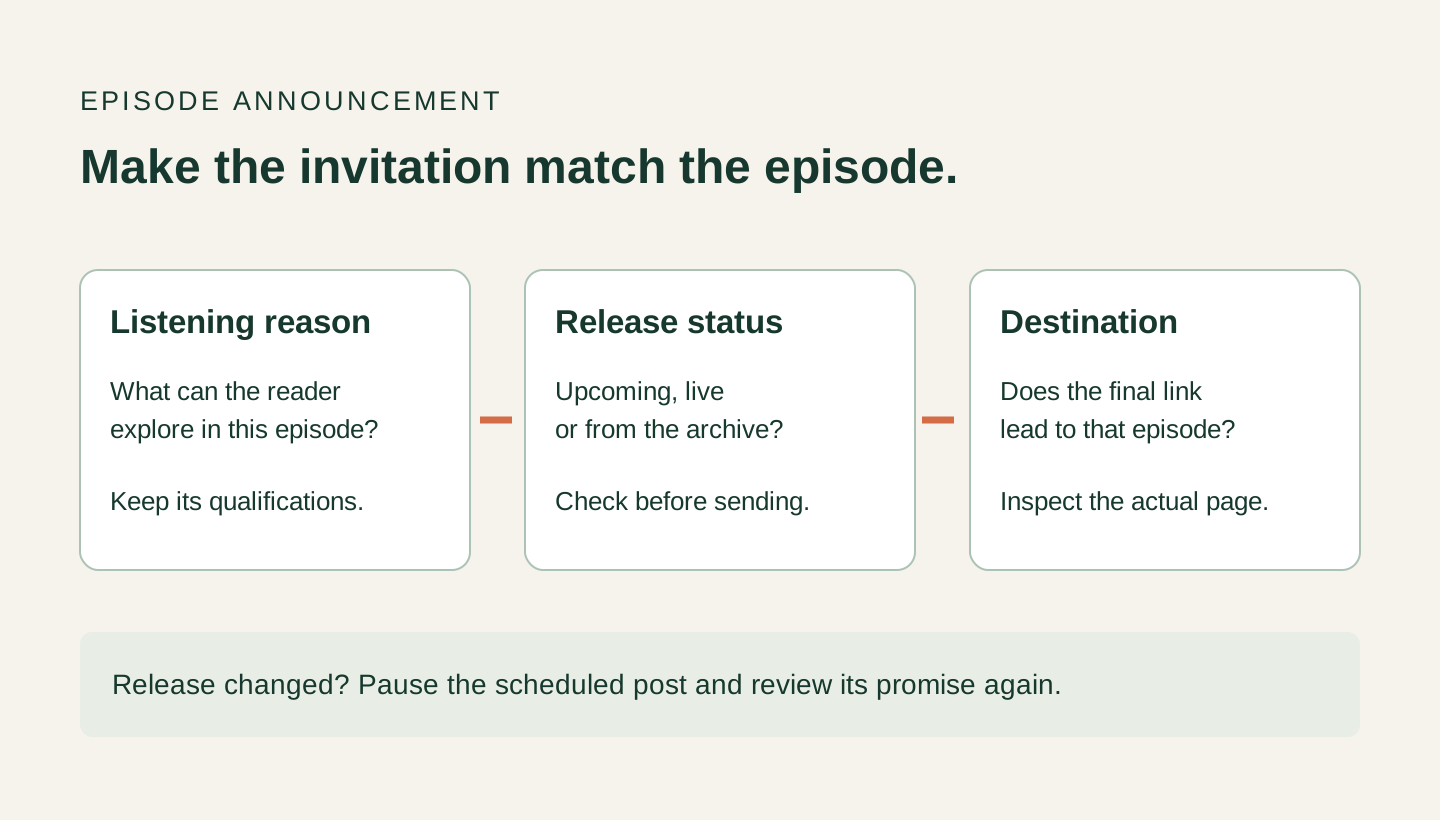
Give the reader a listening decision
Start with a question the conversation addresses or a concrete subject the listener can explore. Then identify the episode. “New episode out now” gives status but leaves the reader to discover the reason for caring. Avoid replacing that missing reason with a promise the conversation cannot support.
For example, an episode about evidence from Mars can invite readers to examine why a possible sign of life still needs investigation. Calling the same discussion proof of life changes the claim. Curiosity is useful only when the invitation remains accurate.
Choose wording for the actual release status
Use the status you have checked when the message will be sent. If an episode is delayed after a social post has been scheduled, review or pause the scheduled post. A review of the text yesterday cannot establish that the public episode is available today.
| State | Useful wording | Check before sharing |
|---|---|---|
| Not yet public | Coming on [confirmed date and time zone]. | The release time is confirmed and the linked destination matches an advance announcement. |
| Public release | Now available: [episode]. | The public page identifies the correct episode and offers the intended listening route. |
| Older episode | From the archive: [episode and original date]. | The original date remains visible; the post does not present old reporting as a new discovery. |
| Status uncertain | Keep the post as a draft. | Resolve the destination or timing before using a live-release claim. |
Link to the episode the post promises
Buzzsprout distinguishes an episode-specific destination from a general follow page. Its help page also notes that the individual link on its free plan goes to the follow page. The practical lesson is to open the final link and inspect where it lands, rather than infer the destination from a button label. Source: Buzzsprout: sharing your podcast.
If the post says “listen to this episode,” check that a reader can identify that episode at the destination. A show directory can still be useful, but label it accurately. Do not write “link below” if the finished placement contains no link.
A real episode, described as an archive recommendation
NASA published Catching Up With Perseverance on Mars on June 2, 2026. Its official page identifies NASA’s Curious Universe and host Jacob Pinter. The description introduces Katie Stack Morgan and Håvard Grip; the written transcript discusses possible signs of past life and Ingenuity’s flight story. Source: NASA episode page and written transcript.
In Katie Stack Morgan’s written response about the unusual rock features, the explanation retains uncertainty about life. The draft below preserves that uncertainty and describes an archived episode. We reviewed the page and relevant transcript passages, not the recording; no audio timestamps or exact quotations are supplied.
Reusable release announcement
Replace each placeholder before publishing
This is a writing template, not scheduled or published copy. Choose one status line; keep a specific listening reason rather than copying every show-note topic.
[LIVE: Now available / UPCOMING: Coming on date, time and time zone / ARCHIVE: From the archive, original date]
[Show name]: [Episode title]

[A question or specific listening reason the episode supports.]
[Speaker or segment, if relevant, and what the conversation actually covers.]

[One qualification the invitation needs, if any.]

[Listen to the episode / View the release details]: [checked public URL]
Build the invitation
From episode page to announcement
Read the episode page before writing the hook
Confirm the title, show, participants and release date. Select a listening reason supported by the description or a recoverable passage. Do not turn a broad topic into an outcome claim.
Write a complete invitation
Combine the listening reason, episode identity, status and destination. Name the speaker when the claim depends on that speaker; avoid a list of credentials that hides what the listener will hear.
Read the invitation without its image
The text should still identify the episode and destination. If you add artwork or a clip, check that the actual asset exists, matches the episode and has the necessary review and usage permission.
Inspect the scheduled version again
Confirm that the final text, link and release status agree. A changed date, redirect or missing attachment can invalidate the earlier review. Keep the draft on hold if the promised episode is not publicly available.
Worked archive announcement
Complete example: a NASA episode from the archive
The following is an unpublished, AI-assisted editorial example. It is not an official NASA post, a new episode announcement for today or a claim of endorsement.
| Element | Purpose | Evidence or limit |
|---|---|---|
| Listening reason | A concrete question about uncertain evidence. | The invitation does not promise that life on Mars has been confirmed. |
| Identity and original date | NASA’s Curious Universe and the episode title remain explicit. | June 2, 2026 is the original publication date, not this guide’s date.Source: NASA official episode |
| Episode link | An episode-specific public page. | The page text was checked. The recording and playback on a recipient’s device were not tested. |
Complete announcement draft:
“From the archive: what makes a possible sign of past life on Mars worth investigating? In NASA’s Curious Universe, Catching Up With Perseverance on Mars, Jacob Pinter talks with Katie Stack Morgan about the rover’s findings and with Håvard Grip about Ingenuity’s flight story. The discussion keeps possible evidence distinct from confirmed life. Published June 2, 2026. Explore the episode and its transcript: https://www.nasa.gov/podcasts/curious-universe/catching-up-with-perseverance/”PodInk editorial principle
The opening gives a reason to explore the conversation. The next sentence identifies the show and the relevant participants. The qualification keeps the invitation within the written source, and the archive label prevents a false “new today” impression.
A release-day adaptation would require a current episode and a checked release status. Do not replace “from the archive” with “just released” merely to make this example sound more urgent.
The complete example is ready to review as text. Sharing it, publishing on behalf of NASA or reusing media is not authorized by this guide. A source link supports attribution; it does not establish endorsement.
Compare how the approved core changes in the LinkedIn workflow and the X workflow.
Release check
Check the version that will actually go out
| Check | What you need | If missing |
|---|---|---|
| Identity | The final post matches the intended episode title, show and speaker. | Correct the mismatch before sharing. |
| Listening reason | The description or source passage supports the invitation and its qualification. | Narrow the hook or choose a different reason. |
| Release status | The wording matches the public state at send time. | Pause or rewrite the scheduled post. |
| Destination and asset | The final link opens the intended page; any promised media is present and reviewed. | Remove the unsupported promise or hold the post. |
- Does the post explain why someone might open this episode?
- Is the original date distinguished from the date of this recommendation?
- Does the hook retain uncertainty from the source?
- Does the final link lead where the invitation says it will?
- If the release is delayed, will the scheduled post be reviewed again?
Limits
What this example does not establish
- The NASA example is based on its public page and selected written transcript passages. Audio and recipient-device playback were not verified.
- No social post was published, no engagement result was measured and no optimal posting time or length is claimed.
- The workflow is PodInk editorial guidance. It does not establish permission to reproduce third-party artwork, audio or video.
Human review remains necessary. No repurposing workflow can turn weak evidence into a strong claim.
FAQ
Frequently asked questions
Is an episode announcement the same as a summary?
An announcement helps a reader decide whether and where to listen. It can use a small part of the episode description without trying to cover the full conversation.
Can I schedule the post before the episode is public?
You can draft it in advance. Review the actual scheduled version and destination when the release status is known; use advance-release wording if the episode is not yet public.
Do I need a clip to announce an episode?
A complete text invitation can stand on its own. If you promise a clip or artwork, check the actual asset and its intended use instead of treating a plan as a finished attachment.
Evidence
Sources and comparison pages
- Catching Up With Perseverance on MarsNASA — Curious Universe
- Sharing Your PodcastBuzzsprout Help