
Podcast post endings
How to write a podcast social media call to action
To write a podcast social media call to action, choose the next step your post has prepared the reader to take. Ask a focused question, suggest a small practice, or point to a clearly named source. Keep the request within the evidence in the post, and check that any linked destination delivers what the closing line promises.
A useful ending does more than ask for attention. It helps someone decide what to do with the idea they just read. This guide shows how to match an ending to a source-based post; it does not rank formulas by engagement or prescribe a platform algorithm tactic.
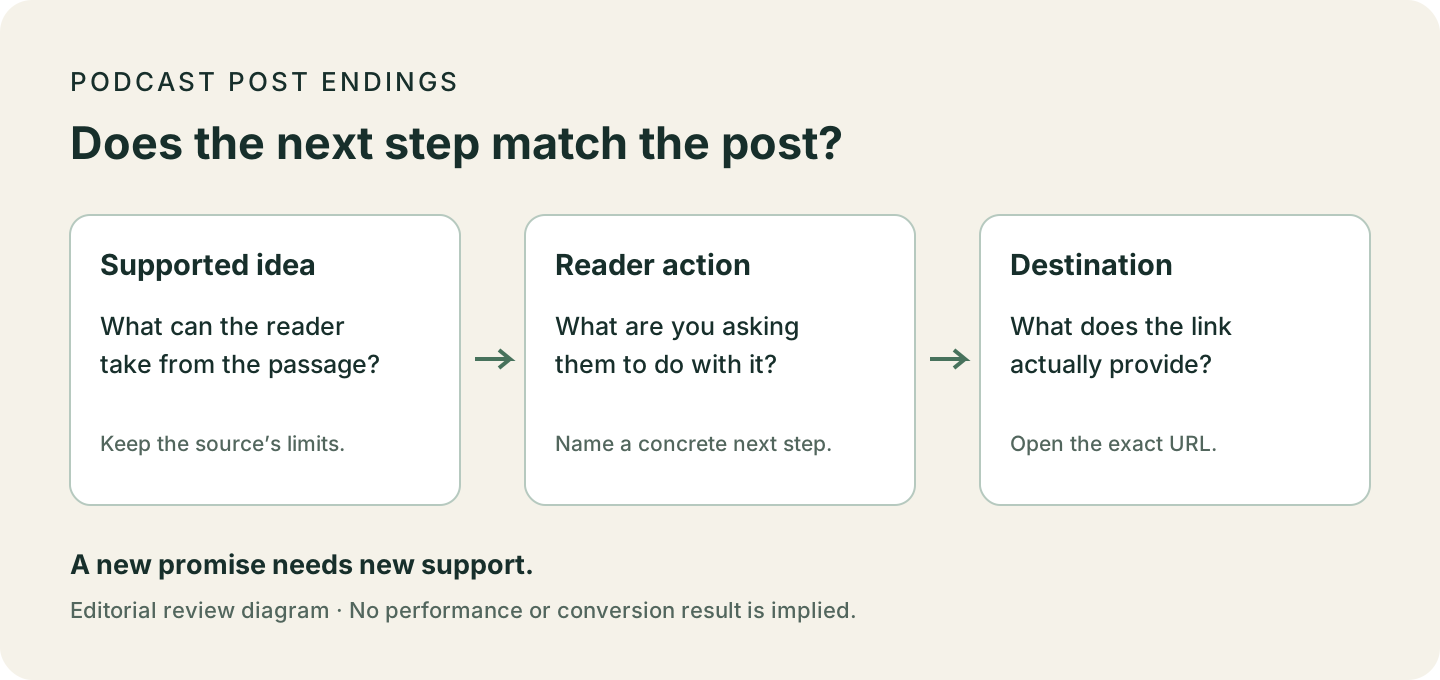
A source link and a call to action do different jobs
The source link lets a reader inspect the material behind your claim. The call to action asks the reader to respond to that claim. An episode link can serve both purposes when you explicitly invite the reader to inspect a particular exchange. A footer alone does not explain why to open it.
The CDC Clear Communication Index recommends telling the intended audience what to do with the information provided. Its examples include seeking more information and sharing information. We apply that communication principle to podcast posts; the CDC guidance is not evidence of social-platform performance. Source: CDC guidance on calls to action.
Choose a main request so the ending can be reviewed against a clear purpose. That is a writing constraint used in this guide, not a rule that every post must have exactly one link or question.
| Job | What an ending can ask | What the post must supply |
|---|---|---|
| Discuss | Invite a specific observation, choice, or counterexample. | Enough context to answer without pretending to know the full episode. |
| Practise | Suggest a bounded action the reader can adapt. | The action, its purpose, and any important condition. |
| Inspect the source | Name the source and the exchange worth checking. | A working link and a truthful passage locator. |
| Explore a product | Describe the next screen or resource accurately. | A real connection to the post and a checked destination; no implied guest endorsement. |
Start with a real exchange, then label your application
In Stanford’s Think Fast, Talk Smart interview with Alison Wood Brooks, published on 6 December 2022, Matt Abrahams asks about supporting or shifting a conversation topic. Brooks distinguishes passively staying on a topic from actively inviting someone to continue, and cautions that a simple stay-or-switch distinction leaves out intermediate moves. Source: Official interview and full transcript.
Locate Abrahams’s question about supporting and shifting choices, then read Brooks’s following answer. This review used that transcript passage and its surrounding small-talk discussion. No recording was played and no audio timing was verified.
The editorial application below asks a meeting host to notice how they keep a topic open. The meeting exercise and social-post wording are ours. The episode does not test these closing lines, and the guest has not endorsed this post.
Make the linked destination match the promise
W3C’s guidance on link purpose explains why readers need to understand where a link leads before following it. Apply that principle in a social post by naming the episode, worksheet, or demo beside its URL. Do not rely on an unexplained “here.” This is a writing application of web-accessibility guidance, not a claim that a social composer exposes the same markup controls. Source: W3C: link purpose in context.
Open the exact URL that will appear in the post. Check its title and content, and note whether access requires signing in. If you offer a worksheet, confirm a usable worksheet is there. If the page is a prepared demo, say so; do not promise to import the reader’s episode.
A reply request can also promise a destination: “comment and I will send the checklist” commits you to sending a real checklist. Use that request only when you have prepared the resource and can fulfil it. Do not introduce a delivery promise merely because the wording sounds persuasive.
Complete teaching post
A discussion ending with enough context to answer
An original, unpublished draft based on a transcript. The first-person application is illustrative; adapt it only if you endorse the proposal.
Keeping a conversation on one topic can be an active choice.

In the published transcript of Think Fast, Talk Smart, Alison Wood Brooks distinguishes passively staying on a topic from actively encouraging the other person to continue.

My proposed meeting check: when a useful point surfaces, notice whether my next turn invites more detail or simply moves the agenda along. I would use the question to notice my choices, not to keep every topic open indefinitely.

For people who host meetings: what tells you a topic deserves another question before you move on?

Source: Alison Wood Brooks with Matt Abrahams, Think Fast, Talk Smart, Stanford Graduate School of Business, 6 December 2022.
Episode: Listen Up: Why It’s Better to Be Interested than Interesting.
Text locator: the exchange about supporting or shifting a conversation topic. Transcript-only; recording not checked.
https://www.gsb.stanford.edu/insights/listen-why-its-better-be-interested-interesting
Choose the next step
Write the ending after deciding what the post supports
Write down the reader’s job
Name the person and the decision in this post. “People who host meetings, deciding when to stay with a topic” tells you which question to ask; “anyone interested in communication” does not. Keep the invitation open to different experiences.
Choose a response the post has earned
Decide whether you want a discussion, a small practice, a source check, or a product visit. If the body does not prepare the reader for that response, revise the body or choose a smaller request.
Separate your proposed action from the guest’s advice
Identify who owns the request. Use language such as “my proposed check” for an application you added. Do not attach the guest’s authority to an untested method, a purchase request, or a claim about expected results.
Make the action concrete enough to recognise
Replace “Thoughts?” with a question tied to the post’s decision, such as what would make a meeting host stay with a topic. A reader should know what sort of answer would be useful. Do not demand a personal story when a general observation can answer the question.
Inspect any destination, then read the whole post
Follow the exact link, check access and the promised material, and read the ending beside the opening. Remove any guarantee or delivery promise the post cannot support. Keep the source footer even when you mainly want readers to discuss the idea.
One source, different requests
Choose the ending by the response you want
The table below gives alternative editorial endings for the conversation-topic example. The endings are not measured variants or quotations. Adding all of them would leave the reader with competing requests.
| Reader task | Proposed ending | Use and boundary |
|---|---|---|
| Discussion | For people who host meetings: what tells you a topic deserves another question before you move on? | The question asks for a judgement tied to the post, rather than agreement with a universal rule. |
| Private practice | Before your next meeting, note a topic you may need to explore further and write a question that could invite useful detail. | Use when the purpose is preparation. This is the writer’s suggested exercise, not a method validated in the episode. |
| Read the source | Read the supporting-versus-shifting exchange in Stanford’s transcript, then compare it with the meeting example above. | Place the transcript URL beside the request. Do not call it an exact listening timestamp. |
| Product detour to reject | Use our tool and become a better listener today. | The claim promises a personal outcome the post has not established. A product invitation would need an accurately described resource and a clear reason to visit it. |
Editorial decision
“The ending should request a response the body has prepared the reader to give.”PodInk editorial recommendation
The discussion ending is the choice for the complete teaching post because its purpose is to invite readers to describe their own decision. The practice and source-reading endings remain alternatives. This editorial choice says nothing about which version would attract more clicks.
Keep the request optional and proportionate. An informative post may simply give the reader a useful source to inspect. A good closing line does not need a demand to like, follow, tag colleagues, and report back all at once.
After choosing the ending, review the full post and its source footer together. A clear request cannot compensate for a claim the source does not support.
Compare how the approved core changes in the LinkedIn workflow and the X workflow.
Closing-line review
Repair the request before testing its appeal
| Draft ending | Problem | Repair |
|---|---|---|
| “Thoughts?” | The reader must invent the discussion topic. | Ask what would change the decision described in the body. |
| “Try this and transform every conversation.” | The request adds an unsupported outcome and universal scope. | Name a small, optional practice without guaranteeing a result. |
| “Download the checklist” → homepage | The destination does not deliver the named resource. | Link the actual checklist or describe the page that really exists. |
| “The guest recommends our tool.” | The source has not established an endorsement. | Remove the attribution; explain any product invitation in the writer’s own voice. |
| “Tell us about your worst colleague.” | The invitation pulls the discussion toward identifiable people. | Ask about a general decision or behaviour without requiring names. |
- The ending has a clear reader and a response tied to the body.
- The request does not add a guarantee, invented result, or guest endorsement.
- Any proposed exercise is labelled as the writer’s application.
- The exact URL opens the resource named beside it, with access requirements checked.
- The source footer still identifies the episode and the passage inspected.
- The final wording and destination are reviewed together before publication.
Evidence limits
What this example establishes
- The worked example is transcript-only. No audio, voice, delivery, or precise media boundaries were checked.
- The post and alternative endings are original teaching drafts. None was posted, endorsed by the participants, or measured for engagement or conversion.
- The workflow is an editorial application of communication and link-purpose guidance, not a platform ranking rule.
- An accurate CTA cannot establish that a speaker’s underlying claim is true or that a proposed practice will work for every reader.
Human review remains necessary. No repurposing workflow can turn weak evidence into a strong claim.
FAQ
Frequently asked questions
Does every podcast social post need a question at the end?
No. Choose the ending by the task. A specific source-reading invitation or a bounded practice can fit an explanatory post better than a question. The request should help the reader use what the post actually supplies.
Can the episode link itself be the call to action?
Yes, when the wording tells the reader what to inspect and why. Name the episode or transcript and identify the relevant exchange. Keep transcript locators distinct from verified audio timestamps.
Should I put several requests into one ending?
Choose a primary response for this draft so the purpose is clear. Supporting links can remain. That is an editorial recommendation, not a claim about how a platform ranks posts.
Which ending gets the most engagement?
The ending examples have not been compared in a performance experiment. Editorial review can reject misleading or mismatched requests. Any performance conclusion would need a separate evaluation with a defined audience, outcome, and comparable posts.
Evidence
Sources and comparison pages
- Listen Up: Why It’s Better to Be Interested than InterestingStanford Graduate School of Business
- Calls to action for the primary audienceCDC Clear Communication Index
- Understanding link purpose in contextW3C Web Accessibility Initiative