
Write an honest opening
How to write a podcast social media hook without changing the claim
Write a podcast social media hook by naming a specific question, disagreement, or proposal that the rest of the post actually addresses. Keep the claim’s owner and limits intact. An opening about your proposed change should sound like a proposal, not a result the guest proved or an experience you never had.
Draft the body first, then check the opening against both the body and the selected source passage. The examples below show how to make that check. They are editorial teaching drafts, with no claim about clicks, reach, or platform ranking.
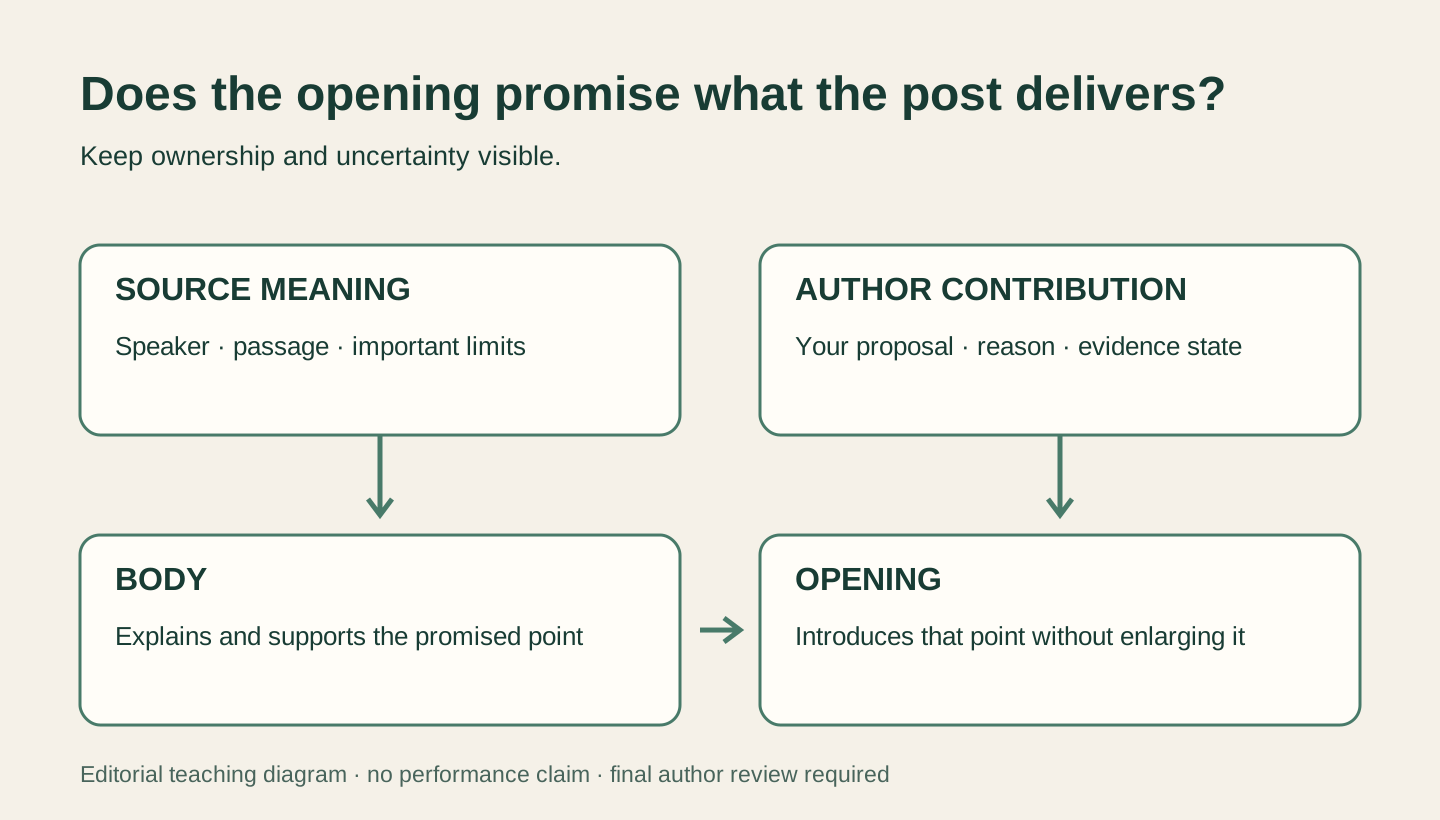
Make the first sentence a promise you can keep
A hook can be a clear statement. You do not need a mystery, a dramatic statistic, or a claim that everyone else is wrong. Pick the decision your reader faces and make the opening specific enough for the reader to recognize it.
In this guide, a promise means what a reasonable reader would expect the post to explain or support. An opening that announces a successful experiment needs a record of what was tested and what happened. An opening that proposes an edit needs the edit and the writer’s reason for proposing it.
SPJ’s Code of Ethics calls for accurate, fair reporting in context and for illustrations to be clearly labeled. We apply those principles here by labeling the constructed examples and separating source ideas from editorial suggestions. This is a writing review method, not a platform requirement. Source: SPJ: accuracy, context, and labeled illustrations.
| Rejected opening | Why it exceeds this evidence | Revision for this example |
|---|---|---|
| One listening trick fixes team conflict. | Claims a guaranteed outcome that neither this passage nor our example establishes. | Before recommending a change, I would ask what the other person thinks I am missing. |
| We changed our handoff and finally got everyone aligned. | Claims a completed project and result; no such experience was supplied. | I would add an unanswered-question field to our handoff note. |
| Kristin Hansen’s exact script for better team handoffs. | Assigns our invented wording and document layout to the guest. | A listening discussion prompted this handoff-note proposal. |
Read the source before borrowing its authority
The worked example draws on Kristin Hansen’s conversation with Matt Abrahams on Stanford GSB’s Think Fast, Talk Smart. In the Full Transcript, locate Abrahams’s question about practices that leaders, managers, and employees can use to listen better. Read Hansen’s reply and the host’s response before the discussion moves to her course. Source: Official episode and transcript.
Hansen connects better listening with intent, openness to another person’s perspective, and genuine questions. She cautions against an easy fix. That supports a restrained account of her listening advice; it does not establish a tested handoff-note method. Source: Selected reply, with surrounding context.
The passage and surrounding exchange were reviewed as text. Audio was not checked, and no timestamp was inferred. All openings and the handoff proposal in this guide are our constructed teaching examples, not Hansen’s words or a record of someone’s results.
Give the reader a reason to continue without hiding the point
For a team lead preparing a handoff, “I would add an unanswered-question field” names an action worth evaluating. The following sentences can explain where the field belongs, why the writer wants it, and what remains uncertain. A vague promise to transform communication leaves those responsibilities undefined.
A question works when the post answers or explores it. “What am I missing before I recommend a change?” invites a particular review step. “Why does nobody listen?” assigns blame to an unspecified group and needs a different argument. Choose the question your actual draft can address.
Keep a qualification in the opening when removing it changes the claim. “I would try” and “we achieved” describe different evidence states. Do not postpone that distinction until the final disclaimer: a reader may only encounter the opening.
Copyable review brief
Put the hook and its evidence beside each other
Fill this in before selecting the final opening. Keep revisions as separate versions so the author can see whether only wording changed or the claim changed too.
READER AND DECISION: Who is reading, and what are they deciding?
SOURCE: Episode link, speaker, passage locator, surrounding context.
SOURCE CLAIM: A brief paraphrase and any condition that matters.
AUTHOR CONTRIBUTION: The view, question, or proposal the author endorses.
BODY: The complete draft that will follow the opening.
HOOK: The proposed first sentence.
PROMISE: What would a reader expect this sentence to establish?
BODY SUPPORT: Point to the sentences that deliver that promise.
OWNERSHIP CHECK: Guest idea / author proposal / verified experience.
REVIEW DECISION: Keep / revise / hold; reason and exact draft version.
AUTHOR REVIEWER: Name to be filled by the publishing author or editor.
EVIDENCE LIMIT: Transcript-only if audio has not been checked.
Draft from the body
Check the opening before polishing it
Write the point and body
Describe the change, question, or interpretation you want the reader to consider. Write enough of the post to see what support and limitations it contains. The body shows what the opening can honestly promise.
Choose an opening that names the task
Try a source-led statement, a question, or your own proposal. Compare what each opening promises the reader. Use the variant that introduces the actual body.
Check ownership and certainty
Underline who appears to be making the claim. Compare verbs such as suggests, would try, tested, and proved. Remove invented experience, guaranteed outcomes, or guest endorsement from the opening.
Read the opening in isolation, then with the body
Read just the opening and ask who did what, and how certain the claim sounds. In the full post, each promised explanation should appear. If it does not, narrow the opening or add support you can actually verify.
A complete teaching post
A proposed handoff note, with an opening that fits
The following variants and complete post are original teaching examples for a team lead. They are not captured model outputs or published posts. The proposed field has not been tested.
| Opening | What it promises | What the body must deliver |
|---|---|---|
| Source-led: A listening discussion prompted me to rethink our handoff note. | A source connection followed by the writer’s response. | Identify the discussion, then explain the proposed document change without claiming the guest prescribed it. |
| Question-led: What am I missing before I recommend a change? | A question applied to a concrete situation. | Explain how the proposed handoff field would make the question visible; do not promise that it resolves disagreement. |
| Proposal-led: I would add an unanswered-question field to our handoff note. | A specific edit the author wants to consider. | Show the field and the author’s reason for it. Keep its untested status clear. |
Editorial principle
“The hook should introduce the claim you can support, with the owner and uncertainty still attached.”PodInk editorial principle, not a guest quotation
Teaching post begins:
I would add an unanswered-question field to our handoff note.
In Think Fast, Talk Smart, Kristin Hansen connects listening with intent and genuine questions. That discussion prompted me to consider how a handoff document could leave room for something I have not understood. Source: Hansen’s listening discussion.
My proposal is to place a field beside the recommendation: “What am I missing before I recommend a change?” I would leave the field open for the person receiving the handoff to answer, rather than fill it with my guess about their view.
The reason is simple: I want the note to show an unresolved question alongside the proposed action. A visible blank would let the recipient see what I am asking them to address.
The wording and layout are my suggestion, not Hansen’s method. They have not been tested here and do not guarantee agreement. If a colleague has already raised a concern, recording that concern accurately matters more than adding a new empty field.
Teaching post ends. The opening promises a document proposal, and the body supplies one. The source provides a starting idea; the author owns the wording, application, and reason for considering it.
Changing this opening to a success story would require new evidence and a new author review. A stronger opening is not worth an experience you cannot honestly claim.
Compare how the approved core changes in the LinkedIn workflow and the X workflow.
Review the promise
Decide what to keep, revise, or hold
| Decision | Evidence in the draft | Action |
|---|---|---|
| Keep for author review | The opening names a proposal and the body explains that proposal with its limits. | Review the exact full post, including attribution and the author’s endorsement. |
| Revise the opening | The hook implies a guarantee, a universal rule, or an experience the body does not support. | Replace the unsupported promise with the actual question or proposal. |
| Hold the claim | The author wants to keep a result or quotation that has not been verified. | Obtain the missing evidence or remove that claim before publication. |
- The opening names a concrete issue for the intended reader.
- The body delivers the explanation promised by the opening.
- Source ideas and the author’s application have distinct owners.
- The hook preserves conditions that change the meaning.
- First-person experience is supplied and endorsed by the author, not invented.
- The final hook and body are reviewed together as one version.
Evidence boundaries
What this example does not establish
- The source-to-hook review checks editorial fit; it does not measure engagement, click-through rate, search ranking, or AI citations.
- The source review is transcript-only. Quoted audio, delivery, and exact clip boundaries remain unverified.
- The handoff note and all alternative hooks are constructed examples with no measured outcome.
- A source link does not establish that the guest endorses a later application.
- The publishing author still needs to approve their own position and final wording.
Human review remains necessary. No repurposing workflow can turn weak evidence into a strong claim.
FAQ
Frequently asked questions
Does a podcast social media hook need to be a question?
No. A specific statement or proposal can introduce the post. Choose a form that matches the reader’s task and the content that follows.
Can I remove a caveat to make the opening shorter?
Only if removing it leaves the claim accurate. Conditions that change scope, certainty, or ownership belong in the opening or directly beside the claim; a distant disclaimer does not repair a misleading first sentence.
Can I use the guest’s idea as a first-person hook?
You can introduce your own reaction or proposal in first person, then attribute the source idea. Do not imply you performed an experiment, invented the source’s idea, or used the guest’s exact words unless that is supported.
How do I know which hook will perform best?
The hook examples in this guide have not been evaluated for performance. Editorial review can reject an unsupported opening; choosing between accurate variants for engagement would require a separate, appropriately designed evaluation.
Evidence
Sources and comparison pages
- “Are You Listening?” How to Stay Open and Curious to Other People’s IdeasStanford Graduate School of Business
- SPJ’s Code of EthicsSociety of Professional Journalists