
Choose the writing task
AI podcast summary vs source-grounded post: choose the deliverable
Choose an AI podcast summary when the reader needs an account of what the source says. Choose a source-grounded position post when the reader needs your interpretation or recommendation about a specific decision. The post needs an author’s position and supporting reasons; changing the summary’s tone does not provide those inputs.
AI describes how a draft was produced. Source-grounded describes how its claims connect to evidence. A summary can be source-grounded, and an author-led post can be AI-assisted. This guide compares two writing jobs, not two competing technologies or levels of quality.
Agree on the reader’s question and the writer’s responsibility
A recap answers what the selected material says. A position-led post answers what the writer wants a particular reader to consider or do, and why. Both require accurate source representation. The difference is whether the assignment also asks the author to make and defend a contribution.
UNC’s Writing Center distinguishes restating material from analysis that develops the writer’s own argument. It also treats summary as useful when the assignment calls for it. The comparison here adapts that distinction to a podcast writing brief; it is an editorial framework, not a rule for social platforms. Source: UNC: summary and analysis.
| Brief item | Podcast summary | Source-grounded position post |
|---|---|---|
| Reader’s question | What does this episode or selected section cover? | What does this writer think the source means for my situation? |
| Promise | Represent the declared source scope fairly. | Offer a clearly owned interpretation, recommendation, or disagreement. |
| Required inputs | The source, its boundaries, intended audience, and level of detail. | The source plus the author’s position, audience decision, reasons, and relevant limits. |
| Role of evidence | Support the account and preserve meaning within the chosen scope. | Support the source account and any factual premises behind the added position. |
| Coverage | Choose material according to the promised recap scope. | Select relevant support without implying that the whole episode endorses the post. |
| Acceptance | The reader can understand the selected material without confusing it with the writer’s advice. | A reader can distinguish the source from the author’s contribution and evaluate both. |
Choose a summary when you have no position to publish
If the brief only asks what a guest said, deliver a summary. You can finish that job without inventing a personal lesson to make it feel worthwhile. A team reference note, an episode overview, or a listening invitation may be the complete deliverable.
If the brief asks for your recommendation, supply the recommendation before requesting a final draft. A drafting assistant may suggest possibilities, but the publishing author must decide which view they actually hold. First-person wording, a sharper hook, or a closing question does not turn a recap into an owned position.
You can also commission both outputs. Keep the recap as a named section and put the author’s response under a separate label. That creates two promises to review; the source summary’s approval does not automatically approve the added advice.
| Request | Choose | Specify before drafting |
|---|---|---|
| Help my colleague understand the interview segment. | A section summary. | The selected passage and what detail the colleague needs. |
| Explain what I would change in our interview brief. | An author-led post. | The actual proposed change, its reasons, and what has not been tested. |
| Share the episode with a useful description. | A recap or listening invitation. | Why this audience might open it; no invented personal experience. |
| Summarize the idea, then challenge its application. | A labeled recap and response. | Where the source account ends and the author’s challenge begins. |
Use the same passage for two different briefs
The paired examples use Stanford GSB’s March 12, 2021 interview with Debra Schifrin, hosted by Matt Abrahams. In the Full Transcript, search for best practices and read the ensuing discussion of reporting and coaching, between the leadership advice and closing-question technique. Source: Official episode and full transcript.
We read the complete transcript; the summary covers the selected section only. No time markers appear for it. The recording was not checked.
Both drafts are original teaching examples written for this guide. They are not outputs captured from a summarizer, a model comparison, published social posts, or text written by the guest. The proposed customer-interview brief is the example author’s own choice.
Copyable paired briefs
Commission either output with these filled briefs
Replace the source, reader, and proposed change for your assignment. If you request both outputs, keep separate labels and acceptance criteria so approval of the recap does not quietly approve the advice.
BRIEF A — SECTION SUMMARY
Reader: A colleague reviewing interview-preparation advice.
Source scope: The selected discussion of interview preparation and follow-ups.
Output: A short account of that discussion with an episode link.
Author contribution: No added recommendation or claimed experience.
Accept when: The account fits this section and is not labeled a whole-episode overview.

BRIEF B — AUTHOR-LED POST
Reader: Someone designing a customer-interview brief.
Position to consider: Separate required prompts from space for follow-ups.
Author contribution: A proposed document layout, not an account of a completed project.
Evidence boundary: Attribute the source idea; do not claim the proposed layout improves interview results.
Accept when: The source account, author’s proposal, and untested outcome are distinguishable.

SHARED HANDOFF
Source URL: https://www.gsb.stanford.edu/insights/question-everything-why-curiosity-communications-secret-weapon
Text locator: Full Transcript; search best practices. Read Schifrin’s reporting/coaching replies after the leadership advice and before the closing-question technique.
Final draft version / reviewer: to be filled by the publishing author or editor.
Evidence status: Transcript-only; no recording check or customer-interview test performed.
Publication status: Examples for review; no social publication approved.
Commission the right output
Write the brief before choosing the drafting tool
Name the reader’s task
Write whether the reader needs to understand the source, evaluate your view, or read both. Avoid choosing the deliverable solely because the destination is LinkedIn, a newsletter, or an episode page.
Specify what the author adds
For a recap, define scope and useful detail. For a position post, write the view you are willing to own and the reasons for it. If you do not yet have that view, request a summary or exploratory notes instead of a final first-person post.
Set the acceptance criteria
Agree on the source link, evidence boundaries, and reviewer. Ask whether the draft delivers the promised account or position. A changed hook, a personal anecdote, or a new claim may change what needs approval.
Paired teaching drafts
A section summary and a complete author-led post
Read both drafts below with their briefs. The summary is complete for its narrow scope. The post adds a specific proposal; it is not an upgraded version of the same assignment.
| Responsibility | Section summary | Author-led post |
|---|---|---|
| Source scope | Account of the selected discussion. | The selected discussion supplies a starting idea, not the whole thesis. |
| Author addition | Selection and wording, without a new recommendation. | A proposed customer-interview document layout, clearly owned by the writer. |
| Unsupported leap to avoid | Claiming to summarize the full episode. | Claiming the new layout has produced better evidence or is the guest’s prescribed method. |
Editorial principle
“Agree on the job before asking whether the draft is good. An accurate recap can still be the wrong delivery for a brief that asks for your position.”PodInk editorial principle, not a guest quotation
Teaching draft A — section summary:
Debra Schifrin describes preparing essential interview questions while allowing unexpected answers to guide follow-ups. She emphasizes curiosity about the other person’s perspective rather than staying inside the interviewer’s frame of reference. Source: Selected transcript discussion.
Teaching draft B — author-led post:
I would separate required prompts from follow-up space in a customer-interview brief.
In Think Fast, Talk Smart, Debra Schifrin describes preparing essential questions while leaving room to pursue unexpected answers. That distinction prompts me to rethink the layout of an interview brief. Source: Same transcript discussion.
My proposal: place the decision each required question serves beside the prompt, and leave a blank area for follow-ups. This layout is my suggestion, not a method Schifrin prescribes. It has not been tested here; a revised brief would not by itself establish that the answers are reliable customer evidence.
End of teaching drafts. Draft A fulfills a request for a source account without adding an original thesis. Draft B also needs the publishing author to endorse the proposed change. The episode link and first-person wording do not supply that endorsement.
Keep the selected brief beside the draft. When an editor asks for more opinion or broader coverage, you can tell whether the draft needs a correction or the assignment has changed.
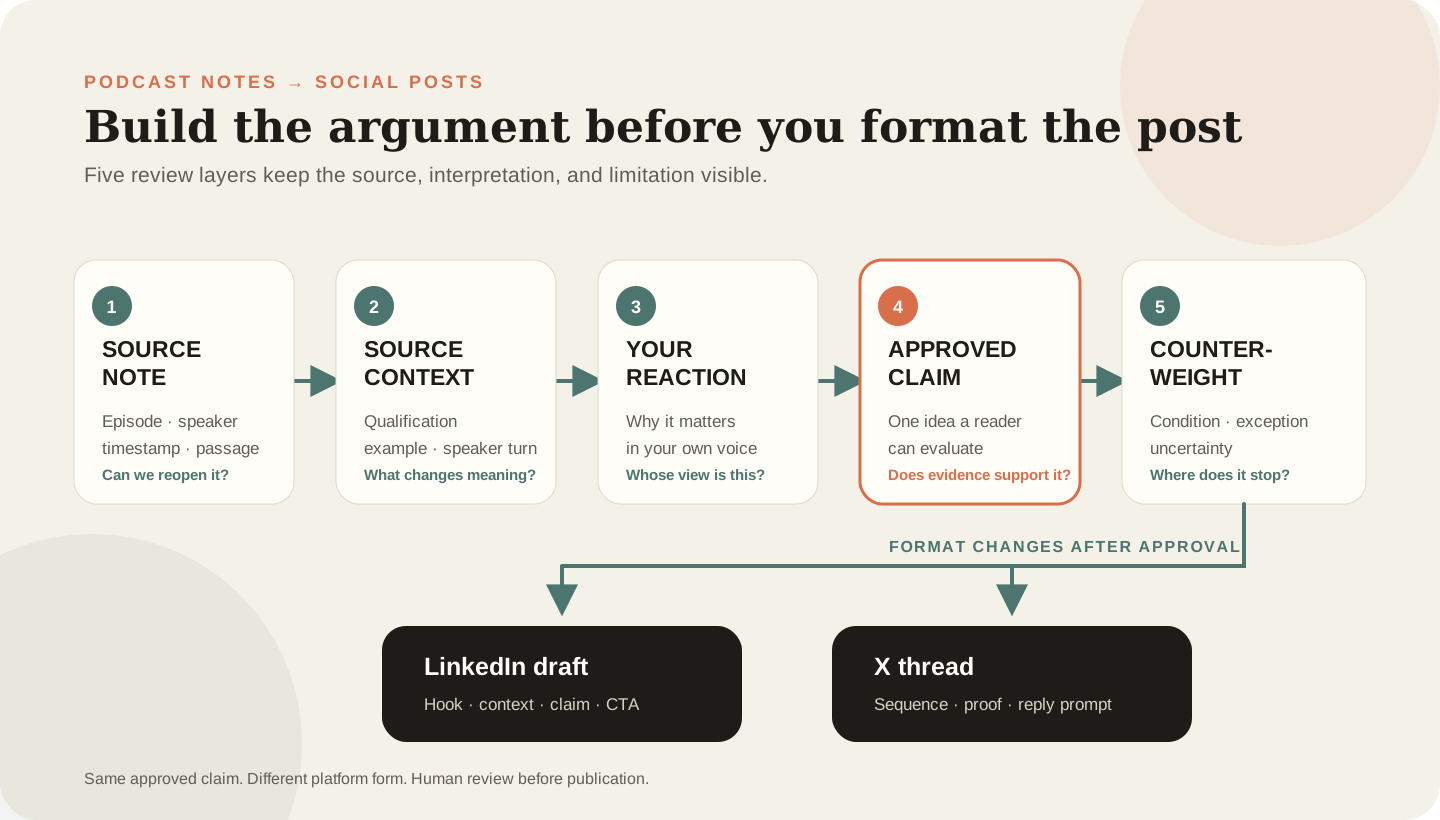
Compare how the approved core changes in the LinkedIn workflow and the X workflow.
Accept the right deliverable
Judge the draft against the agreed job
| Decision | Reason | Next step |
|---|---|---|
| Accept for editorial approval | The output fulfills the declared brief and its source responsibilities. | Review the exact version and record the approving author or editor. |
| Return for the missing contribution | A position brief received only a recap, or first-person text contains no author-approved view. | Ask the author for the position they want to defend, or agree to deliver a summary instead. |
| Narrow or hold | The account misrepresents scope, or an added claim lacks support. | Resolve the evidence problem; changing the deliverable’s label alone does not fix it. |
- The reader’s task is explicit before the writer or tool starts drafting.
- Summary scope is clear; a section recap is not presented as a whole-episode account.
- A position post contains a contribution the publishing author actually endorses.
- Source material and author additions are distinguishable in the finished draft.
- A proposal is not presented as a tested result or a method endorsed by the guest.
- The final acceptance decision refers to the agreed brief and exact draft version.
Evidence and use limits
What these examples establish
- Source-grounded is an editorial standard in this guide, not a product certification or a guarantee that every claim is true.
- The paired examples rely on the published transcript only. No recording was reviewed, and no timestamps or clip boundaries were invented.
- The proposed customer-interview layout is an original teaching suggestion with no measured outcome or claimed personal experience.
- The comparison covers recaps and position-led posts. Social posts may serve other purposes, including announcements or listening invitations.
- No model, platform ranking system, engagement result, or publishing workflow was benchmarked. Choosing one deliverable does not establish superior performance.
Human review remains necessary. No repurposing workflow can turn weak evidence into a strong claim.
FAQ
Frequently asked questions
Can an AI podcast summary also be source-grounded?
Yes. AI-assisted describes how it was drafted; source-grounded describes its connection to evidence. A checked summary can meet that standard without adding the writer’s personal argument.
Does a source-grounded post have to disagree with the guest?
No. The author may agree, apply, qualify, or challenge an idea. What matters is an identifiable contribution and the reasons for it, with the source account kept accurate.
Can I turn a summary into a post by adding a hook?
A hook may help introduce a recap. If you promised an author’s position, the draft also needs that position and its support. Formatting and first-person language cannot substitute for an author-approved contribution.
What should I request if I am still deciding what I think?
Request a scoped summary or exploratory notes. Review the source, then decide whether you have an interpretation or recommendation to publish. There is no need to manufacture a stance to finish the assignment.
Evidence
Sources and comparison pages
- Question Everything: Why Curiosity Is Communication’s Secret WeaponStanford Graduate School of Business
- Summary: Using it WiselyUNC Writing Center