Podcast guest sharing
Podcast guest promotion kit: copy, links and asset status
A podcast guest promotion kit is a small handoff with an episode link, optional sharing copy and any media the guest is actually cleared to use. Its purpose is to let the guest review a specific message without reconstructing the episode or guessing which files are ready.
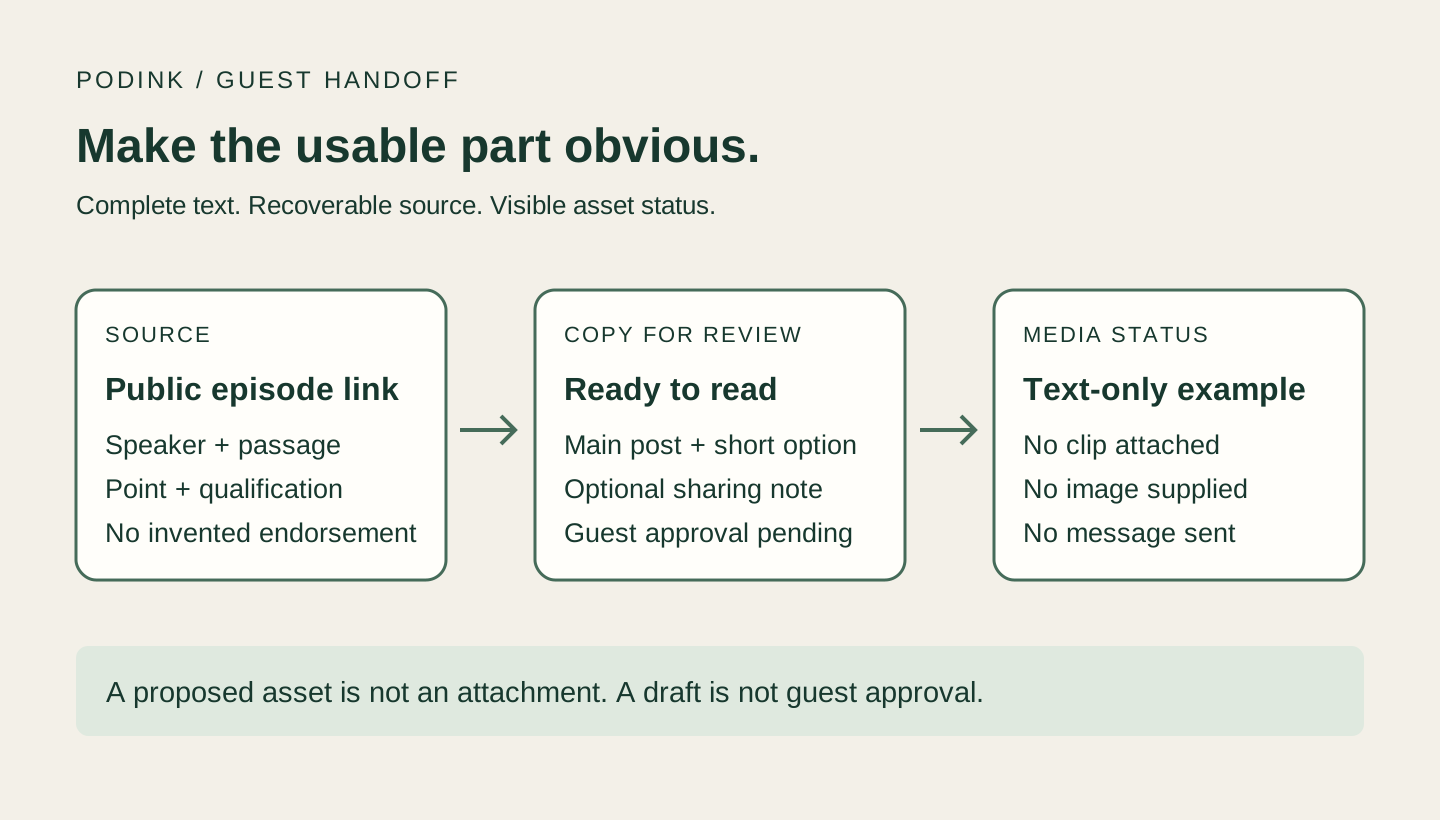
Keep the kit focused on a single supported idea. Include complete text, the source behind it and a plain status for each asset. An attractive folder of unfinished clips is still an editing assignment. Below is a text-only worked example based on a public episode transcript, followed by a reusable handoff template.
What belongs in the guest-facing handoff?
The Berkeley Advanced Media Institute recommends preparing guests for promotion and providing prewritten social or email language. Treat that as a way to reduce the work of composing a post, not as evidence that a guest will share it or deliver a particular audience. Source: Berkeley Advanced Media Institute: involve your guests.
A writing brief tells a creator what to produce. A publication checklist coordinates your own release. The guest kit is the outward-facing result: copy someone can inspect, links they can open and a clear statement of what they may use. Keep internal editing instructions out of the proposed public post.
| Item | What to provide | When to hold it |
|---|---|---|
| Episode destination | The public episode page, title, host and guest names. Open the link before delivery. | The page is private, points to a preview or names the wrong episode. |
| Sharing text | A complete post and a shorter alternative, each tied to the same source point. | The copy changes the guest’s position, invents endorsement or needs missing context. |
| Media, if included | An identifiable file version, intended placement and caption or image-description status. | The file is absent, permission is unresolved or the actual output has not been reviewed. |
| Handoff note | Say what is included, what is optional and how to request a correction. | The note promises an attachment, publication date or approval you do not have. |
Copy the text into the kit, then make the limits visible
Use third-person copy unless the guest has chosen and approved a first-person version. A producer cannot decide that the guest is excited, proud or recommending the show. Leave social handles out until the guest’s preferred account is verified.
If media is not ready, a text-only handoff can still be reviewed. Do not list a hypothetical video filename as a download. If the guest requested a video, state that the kit is incomplete for that request and keep the video item open.
Ask for corrections without imposing a sharing obligation. A useful note names the episode, explains what is supplied and gives the guest room to edit or decline. No message in this guide was sent to the people in the example.
Reusable guest handoff
A guest promotion kit record
Replace the fields for your own episode. This record is an internal companion to the complete public copy; do not send empty placeholders as the finished kit.
Episode title and public URL:
Host and guest names; verified account tags, if wanted:
Recipient and agreed channel or format:
Source locator and supported point:
Qualification that must survive shortening:
Main sharing copy, including link:
Short alternative, including link:
Media actually attached; exact filenames and versions:
Permission, caption and output-review status for each asset:
Missing items and what remains open:
Guest-facing note; sharing is optional:
Approval owner, approved version and delivery status:
Guest handoff method
How to prepare a podcast guest promotion kit
Agree on the scope of the handoff
Record the intended guest, episode and requested channel or format. If preferences are unknown, prepare a neutral text option for review. Do not assume the guest wants a video or has agreed to publish.
Select one point and its qualification
Read the surrounding source passage. Write down the supported point, the condition that limits it and a locator a reviewer can reopen. If you cannot resolve a statement from the available source, choose another point.
Write complete sharing options
Provide a main post and a shorter version with speaker names and the public episode link. Keep editorial framing distinct from direct quotation. Avoid first-person guest language unless that person has approved it.
Separate text from media status
List only real attachments as attachments. Mark absent media as not created, and keep permission or playback checks open until they happen. For a video, identify the exact export and how captions are supplied.
Review the handoff as the recipient
Open the destination link, read the text without internal notes, and check every filename against the actual attachment. Confirm that the note does not promise missing material. Invite corrections and make sharing optional.
Send only the agreed version
Obtain the necessary approval for your real episode, then use the verified recipient and agreed channel. If text or media changes after review, identify the replacement clearly and retire the superseded attachment. This guide does not send messages or publish posts.
Worked editorial example
A text-only kit for a Think Fast Talk Smart episode
Independent teaching example using episode 169, “Don’t Be a ZQ: Make Your Conversations Count,” with host Matt Abrahams and guest Alison Wood Brooks. PodInk has no affiliation with this episode. These are proposed editorial paraphrases, not guest-approved copy.
In the official transcript at [00:03:41]–[00:05:05], Brooks describes a topic pyramid: conversation can move from broadly shared topics toward more personal or shared ground. She also explains that reaching the top is not always the goal. Keep that qualification when preparing a short post. Source: Think Fast Talk Smart, episode 169: official transcript.
The transcript markers locate text in the published transcript. No audio was auditioned for this example, and they are not verified media cut points. The handoff therefore includes text and a public source link, with no clip or quotation attributed to an audio review.
| Kit item | Status or purpose | Content |
|---|---|---|
| Episode link | Public source; opened during research | https://www.fastersmarter.io/169-dont-be-a-zq-make-your-conversations-count/Source: Think Fast Talk Smart, episode 169: official transcript |
| Main sharing copy | Complete editorial draft; guest approval pending | Does every conversation need to go deeper? In Think Fast Talk Smart, Alison Wood Brooks joins Matt Abrahams to discuss how topics can move from common ground to more personal connections—and why the situation matters. One point to consider: a brief interaction does not have to become a deep conversation. Listen or read the transcript: https://www.fastersmarter.io/169-dont-be-a-zq-make-your-conversations-count/ |
| Short alternative | Same idea; no unsupported guest endorsement | A deeper conversation is not always the right goal. Alison Wood Brooks and Matt Abrahams discuss choosing topics that fit the interaction on Think Fast Talk Smart. Episode and transcript: https://www.fastersmarter.io/169-dont-be-a-zq-make-your-conversations-count/ |
| Handoff note | Hypothetical producer note; not sent | Optional sharing copy for “Don’t Be a ZQ: Make Your Conversations Count” is below, along with the public episode link. It focuses on choosing conversational depth to fit the situation. Please edit the wording or flag any misrepresentation; sharing is optional. This example contains text only. No video, image, approval or scheduled post is included. |
| Media | Not created; not attached | No clip, audiogram, thumbnail or quote card is supplied. A future media version needs its own source review, permissions and output checks. |
The useful boundary
“A guest should be able to tell what is usable, what is proposed and what is missing without opening another task list.”PodInk editorial takeaway
The post opens with an editorial question, rather than presenting it as the guest’s exact words. It names both speakers and links to the original episode. The qualification about conversational depth survives in both versions, so the short option does not turn a context-dependent idea into a universal instruction.
The note does not pretend to be an actual exchange with Brooks or Abrahams. It supplies a complete example of the handoff language a producer could adapt for their own guest. Before sending a real kit, replace the example episode and confirm the recipient, permissions and actual attachments.
The guest kit above is a finished text example for review, not a record of guest participation, sharing results or media production.
Compare how the approved core changes in the LinkedIn workflow and the X workflow.
Before delivery
Check what the guest will actually receive
| Check | Ready evidence | If unresolved |
|---|---|---|
| Source and identity | Names and public episode link match the source; the chosen point retains its qualification. | Correct the text or hold the disputed point. |
| Voice and endorsement | The text makes no unapproved first-person claim on behalf of the guest. | Use neutral third-person copy or request a revision. |
| Attachments | Every claimed attachment exists and has an explicit review status. | Remove the promise of an attachment; do not silently substitute a preview. |
| Recipient and permission | The intended recipient and allowed use of included media are confirmed. | Keep the kit as a local draft until the missing decision is made. |
- The episode link opens the intended public source.
- Both sharing options stand alone and preserve the same qualification.
- The guest’s name is accurate; unverified account tags are omitted.
- No first-person statement, direct quote or endorsement has been invented.
- The note accurately describes the included text and media.
- Uncreated assets, audio checks and permissions remain visibly pending.
Evidence and approval boundaries
What this example does not establish
- The worked example uses a public transcript, not an auditioned recording. Its text timestamps are not confirmed video boundaries.
- The example is independent editorial work. No guest approval, affiliation, contact or sharing outcome is claimed.
- No media files or platform upload tests were produced for this text-only kit.
- A public episode page does not by itself grant permission to reuse audio, video, artwork or a guest’s likeness.
- PodInk’s source-review workflow can inform the writing; this page does not claim a built-in guest-kit generator or automatic delivery feature.
Human review remains necessary. No repurposing workflow can turn weak evidence into a strong claim.
FAQ
Frequently asked questions
What is a podcast guest promotion kit?
A podcast guest promotion kit is a guest-facing handoff with a public episode link, optional sharing copy and any approved media that is actually included. It should make unfinished or missing assets easy to distinguish from material ready to use.
Can I send a text-only kit?
Yes, if that fits the agreed scope. Supply usable copy and the source link, and say explicitly that no media is attached. A text-only kit does not fulfill a request for a finished video.
Should the post be written in the guest’s voice?
Use third-person copy unless the guest has approved a first-person version. Do not invent personal reactions, endorsements or claims about recording the episode.
When should I send it?
Agree on timing with the guest and distinguish advance review from a live release. Before a live-sharing handoff, verify the public destination and actual attachments. An embargoed preview needs explicit handling instructions.
Does a guest kit guarantee shares or more listeners?
No. It can reduce the work of composing a post, but the guest may edit, decline or choose another time. This guide reports no sharing rate, audience lift or customer result.
Evidence
Sources and comparison pages
- 169. Don’t Be a ZQ: Make Your Conversations CountThink Fast Talk Smart
- 16 Ways to Promote Your PodcastBerkeley Advanced Media Institute
- How PodInk keeps podcast posts grounded in sourcesPodInk