
Check the words after the design
How to make a podcast quote card you can check
To make a podcast quote card, verify the passage and speaker before designing it. Keep the wording, necessary context and source credit together, then inspect the exported image at its intended display size. Hand over that exact file with its text alternative, accompanying post and working source link.
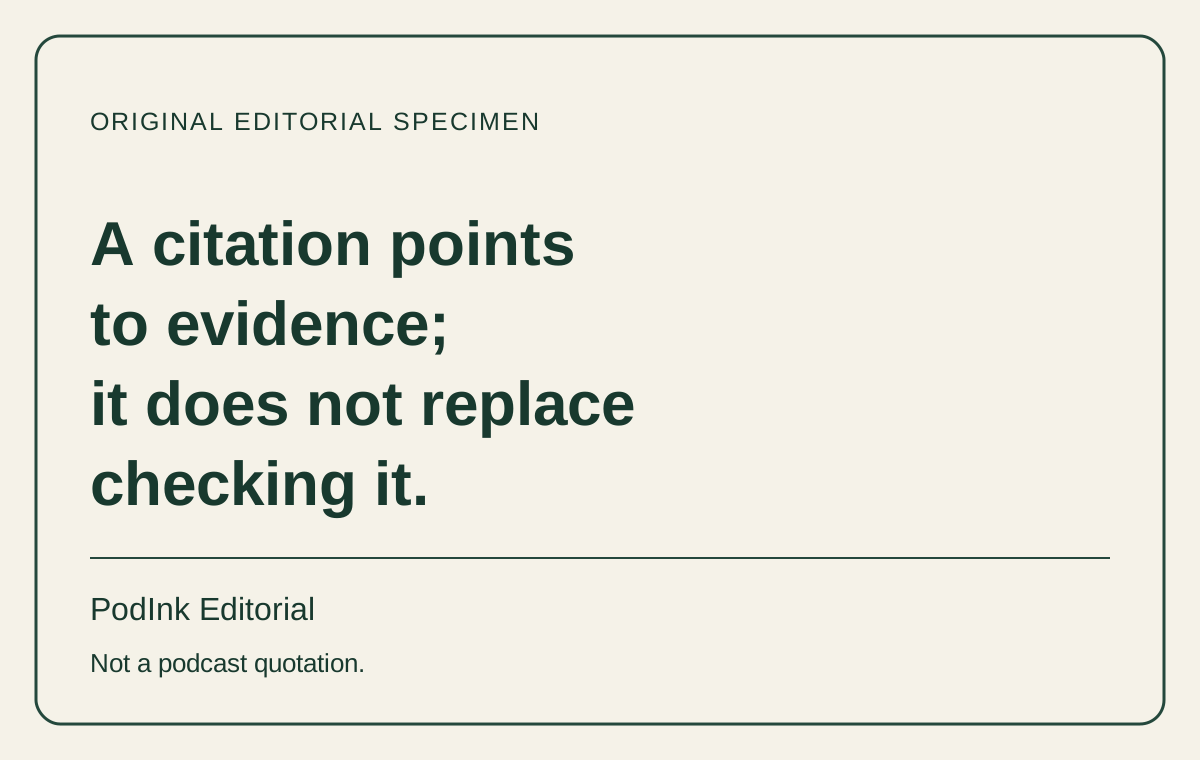
The quote-card checklist covers the final asset review. Its specimen uses original PodInk editorial wording, not a quotation from a guest. The blank handoff record shows what a real episode card would still need before approval.
Choose the wording before fitting the box
A direct quote and a paraphrase need different labels. If you rewrite the speaker’s wording, label the result as a paraphrase and remove quotation marks. Keep the underlying source available in either case.
AP’s quotation standards reject edits that change meaning and warn against taking words out of context. Those are AP’s editorial rules, not a universal license to shorten a podcast passage. Check the policy you are publishing under before using an ellipsis or adding a word. Source: AP quotation standards.
For a real episode, save the surrounding passage and identify the speaker. Record whether you checked a transcript, the recording, or both. If the wording cannot fit legibly with its essential condition, choose a shorter faithful passage or use a text post. Shrinking the condition into an unreadable footer does not preserve usable context.
Make the card’s source identity survive a screenshot
Keep enough credit on the image to identify whose words they are. Put the usable episode or transcript link in accompanying post text, where readers can open it. A URL drawn into an image is not itself a clickable source link.
AP says its graphics carry source credit and should not distort information to suit the visual design. For this workflow, we apply that principle by checking the credit after export, including any crop used for the final post. Source: AP graphics standards.
Our specimen credits PodInk Editorial and explicitly says it is not a podcast quotation. Replacing that footer with a guest’s name would invent an attribution. The typography could stay identical while the meaning became wrong.
Check readable text and provide a written equivalent
Inspect the final image at the size readers will see, including the credit line. If the card needs enlargement to reveal a condition or speaker name, revise the layout. Open the actual export; the design editor’s zoom level is not the publishing preview.
W3C recommends real styled text over images of text on the web because readers can resize it and adjust its presentation. When text must be an image, its alternative should carry the same wording. Keep a selectable text version with the card, and use the destination platform’s image-description field when available. Source: W3C Images of Text.
W3C’s minimum-contrast criterion uses 4.5:1 for ordinary text and images of text, with a 3:1 exception for large text. Use this as a reference when checking the actual foreground and background. A color calculation alone does not establish that the exported card or a social platform is accessible. Source: W3C contrast minimum.
Approve the file that will actually be attached
Review the card together with its image description and post copy. Save the reviewed filename or version with the source note. A new crop, changed line break or rewritten footer should reopen the affected checks.
If the publisher receives several exports, identify which one is approved and which are obsolete. Record the filename beside the approval so the publisher can identify the reviewed image, credit line and accompanying text.
Copyable asset record
Hand over a card with its source and review state
Use the filled lines only for the specimen displayed here. For a podcast excerpt, replace them with checked episode details; do not invent a source to complete the form.
FILLED SPECIMEN RECORD
Asset: podcast-quote-card-specimen.svg
Owner: PodInk Editorial
Wording: A citation points to evidence; it does not replace checking it.
Origin: Original editorial sentence in this guide; no episode or speaker.
Image description: Original editorial specimen. A citation points to evidence; it does not replace checking it. PodInk Editorial. Not a podcast quotation.
Post copy: This is our reminder to reopen a source before reusing its words. It is editorial advice, not a guest quotation.
Social publication: Not performed.

BLANK PODCAST CARD RECORD
Final asset filename / version:
Exact card wording:
Direct quote / paraphrase / author interpretation:
Speaker / show / episode:
Working source URL:
Checked passage and surrounding context:
Recording locator if verified / otherwise transcript locator:
Transcript checked / recording checked / unresolved:
Necessary condition retained on the card:
Visible credit line:
Accompanying post and source link:
Text alternative for this exact image:
Export size and destination preview checked:
Contrast check method / colors / result:
Changes since the last review:
Reviewer / decision / unresolved items:
From source to final file
Review the card in this order
Save the source note
Copy the passage and its surrounding context into your review note. Resolve the speaker and wording before designing. When only a transcript is available, keep that evidence limit visible in the record.
Build the card around the complete claim
Place the wording, necessary condition and source identity in the layout. If they do not fit, change the layout or choose a narrower passage; do not silently remove the part that limits the claim.
Export and read the actual image
Check the exported file against the source note, word by word. Look for missing words, changed punctuation, clipped credit and unreadable text. Recheck at the intended display size.
Prepare its accompanying text
Write the image description against the finished asset. Put a usable source link in the post. Check that the post does not turn a cautious quotation into a stronger headline.
Record a decision for this version
Keep the final file with the post, description and evidence note. Record what was checked and what remains open. If the exported wording changes, review it again before publishing.
Review the displayed specimen
A card can pass wording review and still fail the handoff
The displayed specimen provides a concrete review target. These are editorial observations about that asset, not a guest case study or a measurement of audience response.
| Check | Observed in this specimen | Decision |
|---|---|---|
| Sentence | Matches the original editorial wording | The phrase “does not replace checking it” remains in the card. Removing it would remove the reminder’s limitation. |
| Credit | Identifies PodInk Editorial | The footer does not name a guest or imply that an episode contains this sentence. Keep the “Not a podcast quotation” label when using the specimen. |
| Text equivalent | Included in the filled record above | The written description retains the displayed sentence, author and specimen label. It must travel with this image rather than an older draft. |
| Destination preview | Not tested in a social composer | The web-page review cannot approve a crop, font size or image-description field inside the platform where someone may later post it. |
Name the scope of the decision
“Am I approving the source wording, the exported card, or the whole publication package?”PodInk editorial review prompt, not a guest quotation
The specimen has no guest permissions, recording or episode locator to verify because it makes no episode claim. That simplifies this design exercise; it does not remove those checks from a real podcast card.
For a real card, an unresolved speaker or disputed transcript line is a source problem. Moving the name or making the text larger cannot resolve it. Return to the evidence before approving the asset.
Send the final image, matching text and review record together. Approve a specific version with a stated scope so the next editor can repeat the checks.
Compare how the approved core changes in the LinkedIn workflow and the X workflow.
Before handing it over
Keep the reviewed file and its evidence together
- Does the exported wording preserve the checked claim and its necessary condition?
- Is the speaker or author correctly identified on the card?
- Does the accompanying text carry a working link to the supporting passage?
- Can the text and credit be read at the intended display size?
- Does the image description match this exact file?
- Are the final version, reviewer and unresolved checks recorded together?
Evidence and scope
What this review does not establish
- The specimen is original AI-assisted editorial material. It does not quote a podcast or describe a real guest’s experience.
- No audio, social composer, screen reader or platform crop was checked for this guide. A web preview is not a social-platform accessibility test.
- The checklist is an editorial workflow, not a claim that a card will gain reach, rankings or AI citations.
- A citation identifies a source; it does not establish permission to reuse someone else’s audio, image or words.
- PodInk is not presented here as a quote-card design or automatic image-publishing tool.
Human review remains necessary. No repurposing workflow can turn weak evidence into a strong claim.
FAQ
Frequently asked questions
Can I shorten a quote to fit a card?
Choose a shorter faithful passage or revise the layout. Any permitted omission must retain meaning and follow the publication’s policy. If you rewrite the wording, label it as a paraphrase rather than presenting it as a direct quote.
Is source credit in the caption enough?
Keep speaker or author identity on the quote card because the image may be viewed separately. The accompanying post supplies a usable source link and fuller details. Check both parts before approving the package.
Can I use this specimen for a real guest quote?
Use its review process, but replace the original editorial sentence and credit with verified material. Do not put a guest’s name under the specimen sentence. The blank record identifies the evidence still needed.
Does a contrast check make the card accessible?
A contrast check answers one visual question. Readability, a suitable text alternative and the destination’s behavior still need review. This guide has not tested a screen reader or a social platform composer.
Evidence
Sources and comparison pages
- Telling the Story: quotations and graphicsThe Associated Press
- Images of TextW3C Web Accessibility Initiative
- Understanding SC 1.4.3: Contrast (Minimum)W3C Web Accessibility Initiative