
From a conversation to a reader’s question
How to turn a podcast transcript into a blog post
To turn a podcast transcript into a blog post, choose one reader question, build an outline that answers it, and map each factual section to a supporting passage. Write a standalone article in your own words, retain the speaker’s context and link to the episode. Review the article and its publishing preview before release.
The worked example below turns a small part of a space-gardening interview into an explanatory article. It includes the complete teaching draft and a copyable handoff template. PodInk is not presented as automatically generating or publishing blog posts.
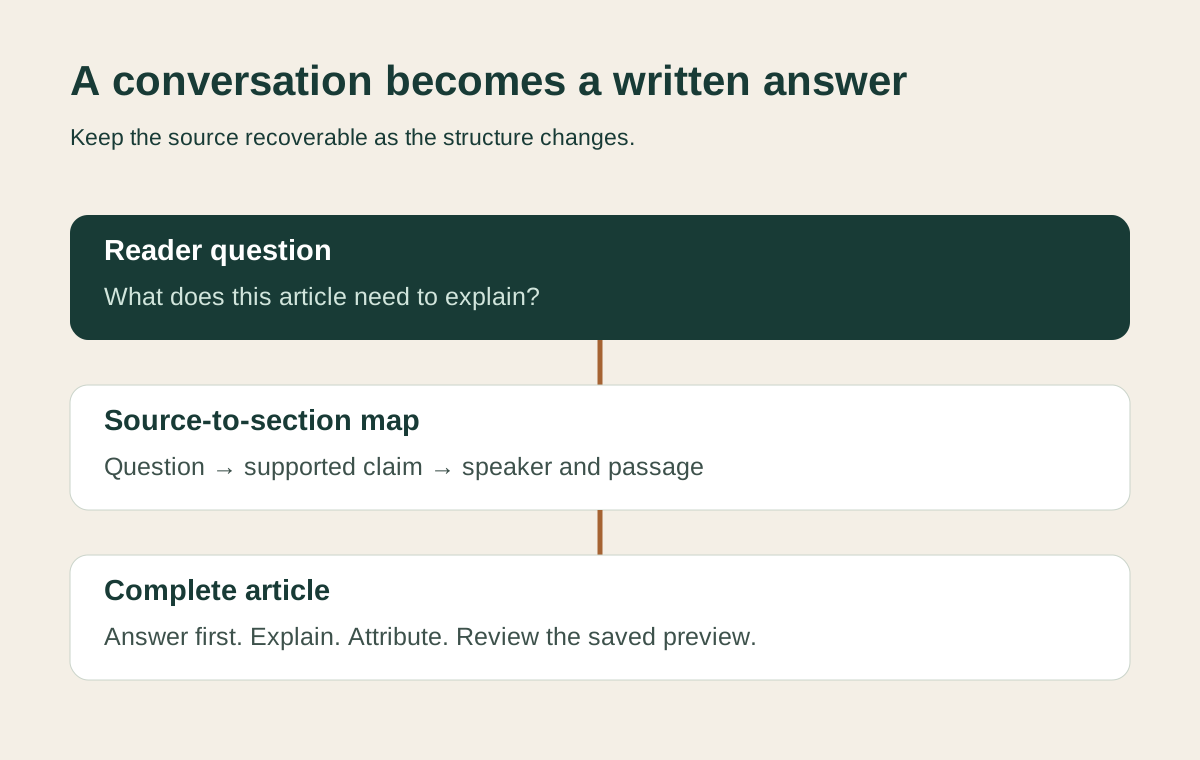
Choose an article question instead of copying the episode order
A transcript follows a conversation. A blog article needs a reader-facing structure: answer the question, explain the mechanism, then resolve the likely follow-up. A guest biography or an unrelated closing topic can be useful in the episode without belonging in this article.
Riverside’s tutorial includes an article title, excerpt and slug in its transcript-to-blog workflow. Prepare those fields after settling the article’s scope, so the page title does not promise a broader answer than the text provides. Source: Riverside transcript-repurposing tutorial.
For this teaching article, the reader is curious about plant growth in space. The question is narrow: why can a space garden become too wet when its fan stops? A full history of space agriculture, future mission plans and home-gardening instructions fall outside that question.
Map the question to the passages you will actually use
The source is NASA’s Small Steps, Giant Leaps interview with Gioia Massa, published July 10, 2024. Find the host’s question about challenges with Veggie and Massa’s answer about the fan, excess moisture and ventilation. These are transcript locators, not verified audio timestamps. Source: NASA official transcript — the Veggie challenges exchange.
Read the surrounding exchange before paraphrasing. Keep the account in the past: the source describes a particular experiment and what the team learned. Do not present the old incident as evidence of the hardware’s current condition.
| Reader question | Source passage | Writing decision |
|---|---|---|
| What happened? | Massa’s explanation of the power interruption and fan state. | Open with the mismatch between an illuminated indicator and actual airflow; keep it tied to this reported incident. |
| Why did moisture build up? | Massa’s explanation of airflow and moisture removal in microgravity. | Explain the mechanism without adding a general plant-watering prescription. |
| What helped? | Massa’s statement about restoring the fans and ventilation. | End with the reported response, then label any broader editorial lesson as your interpretation. |
| What should be left out? | Other exchanges on future missions, crop candidates and personal history. | Exclude them because this short article answers the fan-and-moisture question. |
Read the complete short article
Teaching example — original PodInk explanatory copy based on the linked NASA transcript. This is the whole short article, not a proposed outline or a claim that NASA commissioned or endorsed it.
Why airflow mattered in a space garden
A space garden can receive light and still have a moisture problem. In NASA’s Small Steps, Giant Leaps interview, Gioia Massa describes an incident in the Veggie plant-growth system: after power returned, a fan indicator came on even though the fan itself had not restarted. Source: NASA official transcript — the Veggie challenges exchange.
Why the plants became too wet
Massa explains that without the fans, the air was not moving moisture away from the plants in microgravity. Water accumulated, and fungal growth became a problem. The illuminated indicator did not establish that the ventilation was working. Source: NASA official transcript — the Veggie challenges exchange.
What the team changed
According to Massa, the situation improved when the fans were switched back on. The useful distinction in this account is between a signal that equipment has power and the physical process the plants need. Source: NASA official transcript — the Veggie challenges exchange.
Our editorial takeaway: when explaining a system, name the function you are checking. Here, the source account turns on airflow, not simply whether a light is on. This is a reading of one reported experiment, not a plant-care instruction or a description of today’s Veggie configuration.
Source: NASA’s interview with Gioia Massa. Find the exchange about challenges with Veggie, followed by Massa’s explanation of the fan and moisture buildup. Source: NASA official transcript — the Veggie challenges exchange.
Prepare the page around the finished article
For the teaching article, a suitable page title is “Why airflow mattered in a space garden.” A possible slug is “space-garden-airflow”; an excerpt could read “A reported fan incident in NASA’s Veggie system shows why a status indicator and working ventilation are different checks.” These are suggested editorial fields, not a created page or a measured search strategy.
The article’s short section labels can become headings in your content management system (CMS). Keep source links beside the claims they support, add the publication’s actual author information, and inspect the saved preview. If you add an image, its caption and alt text should explain that image without implying it depicts the reported incident unless that has been verified.
A short article is sufficient for this bounded question. Expand it only when an additional reader question requires more evidence. No word count, headline formula or structured-data block guarantees rankings or AI citations.
Copyable blog handoff
Keep the article and its evidence together
Use this record for the exact article handed to the publisher. Leave unknown review and publication decisions pending.
ARTICLE / VERSION:
READER / QUESTION / ONE-SENTENCE ANSWER:
TITLE / PROPOSED SLUG / EXCERPT:
SECTION OUTLINE IN READER ORDER:
SOURCE MAP: section → claim → episode URL → speaker → passage locator
COMPLETE ARTICLE WITH INLINE SOURCE LINKS:
EDITORIAL INTERPRETATIONS / HOW THEY ARE LABELLED:
OMITTED TOPICS / REASON:
TRANSCRIPT CHECK / AUDIO CHECK / UNRESOLVED CLAIMS:
AUTHOR / IMAGE SOURCE / CAPTION / ALT TEXT:
CMS PREVIEW / LINKS CHECKED / MOBILE VIEW:
FINAL COPY / REVIEWER / PUBLICATION DECISION:
Build the article
Move from transcript to a complete written answer
Define the written answer
Write the reader’s question and a provisional one-sentence answer. If the available passages cannot support that answer, narrow the question or find additional evidence before drafting.
Build the source map
Identify the speaker and supporting turns for each planned section. Save the surrounding exchange and mark transcription uncertainty. Transcript-only work should not claim a listening check or supply invented audio timings.
Draft in reader order
Lead with the answer, explain the causal steps the source supports and finish with the relevant implication. Remove conversational detours without deleting qualifications that change the meaning.
Separate reporting from interpretation
Attribute the account to its source. Label your own lesson as editorial interpretation, and avoid turning a specific reported incident into a claim about every system.
Review the whole article package
Read the title, excerpt, headings, full text and source links together. Check the saved CMS preview before publishing; a well-formed local draft does not establish that an external CMS renders it correctly.
Inspect the adaptation
See why this is an article rather than a transcript summary
The teaching draft uses only the exchange needed to explain the moisture problem. The table evaluates that editorial decision, not search performance.
| Article part | Editorial choice | Check |
|---|---|---|
| Lead | Answers the reader’s question early | Identifies the fan incident and source without making readers work through the full interview introduction. |
| Middle | Explains the supported mechanism | Connects ventilation and moisture using the same interview exchange; adds no watering schedule. |
| Ending | Labels the editor’s interpretation | The lesson about checking a physical function is presented as our reading, not as a quotation from Massa. |
| Source link | Makes the account recoverable | Names the speaker and text exchange; does not pretend that a transcript locator is an audio timestamp. |
Final review question
“Can a reader understand the answer and identify its evidence without hearing the episode first?”Original PodInk editorial question, not a guest quotation
For this example, the opening, mechanism and response make a complete short explanation. The link offers the original context and a way to inspect the account.
An unsupported rewrite would advise every grower to use a particular fan setting. The inspected passage does not establish that prescription. Keep the narrower explanation or obtain the evidence needed for the new claim.
Read the full article against its source map, then check the saved publishing preview. A completed map alone does not establish that the final copy is accurate.
Compare how the approved core changes in the LinkedIn workflow and the X workflow.
Repair the draft
Catch the changes that distort an interview
| Problem | Consequence | Repair |
|---|---|---|
| Headings follow every interview question | The reader must reconstruct the answer across unrelated topics. | Reorder sections around the chosen question and keep a source locator for each. |
| A host question becomes a factual claim | The article attributes an assumption to the guest. | Check the answer and identify which speaker supports the sentence. |
| An old incident is written as a current fault | Readers may infer that the problem still exists. | Keep the historical framing or verify the current condition separately. |
| The title promises a complete guide | The short article explains only one mechanism. | Narrow the title or report the missing parts before broadening the promise. |
- Does the article answer one clearly stated reader question?
- Can every factual section be traced to an identified source passage?
- Are qualifications and speaker identities preserved?
- Are the author’s interpretations distinguished from source statements?
- Do title, excerpt and section headings match the finished text?
- Has the actual CMS preview been checked before release?
Evidence boundaries
What this example establishes
- The NASA transcript was read; the recording was not reviewed. No audio timestamp or direct spoken quotation is verified.
- The article is an original teaching adaptation, not a NASA case study about content marketing or an endorsed publication.
- The example describes an account in an archived interview. It does not establish current hardware behavior or provide plant-care instructions.
- No external CMS publication, audience test, ranking improvement or AI citation was measured.
- The prepared PodInk demo illustrates source-review concepts; it does not generate or publish this article.
Human review remains necessary. No repurposing workflow can turn weak evidence into a strong claim.
FAQ
Frequently asked questions
Can I publish a transcript as a blog post?
A transcript can serve readers who want the conversation itself. For a standalone explanatory article, choose a reader question and restructure the relevant material. Keep attribution and source access, and complete your publication’s review before release.
How long should a podcast-based blog post be?
Long enough to answer the chosen question with necessary context and evidence. This example is deliberately short because it covers one reported incident. Adding unrelated transcript material does not improve that answer.
Should I keep the guest’s exact words?
Use attributed paraphrases for the explanation unless a direct quotation has a clear purpose and you can verify its wording and context under your editorial policy. Do not silently turn an uncertain transcript into a verified spoken quote.
Is this different from an email newsletter?
This workflow creates a standalone page with an article outline, title, excerpt and source map. A newsletter also needs inbox copy and a sending context. Reuse the same evidence if relevant, but review each finished format on its own.
Evidence