
Check the text before you reuse it
How to check podcast transcript errors before writing a social post
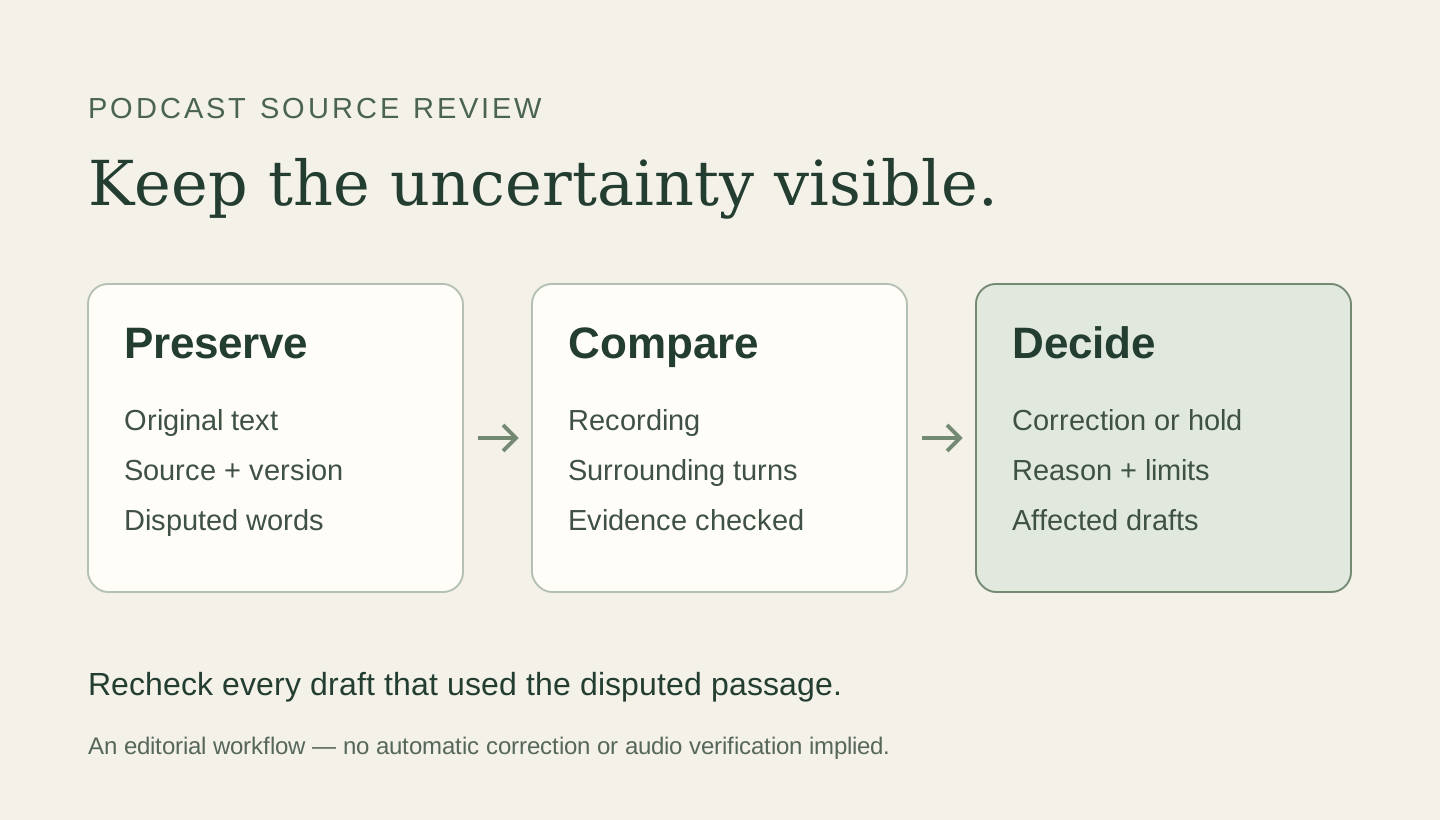
Check podcast transcript errors before turning a passage into a social post. Save the original text, mark the disputed words, and compare them with the recording and surrounding turns. Record a correction only when the evidence supports it. If the uncertainty changes the claim, hold that claim instead of choosing the wording that reads best.
A readable transcript is not proof of accurate speech recognition. This workflow gives you a discrepancy log that connects the source version, the evidence checked, and the drafts that need another review. Use the log before choosing a quote or checking the meaning of a finished post.
Which transcript errors deserve attention first?
Start with the passages you intend to reuse. Mark doubtful negations, names, amounts, units, comparisons, and speaker changes. A missing word can reverse a claim; a misplaced speaker label can assign it to someone else. Read the complete exchange before deciding whether the apparent error is in the transcript or in your interpretation.
YouTube warns that automatic captions can misrepresent speech, including when pronunciation, accents, dialects, or background noise interfere. Its guidance asks creators to review and edit the captions. That supports checking source text; it does not tell you the correct wording of a particular disputed passage. Source: YouTube Help: automatic captioning.
Section508.gov also advises checking names, places, terms, and substitutions between similar-sounding words when editing automatic captions. Use those categories as review prompts, not as permission to replace unfamiliar language with a more familiar word. Source: Section508.gov: editing automatic captions.
What counts as evidence for a correction?
The recording is the comparison for what was said. Surrounding turns can clarify the subject or explain a self-correction. An episode page or a person’s official profile can help establish a spelling, but spelling evidence alone does not prove that the speaker named that person.
Treat a second transcript or an AI suggestion as a candidate reading. Neither resolves a disagreement by itself. A correction note should name the source actually checked, preserve the disputed text, and explain why the replacement follows from that evidence.
A speech transcript may also omit evidence you need. W3C distinguishes basic transcripts of speech and relevant non-speech audio from descriptive transcripts that include important visual information. If the claim depends on a displayed chart, gesture, or demonstration, check that part of the video too. Source: W3C: transcript types.
Should you overwrite the original transcript?
Keep the original capture and make an annotated working copy. Save the publisher URL, retrieval date, language, transcript version if available, and enough nearby text to find the occurrence again. Mark whether a timestamp came from the publisher or from your own recording review.
Keep an unresolved reading visible. Do not silently replace it, then let the polished text become the evidence for an AI summary or quote card. If the publisher later changes the transcript, retain both captures and compare the affected passage.
List the notes, summaries, and post drafts that used the disputed wording. A transcript correction does not update them automatically. Recheck the affected claim in each output, including image text and calls to action, before using it. Otherwise, a repaired transcript can still leave a misleading post in the publishing queue.
Copyable transcript discrepancy log
Keep the original reading beside the evidence
Use one entry for each disputed passage. Leave the correction blank when the evidence cannot settle it. Keep private working notes separate from anything you publish.
SOURCE: episode title / publisher URL / publication date:
CAPTURE: retrieval date / transcript version / language:
LOCATOR: speaker label / timestamp source / surrounding words:
ORIGINAL TEXT (unchanged):
DISPUTED TOKEN OR ATTRIBUTION:
WHY IT MATTERS: which claim would change?

PROPOSED READING (not yet a correction):
EVIDENCE CHECKED: recording range / visual cue / spelling source:
REVIEW METHOD: text only / recording / video:
DECISION: corrected working text / clear meaning for paraphrase / hold
CORRECTION AND REASON (or missing evidence):

AFFECTED OUTPUTS: note / summary / post / image text, with ID and version:
RECHECK RESULT FOR EACH OUTPUT:
REVIEWER / DATE / REMAINING CHECKS:
Transcript review workflow
Check a disputed passage before you reuse it
Save the source before editing
Capture the original transcript and its source details. Copy the complete disputed sentence and nearby turns into your working note. Preserve the original speaker label even if that label is what you are questioning.
Name the consequence of the uncertainty
Write down what would change if either reading were correct. Prioritize a disagreement that changes who acted, what happened, or how certain the speaker was. Punctuation matters too when it changes a question into a statement or moves words into someone else’s reported speech.
Compare the relevant recording and context
Listen to the available passage in context and record the range you actually checked. Follow a self-correction through to the completed thought. Use visual evidence if the passage depends on it. When the recording is unavailable or remains unclear, record that limit instead of claiming verification.
Record the decision without erasing the uncertainty
If the evidence settles the wording, add the correction to the working copy with its reason. If the meaning is clear but exact wording is not, write an attributed paraphrase and retain the wording limit. If the uncertainty changes the meaning, hold the claim.
Recheck every output that used the passage
Find the summary, quote candidate, post, and image text derived from the disputed wording. Update the affected version and compare the complete claim with the source again. If an affected post is already public, follow a correction process instead of quietly fixing only the private transcript.
Invented teaching example — no recording supplied
Worked example: a missing negation changes the proposed post
The following source note and draft are invented for instruction. They do not come from an episode, customer, or completed listening review. The exercise shows how to document an unresolved discrepancy without inventing its answer.
Imagine an editor receives a draft transcript about a product pilot. The text says the pilot can establish demand, but the editor flags a possible missing negation. No recording or publisher clarification is available in this exercise. Neither possible reading has been verified.
| Record field | Example entry | What it establishes |
|---|---|---|
| Original capture | The pilot can establish demand. | Text copied from the invented transcript; not an established statement by a real speaker. |
| Possible alternative | The pilot cannot establish demand. | A proposed reading to investigate, not a correction. |
| Consequence | The two readings give opposite answers about the pilot. | Removing quotation marks would not settle the uncertainty. |
| Evidence checked | Draft text only; no recording or clarification. | The correct reading remains unknown. |
| Decision and dependencies | Hold the claim in summary A and post A. | Save both versions; obtain evidence before rewriting either as a supported claim. |
Post A — invented draft that depends on the disputed reading:
“The pilot establishes demand. The team can use it as proof that the market wants the product.”Invented proposed post, not a real quotation or customer result
The draft has more than a possible transcription problem. It also changes can establish into establishes and adds a claim of proof. Even if the original reading were later confirmed, those stronger statements would need their own evidence.
Proposed softer draft: The team sees the pilot as a way to assess demand. Hold this version too. It still assigns an interpretation that the available evidence cannot resolve. A pleasant paraphrase is not a substitute for checking the source.
Next action: request or locate the recording, compare the disputed sentence and its surrounding exchange, and record the outcome. The editor could instead choose an unrelated, independently checked passage; the unresolved demand claim should not travel into that new post.
The completed log has a useful result even without a corrected sentence: it identifies the uncertainty, the outputs affected, and the evidence still needed. No audio was played for this teaching example, and no version is presented as a publishable account of a real event.
Compare how the approved core changes in the LinkedIn workflow and the X workflow.
Choose the next action
Correct, paraphrase, or hold?
| Evidence state | Action | Boundary to preserve |
|---|---|---|
| Wording resolved | Correct the annotated working text and log the comparison. | Keep the original capture. Correct words do not verify the speaker’s underlying factual claim. |
| Meaning clear; wording uncertain | Use an attributed paraphrase only within the supported meaning. | Do not put the paraphrase in quotation marks or approve a clip from that result. |
| Meaning or speaker unresolved | Hold the affected claim and identify the evidence needed. | Do not choose the more plausible reading or invent a speaker. |
| An affected output is already public | Review the public claim and apply the appropriate correction. | Fixing the source note alone leaves the audience-facing error in place. |
- Keep the original text, proposed reading, and final decision in separate fields.
- Explain which claim changes if the disputed word or speaker changes.
- Record the recording or video range only if you actually reviewed it.
- Check all affected drafts; do not reuse an earlier approval after changing the claim.
Evidence boundaries
What a transcript check cannot establish
- This is an editorial source-review workflow, not a transcription accuracy benchmark. No error rate or time saving has been measured.
- The worked example is invented and unresolved. No episode audio was listened to for it.
- A wording check establishes what the reviewed evidence supports, not whether the underlying claim is true. Facts may need independent sources.
- The record covers selected passages, not the entire episode. Clip timing, accessibility of finished captions, permissions, and publication approval require their own checks.
Human review remains necessary. No repurposing workflow can turn weak evidence into a strong claim.
FAQ
Frequently asked questions
Can I correct an obvious podcast transcript typo?
Correct an annotated working copy when the evidence supports the replacement, and retain the original. A familiar-looking word is not enough when the change affects meaning, identity, or attribution. Record the evidence and recheck outputs that used the passage.
Can another AI model settle a transcript disagreement?
A model can suggest a reading or flag a discrepancy. Its answer is not evidence of the recorded words. Compare the source recording and context; if the uncertainty still changes the meaning, hold the claim.
What if the recording is unavailable?
State which text source you reviewed and what remains unknown. A clear, limited paraphrase may be possible from reliable text, but do not use it to conceal a disputed meaning. Hold the claim when the unavailable recording is needed to resolve it.
Does a corrected transcript approve a direct quote or clip?
No. A direct quote still needs exact wording and context checks for the intended use. A clip also needs its own boundaries and delivery review. Keep those results separate from a source-text correction.
Evidence
Sources and comparison pages
- Use automatic captioningYouTube Help
- Captions and TranscriptsSection508.gov
- TranscriptsW3C Web Accessibility Initiative