
Podcast document-post workflow
Turn a podcast into a LinkedIn document carousel
To turn a podcast into a LinkedIn carousel, choose one question the episode can answer, write a short sequence of pages, and map each source claim to a recoverable passage. Put any qualification on the page that needs it. Add a source page and caption, then review the exported document before uploading it.
Here, carousel means a multipage document shared in a LinkedIn post. The worked example below includes complete slide copy, a caption and a source map. It turns a NASA podcast passage into a lesson about sample recovery without presenting editorial interpretation as a scientist’s quotation.
Give the document one job
A document works when the reader needs a sequence: a decision followed by its reasons, a procedure, or a comparison. If the useful idea fits in a short paragraph, a text post may be enough. Do not spread a small claim over extra pages merely to create a carousel.
Start with a reader question, then select passages that answer it. For the example here, the question is: why did the sample still need protection after the capsule landed? That question excludes most of the episode’s launch history and emotional narration. The omissions keep the document focused without changing what the selected passage says.
LinkedIn’s help page describes uploading documents and recommends PDF. Use consistent page sizes and treat animations as static content. The document title and accompanying post description are separate from the pages inside the file. Source: LinkedIn document preparation.
Keep the limit beside the claim
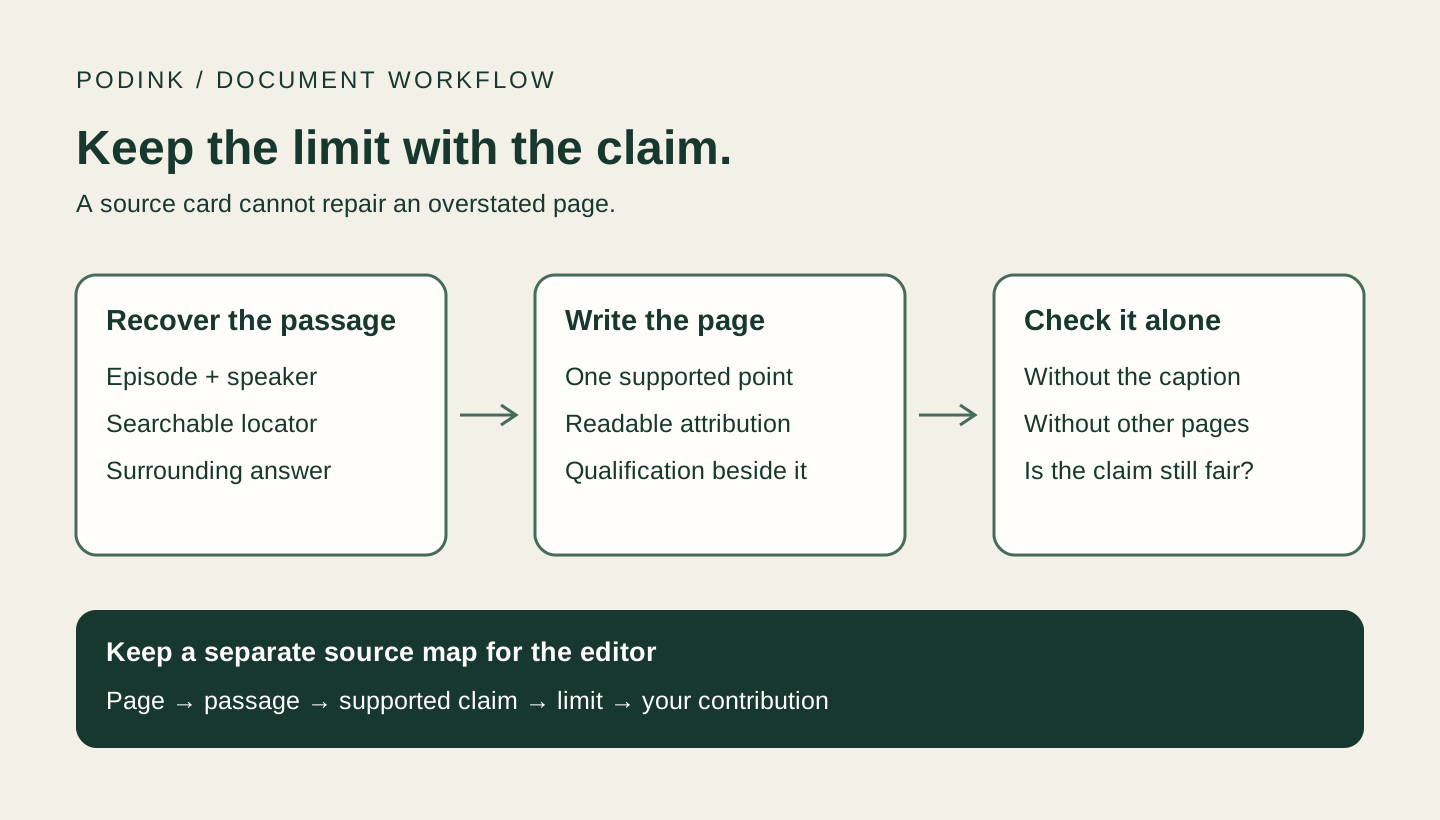
A reader may encounter a screenshot of one page without the caption or final source page. Write each factual page so that its subject, speaker or institution, and important limit remain visible. A source link at the end cannot repair a misleading headline earlier in the document.
In the sample, a page about protecting asteroid material stays about protecting material. It does not announce a discovery about the origin of life. A future research aim is not a completed result. Keep the handling detail the passage supports, and remove any stronger implication introduced by your headline.
| Draft move | Risk | Usable alternative |
|---|---|---|
| Turn a research aim into a discovery | The headline claims an outcome the selected passage does not establish. | Describe the handling step and why the source says it matters. |
| Move the caveat to the last page | A screenshot can separate the claim from its qualification. | Keep the condition or uncertainty on the same page as the claim. |
| Fill a slide with a long quotation | Compression can silently alter a speaker’s words. | Use an attributed paraphrase, or retain a short exact quotation only after checking it. |
| Use a mission image as decoration | The image may imply this is an official NASA document. | Use an original text layout; review image rights and attribution separately if adding assets. |
Complete teaching carousel and reusable handoff
Copy the pages, caption and source record
The six pages below are complete draft copy for an illustrative document. They have not been laid out or uploaded. The source credit on each factual page is intentional; keep it readable if designing a PDF.
DOCUMENT TITLE: After the asteroid sample landed

PAGE A — COVER
Why did an asteroid sample still need protection after landing?
A recovery-to-curation sequence from NASA’s Curious Universe.

PAGE B — CHECK THE SURROUNDINGS
The team collected environmental samples around the returned capsule.
NASA’s account explains that these would help assess possible contamination of the asteroid material.
Source: NASA, Special Delivery from Outer Space — field recovery passage.

PAGE C — LIMIT EXPOSURE
Getting the material into controlled conditions was part of the recovery.
Curator Aaron Regberg explained the use of nitrogen to limit exposure to oxygen.
Source: NASA, Special Delivery from Outer Space — cleanroom discussion.

PAGE D — HAND OFF THE WORK
Landing did not finish the curation job.
The episode follows the sample toward Johnson Space Center, where opening, documenting and studying it would continue.
Source: NASA, Special Delivery from Outer Space — curation-team passage.

PAGE E — LOOK AT THE HANDOFF
The landing is one event. Protecting the material continues afterward.
When you read the episode, notice which team takes over and what that team must preserve.
Editorial reading prompt; not a quotation or a claim about later research results.

PAGE F — SOURCE AND SCOPE
Adapted from NASA’s Curious Universe: Special Delivery from Outer Space.
Based on the official written transcript. Original teaching copy; not an official NASA document or endorsement.
Read the recovery and cleanroom passages in the full episode transcript:
https://www.nasa.gov/podcasts/curious-universe/special-delivery-from-outer-space/

COMPLETE COMPANION CAPTION — unpublished teaching copy
The asteroid sample’s landing is only part of the story.
This document follows the recovery-to-curation sequence in NASA’s Curious Universe: Special Delivery from Outer Space. It focuses on how the material was protected during the handoff, rather than on later scientific findings.
The pages are my paraphrase and reading prompt, based on the official transcript. What changes when you pay attention to the work after the landing?
Read the full episode transcript: https://www.nasa.gov/podcasts/curious-universe/special-delivery-from-outer-space/

BLANK HANDOFF FOR YOUR OWN EPISODE
Reader question: [the question the document answers]
Supported answer: [answer and limit]
Page copy: [complete text, including readable qualification and credit]
Source map for each page: [episode URL; speaker; searchable passage; supported claim; limit]
Editorial additions: [your interpretation, comparison or prompt]
Document title and caption: [complete text]
File: [exact PDF filename; export check still open until the file exists]
Review status: [source; images; readability; accessibility; publication decision]
Build the document
Move from a source passage to a readable sequence
Choose the question before the slide count
Write the reader’s question and a one-sentence answer supported by the episode. Choose a sequence only after the answer is clear. The six-page example below is an editorial choice, not a recommended length for every LinkedIn document.
Make a passage map
Record the episode URL, speaker or narrator, a searchable phrase and the surrounding context for each factual page. Keep claims of your own in a separate column. A transcript locator is useful evidence, but it is not a verified audio timestamp.
Draft the complete pages before designing them
Write a cover that names the question, supporting pages that advance the answer, and a final page that credits the source and offers a useful next action. Read the pages in order without the caption. Replace a vague transition with the fact or decision the reader needs.
Cut wording without removing the condition
Shorten repeated introductions and decorative phrases first. Keep the subject and any limit that changes the meaning. If a page still cannot be read comfortably, split the idea or remove a secondary point. Do not solve crowding by making the evidence note tiny.
Prepare the file and caption as separate deliverables
Export the designed pages and open the actual PDF. Check page order, readable text, selectable text where possible and source links. LinkedIn says viewers can download the document as a PDF and that the uploaded document itself cannot be edited in place; review the file before posting. Selectable text is only one accessibility check, not proof that the PDF is accessible. Source: LinkedIn upload and document-editing limits.
Hand off the exact document for approval
Return the file, complete caption, document title and source map together. Record any outstanding image, accessibility or source check. A reviewer should see the file intended for upload, rather than only the copy that went into the design. A text-only approval leaves file review open.
Worked document copy
Worked example: why the landing was not the end
The carousel copy below is an original teaching adaptation. The page sequence and reader question are editorial choices; NASA is the source for the recovery and curation details.
NASA published this Curious Universe episode on 2023-12-05. The transcript describes the sample capsule’s return on 2023-09-24, then follows environmental sampling and the handoff to the curation team. Read the section from Christian Elliott’s account of the field team through Aaron Regberg’s explanation of nitrogen and the cleanroom. Source: NASA episode and transcript.
The source map uses speaker and topic locators, not invented timestamps. The document copy uses paraphrases. The source date identifies the historical account; it does not make the example a report on the current state of asteroid research.
| Page | Source support | Editorial boundary |
|---|---|---|
| Cover | The transcript moves from landing to recovery and curation. | The cover question is our way of organizing that sequence. It is not a quotation.Source: NASA transcript |
| Environmental sampling | Elliott describes the team collecting environmental samples around the capsule after it was judged safe. | Say the samples help assess contamination; do not claim the environmental samples alone prove the asteroid material was untouched.Source: NASA: field-team passage |
| Cleanroom and nitrogen | Regberg explains the plan to put the material under inert gas and the steps needed to reach the canister port. | Keep this about limiting exposure. Do not turn the handling precaution into a new scientific finding.Source: NASA: Aaron Regberg’s cleanroom explanation |
| Handoff and closing question | Nicole Lunning describes the move through cleaner spaces; Elliott describes the curation work continuing at Johnson. | The closing prompt asks the reader to notice the handoff. It does not claim the episode validates a general business method.Source: NASA: curation-team passage |
Editing principle
“A page should carry enough context to remain accurate when it is separated from the rest of the document.”PodInk editorial principle
The copy keeps the episode’s recovery steps and removes most of the journey narrative. The source card provides a path back to the full account. The document’s question is narrower than the podcast topic, but the selected details still support the answer.
Check the cleanroom page in isolation: it names the sample, attributes the explanation and states the purpose of the handling step. Replacing that copy with “NASA proved where life began” would change the claim, not merely improve the hook.
Use the same method for a business interview: make the page-sized claim explicit, keep its limits visible, and leave a source map the reviewer can follow. An attractive layout does not establish that a shortened claim is faithful.
Compare how the approved core changes in the LinkedIn workflow and the X workflow.
Review the exported file
Check what survives when a page travels alone
| Check | What to inspect | If it fails |
|---|---|---|
| Separated page | Read a factual page without the cover, caption or final source card. | Restore the subject, attribution or qualification on that page. |
| Source recovery | Follow each source-map locator and read the surrounding answer. | Revise the page or remove the unsupported claim. |
| Actual PDF | Inspect the exported pages, links and smallest text on a phone-sized view. | Return to the design file and export again; text review alone does not clear the PDF. |
| Publication package | Compare the proposed upload file, document title and full caption with the approved package. | Keep publication pending until the actual package is reviewed. |
- The reader question is clear without a claim about reach or engagement.
- Each factual page can be traced to a passage and remains accurate on its own.
- Paraphrases and editorial prompts are distinguishable from direct quotations.
- The source card and caption credit the episode and provide a recoverable URL.
- The actual exported file has been reviewed, or its review remains explicitly open.
- The source map, document and caption are handed off together for a separate publication decision.
Evidence and delivery limits
Copy approval is not a completed document post
- The slide copy, caption and source map are unpublished AI-assisted teaching examples. They are not a NASA communication, endorsement, client campaign or record of audience results.
- The NASA review used the official written transcript. No recording was listened to, no clip boundaries were checked and no spoken quotation is reproduced in the slides.
- The example explains the return and curation sequence described in the historical episode. It does not report later sample findings or claim that a research question has been settled.
- The podcast carousel example supplies copy and an editorial handoff. No PDF was exported or uploaded to LinkedIn for the example, and no in-composer, assistive-technology or audience-performance test was run.
Human review remains necessary. No repurposing workflow can turn weak evidence into a strong claim.
FAQ
Frequently asked questions
Is a LinkedIn document carousel the same as a carousel ad?
A LinkedIn document carousel in this workflow is a document attached to an ordinary post. Paid carousel ads and their image specifications are outside this workflow. Check the upload guidance for the format you actually intend to publish.
How many pages should a podcast carousel have?
Use the pages needed to answer the chosen question without padding. The example uses six pages for explanation, a reading prompt and source credit. That count is an editorial choice, not an algorithm recommendation.
Can the source credit appear only in the caption?
Keep a recoverable source in the caption, but also add readable attribution to factual pages and a source card inside the document. A downloaded PDF or screenshot may be separated from the post description.
Do I need to quote the guest word for word?
No. An attributed paraphrase may fit the page better. If using quotation marks, check the exact words and surrounding context. Reviewing a written transcript does not establish audio timing or approve a clip.
Does PodInk export or publish the document in this guide?
No. The linked tool is a prepared source-to-draft example. This guide provides writing and review materials; designing, exporting and uploading the document are separate tasks.
Evidence
Sources and comparison pages
- Special Delivery from Outer SpaceNASA — Curious Universe
- Upload and share documents on LinkedInLinkedIn Help