
Podcast quote translation
How to translate a podcast quote for a social media post
To translate a podcast quote for a social post, preserve its meaning, identify the language change, and hold unclear wording.
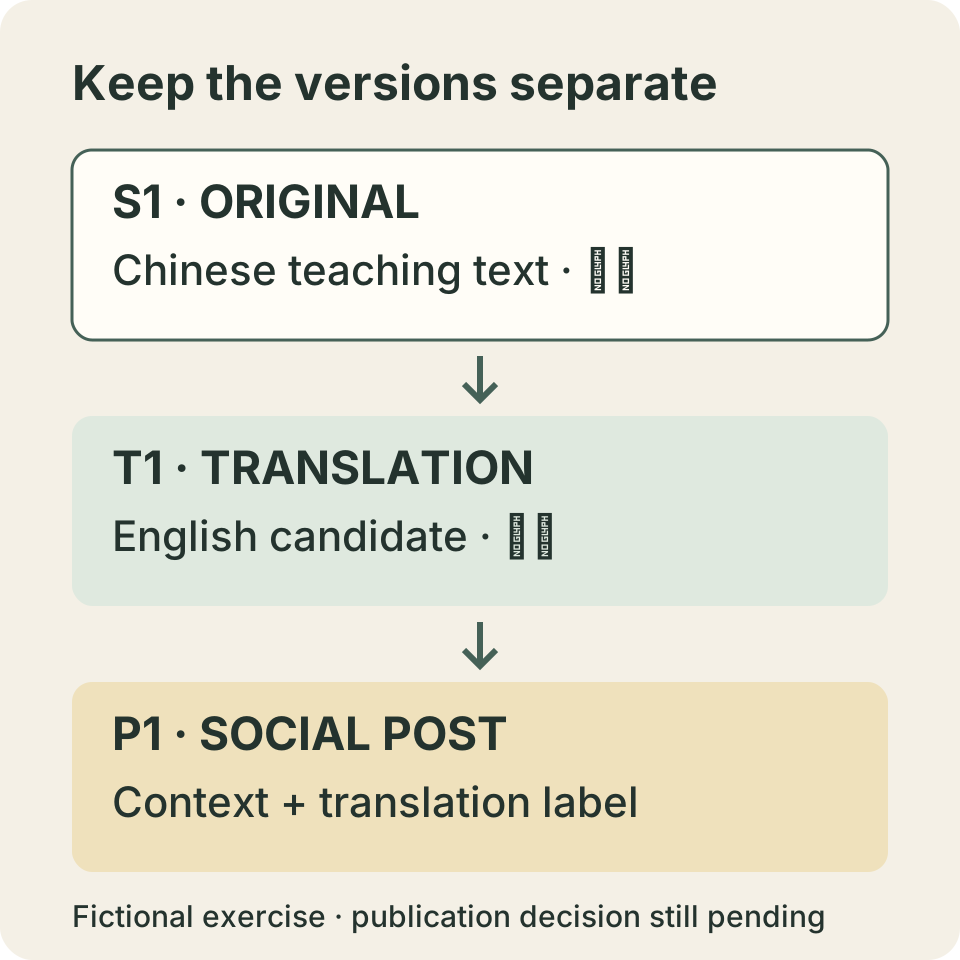
The worked example separates a Chinese source passage, an English translation and the writer's complete post. A filled review record shows what was compared and what remains unapproved. The source text is invented for teaching; no podcast recording was used.
A translated quote is not the original-language wording
Reuters calls for natural translation with equivalent tone. It also warns against reconstructing an original quote from another publication's translation. Return to the original source when the wording matters. Source: Reuters translation guidance.
AP requires faithful translation and, where appropriate, identification of the spoken language. Its quotation guidance also rejects passages whose meaning is too unclear to paraphrase accurately. Source: AP quotation guidance.
Label the example's wording as English translated from invented Chinese text. For a real passage, identify the speaker and original source.
Name the reviewer’s actual language competence
ATA's professional code asks members to work within their competence and convey meaning accurately for the context and audience. It does not certify a fluent-looking draft or endorse this workflow. Source: ATA Code, tenets 2 and 6.
The review record here separates a text comparison from a publishing decision. Its reviewer field describes AI assistance, not a named bilingual professional. Do not copy the example's status into a real approval record.
Copyable working note
Keep the passage, translation and post together
Start with the completed fictional record below, then use these blank fields for your own material. Replace the teaching labels with real evidence and leave approval blank until a real decision exists.
RECORD / TRANSLATION VERSION / POST VERSION:
EPISODE / SPEAKER / SOURCE URL:
ORIGINAL LANGUAGE / TARGET LANGUAGE:
EVIDENCE: recording checked / publisher transcript only / other / unresolved
LOCATOR / NEIGHBORING QUESTION AND ANSWER:
ORIGINAL PASSAGE, UNCHANGED:
TRANSLATED PASSAGE, COMPLETE:
TRANSLATOR OR TOOL / ROLE ACTUALLY PERFORMED:
DISPUTED WORD OR PHRASE / ALTERNATIVE READINGS:
COMPARISON NOTES:
COMPLETE SOCIAL POST, INCLUDING TRANSLATION LABEL AND SOURCE:
LANGUAGE REVIEWER / COMPETENCE / DATE / EXACT VERSION REVIEWED:
DECISION: revise / hold / wording accepted within stated evidence
PUBLICATION DECISION / PERSON / DATE: separate and not assumed
NEXT EDIT / CHECK TO REPEAT:
Before you draft
Review the translation before shaping the post
Save the source packet
Open a record containing the episode link, speaker, original passage, neighboring exchange and source locator. Mark whether the evidence is written text or a recording you actually checked.
Compare tone as well as words
Use natural target-language phrasing without making the speaker sound more certain, forceful or dismissive. Check a translation against the original, not an intermediate translation. Source: Reuters translation guidance.
Name the reviewer for difficult wording
Use relevant language and subject competence to review disputed wording. Record the limits; fluency alone does not establish accuracy. Source: ATA professional competence.
Resolve meaning before publishing
State the language change. Do not publish a passage whose meaning you cannot establish. Source: AP quotation guidance.
Save the whole post and the decision
Store the exact translation and complete social draft together. Give any later edit a new version, then record whether the earlier comparison still applies. Leave the publication decision as its own field.
Original bilingual teaching example
A prepared workshop group is not every workshop group
Everything in this example is original fictional teaching text: the workshop, facilitator, host, source turns, translations and posts. There is no real episode, audio, source URL or timestamp. S0–S2 are text labels, not recording locations.
S0 — invented host question: 只要提前发材料,所有小组都可以省掉开头的回顾吗? English gloss: If we send the material in advance, can every group skip the opening recap?
S1 — invented facilitator answer: 不一定。如果大家提前读过材料,小组也许可以少花一点时间复述内容;第一次参加的人仍然需要背景介绍。
S2 — invented follow-up: 发过材料不等于每个人都读过。 English gloss: Sending the material does not mean everyone has read it.
| Record | Text or decision | What to inspect |
|---|---|---|
| T0 — reject | Every group can skip the recap once the material has been sent. | The English sentence changes read into sent, some reduction into total removal, and the conditional group into every group. It drops the newcomer qualification and contradicts S2. |
| T1 — translation candidate | Not necessarily. If everyone has read the material beforehand, the group might spend a little less time recapping it; first-time participants still need background. | Compare the opening answer with S0, the reading condition and tentative reduction with S1, and the final clause with the newcomer qualification. T1 is an AI-assisted translation of invented text, not a verified spoken quote. |
| P0 — reject the framing | A simple fix for every workshop: stop recapping. | P0 sounds simple, but it leaves a newcomer out of the picture. Even followed by T1 verbatim, the hook would promise something the fictional source denies. Rework the hook before treating the post as a candidate. |
Writer's separate response:
“I would shorten a recap only after checking what this particular group already knows.”Original editorial response to the fictional example; not a guest quotation
P1 — complete English social draft, fictional example only:
Does advance reading make the opening recap unnecessary for every workshop group? In this invented discussion, the facilitator gives a qualified answer.
English translation of invented Chinese text: “Not necessarily. If everyone has read the material beforehand, the group might spend a little less time recapping it; first-time participants still need background.”
My takeaway: a shorter recap is an option to consider for a prepared group, not a reason to leave newcomers behind. I would ask what participants already know before changing the opening.
Teaching source: fictional host and facilitator turns S0–S2 above. S2 distinguishes sending material from reading it. No real speaker, episode, recording or external source link exists for this exercise.
TR-01 wording disposition: T0 and P0 rejected; T1 and P1 retained as teaching candidates after an AI-assisted text comparison. That disposition does not record a human language review or authorize a real social post.
The draft is complete enough to review: it contains a question, a labelled translation, the writer's response and an explicit teaching-source note. Publication approval is pending. No real social account, translation service or audio passage was used.
Compare how the approved core changes in the LinkedIn workflow and the X workflow.
Filled review record
TR-01: a comparison decision with publication still pending
| Saved item | Comparison result | Remaining boundary |
|---|---|---|
| Source and versions | Original invented Chinese turns S0–S2; English T0/T1; social P0/P1. Reviewed as text on October 15, 2026. | No episode URL or audio locator exists. Do not relabel S1 as a timestamp or a real transcript. |
| Reading condition | T1 says everyone has read the material. T0 only requires that someone sent it; S2 explicitly distinguishes those states. | A later change from read to received or sent would reopen this comparison. |
| Size and certainty | T1 retains might and a little less time. T0 replaces that possibility with permission to skip the recap. | The fictional statement supplies neither a measured time saving nor a universal recommendation. |
| Newcomers and framing | T1 retains background for first-time participants. P1 carries the workshop question and labels the writer's takeaway separately. | Removing the final clause or reviving P0 would require another review of the complete draft. |
| Reviewer and decision | AI-assisted editorial text comparison; retain T1/P1 as fictional candidates. No named bilingual professional reviewed the passage. | Human language review and publication decision remain unperformed. Do not enter approved in a real record on the strength of this exercise. |
- S0 remains visible beside S1, so Not necessarily has an identifiable question to answer.
- T1 preserves read beforehand; sending a document is not substituted for participants reading it.
- T1 retains might, a little less time and the newcomer clause; no numerical saving is invented.
- P1 identifies the English as a translation of invented Chinese text and separates the writer's response.
- The saved review names T1/P1 and its actual AI-assisted scope; publication approval is a separate unresolved field.
What was checked
The limits of this text exercise
- This is a text-only, AI-assisted teaching exercise. No recording, real speaker, real episode, human bilingual reviewer or translation product was tested.
- The Chinese and English sentences are original teaching material, not samples from Reuters, AP or ATA. The cited organizations do not endorse this guide or the example.
- Ambiguity example: 再看看 appears alone, without an identifiable action. Save the surrounding exchange; this guide assigns no English equivalent while that meaning remains unresolved.
- A model-generated translation is a candidate in this workflow, not a completed language review. Agreement between two candidate outputs is not recorded here as independent approval.
- A wording review does not establish the truth of a speaker's claims, reuse rights, or the suitability of a media edit. Those decisions need their own evidence.
Human review remains necessary. No repurposing workflow can turn weak evidence into a strong claim.
FAQ
Frequently asked questions
Should a translated podcast quote identify its language?
Identify the language when needed, as AP recommends. Label the translation next to the quote.
Should I translate every word literally?
Reuters recommends natural wording with equivalent tone. A readable sentence still needs comparison with the original; it should not become stronger.
Who should check a difficult translation?
Choose a reviewer with relevant competence and state the review's limits. ATA's code requires members to work within their capabilities.
Does this example prove the quote was spoken?
No. S0–S2 were invented for this guide and have no recording. T1/P1 are teaching drafts with no human publication approval.
Evidence
Sources and comparison pages
- Journalistic Standards: translation guidanceReuters
- Telling the Story: quotationsAssociated Press
- Code of Ethics and Professional ResponsibilityAmerican Translators Association