
One source, two complete drafts
LinkedIn post vs X thread: adapt the same podcast moment
To adapt a podcast into a LinkedIn post and an X thread, preserve the source claim, its limits, and the ownership of your added advice. Rewrite the opening, transitions, and distribution of detail for each format. Compare the completed drafts by what they mean, not by whether they share the same sentences.
A shorter draft can read smoothly while saying something stronger than you intended. The worked pair below gives you a comparison to make: both address a writer sending work to an editor, and both propose a more specific review request. Check where the formats diverge without letting the advice drift.
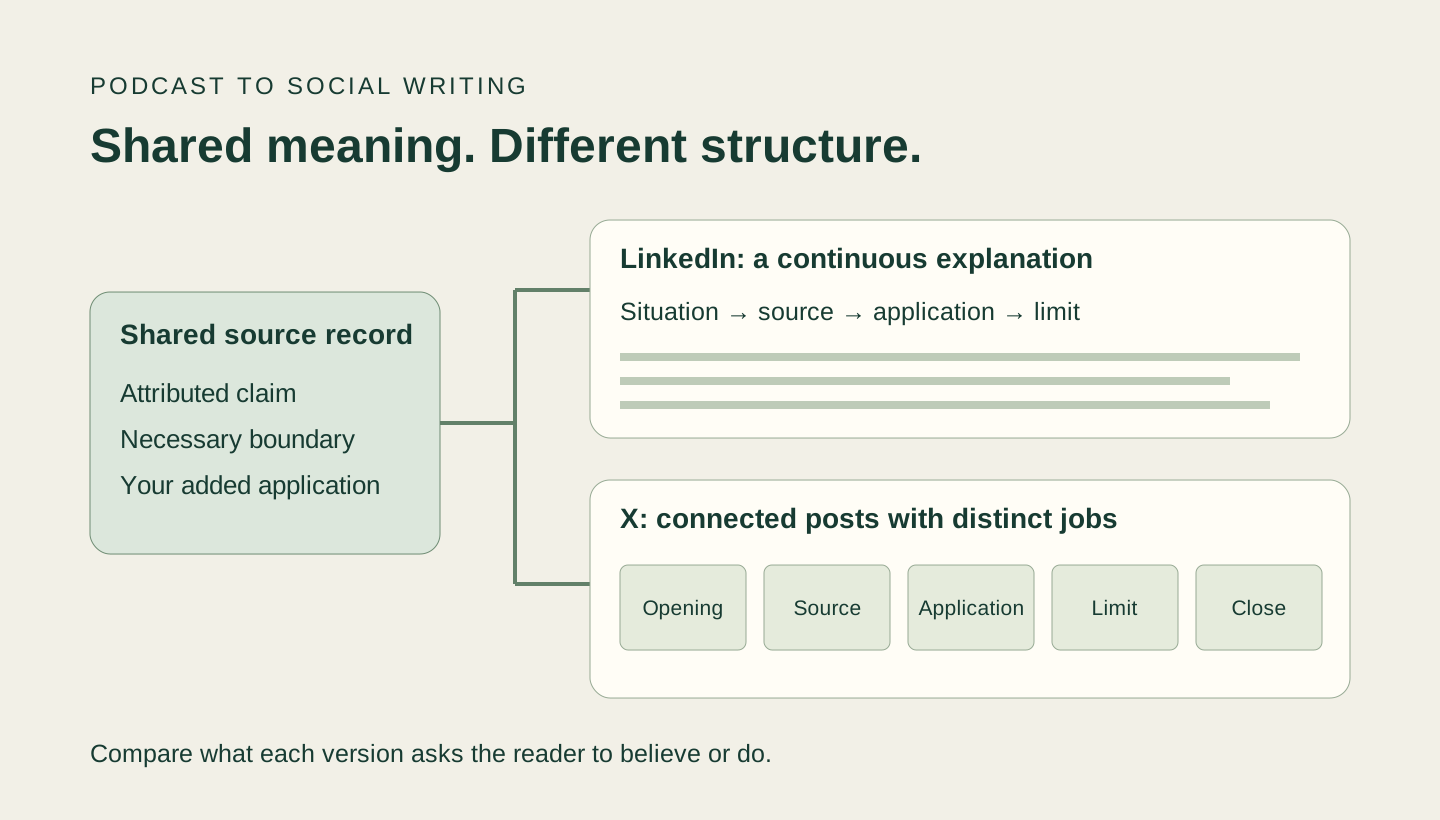
Make a format decision before shortening
For this worked pair, the LinkedIn post builds a continuous explanation around a workplace situation. The X thread gives the opening, source, example, qualification, and closing question separate posts. These are editorial choices for this idea, not claims about either platform’s algorithm or preferred length.
LinkedIn’s official guidance asks writers to consider their audience and make thought leadership useful and concise. That supports a focused writing decision; it does not establish that this example will earn more attention. Source: LinkedIn’s audience guidance.
X describes threads as connected posts that can extend a point. In our example, the source post names the speaker and links the transcript; the application post identifies its own author. The suggested order is ours, not a platform requirement. Source: X’s explanation of threads.
The shared source record
Read Bob Sutton’s exchange with Matt Abrahams in the official Stanford transcript linked below. Search the Full Transcript for hand-offs and read the surrounding collaboration question, Sutton’s response, and the host’s follow-up. Source: Stanford episode and written transcript.
Selected paraphrase: Sutton directs leaders to examine handoffs and consider both the person giving work and the person receiving it.
Scope: a starting point within a broader conversation about collaboration. The review-request example below is our application, not a method prescribed or tested in the interview. Only the written transcript was reviewed; there is no audio-verified quote or clip boundary.
Complete copyable pair
Two complete drafts from the same passage
Copy only the text between the chosen START and END markers. These unpublished, AI-assisted drafts use first person for a proposal, not an experience or result. Use the blank map afterward to identify what your own pair must keep and what needs a rewrite.
LINKEDIN POST — START

Before sending a draft to an editor, I would put one decision above the document: what should this person assess?

In Stanford’s podcast transcript, Bob Sutton directs leaders to examine handoffs from the perspective of both the giver and the receiver.

My application for a writing review: add a specific request above the draft.

For example: Please check whether the opening overstates the source.

That gives the editor a decision to address. It does not establish that the claim is accurate or that the draft is ready to publish. If the editor needs different information, I would revise the request before another pass.

This is my proposed writing habit, not Sutton’s prescribed method or a measured result.

What decision would you put at the top of your next draft?

Source: Bob Sutton with Matt Abrahams, Stanford. Written transcript; search hand-offs. Recording not checked.
https://www.gsb.stanford.edu/insights/be-better-work-how-communicate-better-coworkers-employees

LINKEDIN POST — END

X THREAD — START

1/5 Before a draft changes hands, write the decision you want the next person to make. My example is a writer asking an editor to assess an opening claim.

2/5 Bob Sutton, Stanford: examine handoffs from the giver and receiver perspectives. Written transcript; search hand-offs. https://www.gsb.stanford.edu/insights/be-better-work-how-communicate-better-coworkers-employees

3/5 My proposed request: Please check whether the opening overstates the source. I would put it above the draft so the editor has a decision to address. This is my application, not Sutton’s prescribed method.

4/5 A precise request does not establish accuracy or publication readiness. If the editor needs different information, I would revise the request before another pass.

5/5 What decision would you put at the top of your next draft? The example is a proposed writing habit, not a measured result. The source is a written transcript; the recording was not checked.

X THREAD — END

BLANK ADAPTATION MAP — KEEP WITH YOUR DRAFTS
Reader and decision:
Shared source claim and recoverable passage:
Source qualification that must survive:
My contribution, clearly distinguished from the source:
LinkedIn opening and route to the action:
X opening and job of each post:
Where each version keeps attribution and necessary limits:
Sentence that changed meaning during adaptation (paste both versions):
Repair in the actual final copy (paste the revised sentence):
Adapt the pair
How to rewrite the format without changing the claim
Set the same reader and decision
Keep both drafts focused on a writer preparing an editorial review request. Changing the reader to an executive planning a reorganization would require a different application. You would then be comparing topics as well as formats.
Separate the shared meaning from the wording
Record the source claim, its scope, your own proposed action, and the outcome you cannot promise. Those are the elements to compare after rewriting. Sentences can move or disappear as long as their necessary meaning remains visible.
Give each version its own route to the action
Build the LinkedIn version around the writer’s situation, then connect evidence to a concrete request. For X, label the job of each post before drafting: opening, source, application, qualification, close. Reintroduce a subject when a new post would otherwise start with an unexplained pronoun.
Compare the completed drafts, then read each alone
Purdue OWL’s revision guidance asks writers to identify their point and readers, evaluate the evidence, and remove irrelevant material. Apply that check to each complete version, then use the transformation map to catch any change in meaning between them. Source: Purdue OWL on revision.
Completed transformation map
What moved, what was rewritten, and what stayed true?
The pair makes the same proposal to the same reader. The map compares the actual displayed copy, rather than giving general advice about LinkedIn or X audiences.
| Part of the argument | LinkedIn version | X version |
|---|---|---|
| Opening | Begins inside the writer’s situation and asks what the editor should assess. | Post 1 states the proposed action first, then names the writer and editor. Post 2 supplies the attributed source before the application in post 3. |
| Source and ownership | A named paraphrase appears before the author’s application; the full link and locator close the post. | Post 2 keeps the attributed source idea with its link. Post 3 restarts with My proposed request so the reader can distinguish the application from the guest’s advice. |
| Concrete application | The request stands on its own line inside a continuous explanation. | Post 3 contains the request, why the writer would use it, and the ownership boundary in the same unit. |
| Limit and next move | The paragraph after the request limits what it establishes and says when to revise it. | Post 4 contains both the limitation and the conditional next move. Neither is reduced to an unexplained See above. |
| Close | The question follows a separate statement that the writing habit is proposed and untested. | Post 5 combines that status with the same reader question. It does not introduce a new promise to make the ending stronger. |
Adaptation rule:
“The second version should offer another way through the same argument.”PodInk editorial principle for this example
A cut-and-number conversion of the LinkedIn post would separate the short request from the explanation of why it is there. The displayed X version instead combines them in post 3. That changes the writing unit from a paragraph in a continuous post to a self-contained proposal.
The LinkedIn draft can let neighboring paragraphs carry the transitions. The X draft repeats ownership and subjects because each new post begins another unit. Repetition has a job here; repeating the same hook throughout the thread would not add another reason to keep reading.
Use the LinkedIn version when you want the reader to consider the situation and proposal in one connected post. Use the X version when you want to give each part of the argument its own post. The choice changes the reading sequence; no engagement comparison was performed.
The result is a complete pair with a shared source and proposal, not a claim that one platform is superior. The next review concerns your final wording, intended reader, and source fidelity. Neither sample has been posted.
Compare how the approved core changes in the LinkedIn workflow and the X workflow.
Meaning comparison
Which edits change format, and which change the argument?
| Proposed edit | What it changes | Decision |
|---|---|---|
| Move the workplace setup after the opening | Order changes while the same writer and review decision remain identifiable. | Accept as a format choice; the X opening already does this. |
| Move the source link into the source post | The recoverable passage moves closer to the paraphrase. | Accept. Keep attribution in both versions rather than relying on a link alone. |
| Replace My proposed request with Sutton’s method | The writer’s invented application would become advice falsely assigned to the guest. | Reject. The application must remain the writer’s, regardless of platform. |
| End with This will eliminate revision rounds | The new sentence promises a result neither the source nor these unpublished examples establish. | Reject the outcome claim. Keep the reader question and the untested status. |
| Remove the limitation to fit a shorter version | The request could appear to establish accuracy or readiness by itself. | Cut optional setup first, or narrow the recommendation. Do not solve a space problem by strengthening the claim. |
- Both openings identify the same reader and a compatible decision.
- The source idea remains attributed, recoverable, and limited to the selected passage.
- Each version separates the writer’s application from the guest’s advice.
- The action and its important qualification survive in both complete drafts.
- Each X post has a clear subject and a distinct job in the sequence.
- The ending adds no result, endorsement, or experience that the source does not establish.
- Review the actual numbered posts and links in the intended composer before publishing.
Evidence boundaries
What these drafts establish
- The podcast evidence is a written transcript reading. Exact spoken wording, tone, and clip timing were not checked.
- The writer/editor scenario and review request are original teaching examples, not a real team case or a measured intervention.
- The structure choices do not establish platform reach, engagement, ranking preferences, or an ideal length.
- The drafts have not been entered into LinkedIn or X. Local text review is not composer validation or publication approval.
Human review remains necessary. No repurposing workflow can turn weak evidence into a strong claim.
FAQ
Frequently asked questions
Can I use the same podcast idea on LinkedIn and X?
Yes. Preserve the source claim, qualification, and ownership of your interpretation. Then write each version for its own reading sequence. The paired example shows different openings and transitions without inventing a second takeaway.
Should I split a LinkedIn post into numbered X posts?
Use that as a rough outline only if it helps. Then check what each resulting post needs to make sense. In this example, the request and its explanation are combined into one post, and source attribution is kept with a direct link.
Which format should I choose if I only want one?
For this writing task, choose the continuous post to present the situation and proposal together, or the thread to separate the argument into inspectable parts. Use the format your intended readers can follow. The example provides no evidence that either produces better results.
Do the two versions need identical wording?
No. Compare what each version asks the reader to believe or do. If a shorter sentence changes a proposal into a proven method, or removes an important condition, repair the meaning before polishing the phrasing.
Evidence
Sources and comparison pages
- Be Better at Work: How to Communicate Better with Coworkers and EmployeesStanford Graduate School of Business
- How to Create Impactful Thought Leadership ContentLinkedIn Marketing
- How to create a thread on XX Help Center
- Steps for Revising Your PaperPurdue OWL