
Before the writing brief
How to choose podcast moments for social media
Choose podcast moments for social media by comparing how well each passage serves a specific reader, whether its meaning survives outside the episode, and what evidence the proposed use needs. Keep the candidate with the clearest useful point and recoverable support. Hold candidates with unresolved evidence; drop those that do not fit the assignment.
A memorable line is a candidate, not yet a reason to use it. Use the comparison below when you have several interesting passages and need to choose what to develop first. The worked example selects from one real interview. Its keep, hold and drop decisions are editorial judgments, not predictions of social performance.
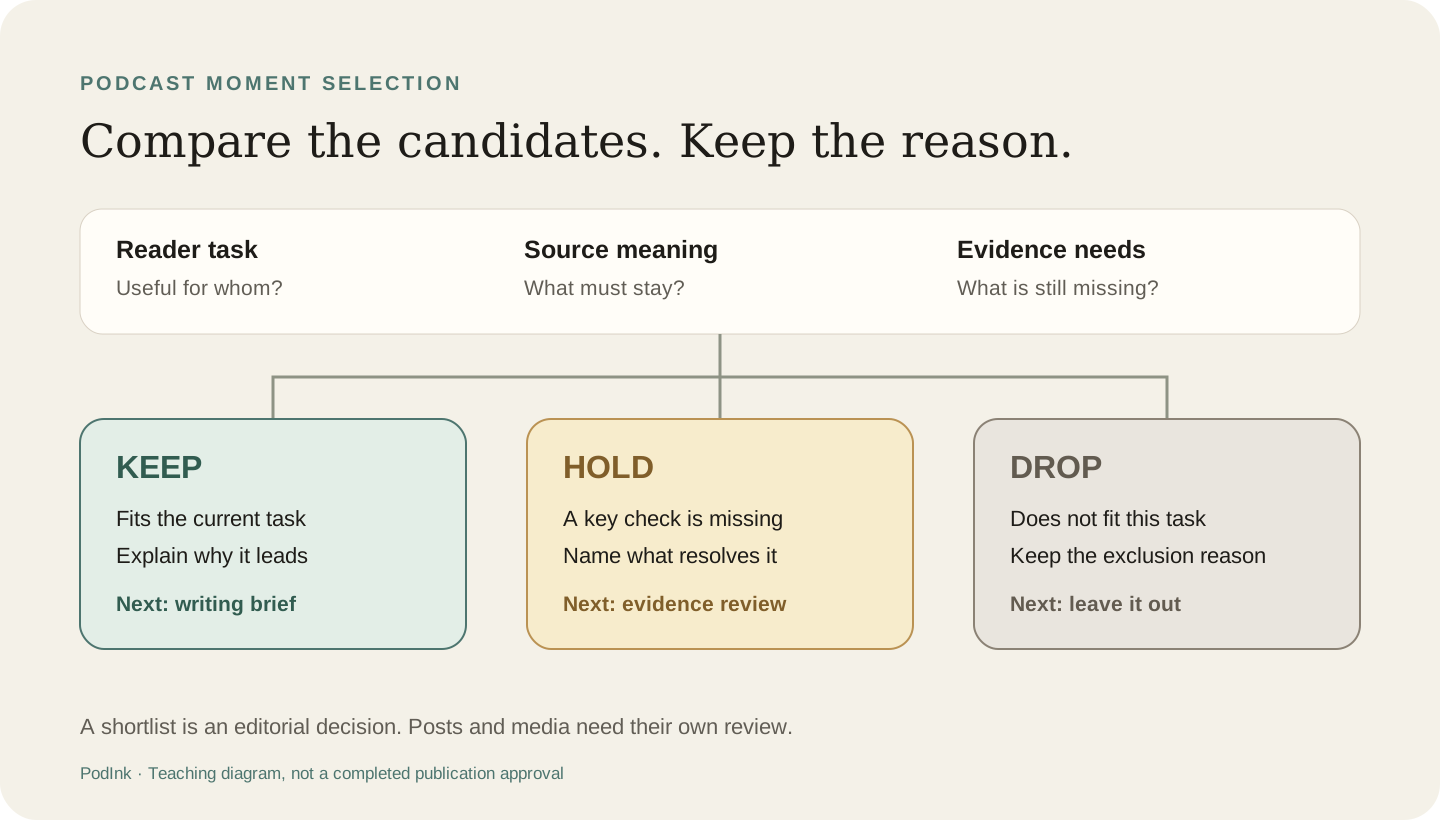
Choose for the reader’s task, not the loudest line
Write the intended reader and situation before comparing passages. A broad topic such as communication leaves almost everything in the episode eligible. A task such as preparing for a tense conversation gives you a reason to prefer one passage over another.
Descript’s clip-selection guidance emphasizes a moment’s standalone value, fit with the show and relevance to the intended audience. The selection sheet here adds a visible evidence decision before a candidate moves into writing or production. Source: Descript’s selection guidance.
| Decision | Meaning for this assignment | Next step |
|---|---|---|
| Keep | Useful for the named reader, with enough recoverable context for the proposed use. | Choose a lead candidate and retain a relevant alternative if needed. |
| Hold | Potentially relevant, but a missing source, qualification or media check affects the central point. | Name the evidence that would resolve the hold before developing that claim. |
| Drop | Does not serve this assignment, repeats another candidate, or needs a misleading framing to fit. | Remove it from the current shortlist. Drop does not mean the source is false or worthless. |
Resolve evidence problems before comparing appeal
A vivid passage can still lack the evidence needed for its central claim. Mark that candidate hold before comparing appeal. A high score for relevance or originality cannot resolve a missing source.
Among usable candidates, prefer the passage that answers the reader’s question most directly, needs the least added explanation to remain fair, and contributes a different point from your recent posts. Keep necessary context even when the shorter version sounds punchier.
State whether you want text, a quotation or a clip so the next editor knows which checks remain. An idea selected for an attributed text discussion may still need recording review for spoken wording, duration, delivery or a video cut.
Copyable selection sheet
Save the decision before writing the post
Use the blank sheet for your episode. The filled memo shows the result of the candidate comparison later in this guide. It can start a writing brief; it is not a finished post, an audio check or a publication approval.
BLANK SELECTION SHEET
Reader and situation: [who needs what; research or editorial assumption]
Intended use: [attributed text, direct quote or media clip]
Episode and source URL: [recoverable source]
For each candidate: [ID / speaker / where to find it / source summary]
Reader value: [question this candidate answers]
Context required: [setup, qualification or response that must remain]
Evidence still needed: [specific missing check, or none for the stated scope]
Decision: [keep lead / keep alternative / hold / drop]
Reason: [why this candidate fits or loses to another one]
Next action: [writing task, source check or removal from this assignment]

FILLED SELECTION MEMO — teaching example
Reader: A manager preparing for a tense one-to-one conversation; editorial assumption.
Intended use: An attributed text discussion, not a quote card or clip.
Source: Stanford interview with Charles Duhigg and Matt Abrahams.
Source URL: https://www.gsb.stanford.edu/insights/good-great-what-makes-supercommunicator
Lead: B. Search looping for understanding; read the conflict question, full answer and workplace comparison.
Angle: Give the reader a way to check their understanding before offering a response.
Writer addition: Offer a practical preparation prompt. Label any workplace exercise as your own application, not the guest’s tested advice.
Boundary: No promise of agreement, conflict resolution or equal power between colleagues.
Alternative: A, conversational purposes. Reconsider it if the reader’s task changes; document the new reason before switching.
Hold: C, the question-frequency passage. Find the original study and check the measured questions, comparison group and setting before using its numerical angle.
Drop for this task: D, the NASA storytelling anecdote; it does not answer the selected reader question.
Next action: Create a writing brief for B, then compare the complete draft with the source.
Review status: AI-assisted text selection only; recording and human publication approval pending.
Selection method
Compare candidates before polishing a hook
State the reader’s problem and intended format
Complete this sentence: the reader needs help deciding or doing ___. Then state whether you want an attributed text discussion, a direct quote or a media clip. Different uses need different evidence; do not choose a clip because its transcript reads neatly.
Save each complete thought and where to find it
For each candidate, save the source, speaker, nearby question and relevant qualification. Use a heading or a short search phrase when the transcript has no useful timestamps. A locator gets you back to the passage; it is not a reviewed in/out point.
Apply keep, hold or drop to each candidate
Check reader fit, context and evidence before writing hooks. Name the actual missing evidence for a hold. A research-based numerical claim may need the original study; a passage whose meaning depends on delivery may need the recording. Do not replace either check with a confident rewrite.
Choose a lead and state why it wins
Compare candidates that fit the stated use. Write the reader’s question beside the lead and the strongest alternative, then explain which passage answers it more directly. If the choice is a tie, prefer less added setup without removing necessary context. Record what would make you switch.
Transcript-only teaching example
Compare passages from one interview
Teaching assignment: help a manager prepare for a tense one-to-one conversation in which they may be rushing to respond. The reader and task are our editorial choices, not audience research or a commission from the speakers.
Charles Duhigg speaks with Matt Abrahams on Think Fast, Talk Smart. Read Stanford’s transcript below; no recording was reviewed. Source: Stanford transcript.
Open the Full Transcript on the source page and use the locators in the first column. Read each surrounding exchange, not only the matching phrase. The summaries are deliberately brief; the editorial decisions rely on the fuller context described in the memo.
| Candidate and locator | What the transcript says | Selection decision |
|---|---|---|
| A · Conversation-types question and subsequent cues. | Duhigg contrasts conversational purposes, including advice versus empathy. | KEEP AS ALTERNATIVE. Useful if the reader needs to choose a response type. For the current assignment, B gives a more direct listening action.Source: Stanford transcript |
| B · Conflict answer and workplace comparison. | Duhigg describes asking, restating and checking accuracy. Abrahams notes workplace hierarchy. | KEEP AS LEAD. Fits the reader’s immediate task. Preserve the request for correction and avoid implying the technique removes hierarchy or guarantees agreement.Source: Stanford transcript |
| C · Frequency comparison before deeper questions. | Duhigg makes a numerical question-frequency comparison without naming the underlying study in that passage. | HOLD THE NUMERICAL ANGLE. The underlying study, comparison group and measurement are unverified here. A catchy statistic would create a new research task.Source: Stanford transcript |
| D · NASA story and subsequent discussion. | Duhigg uses an applicant-laughter anecdote to explain storytelling. | DROP FOR THIS ASSIGNMENT. Memorable, but it shifts the task toward interpreting someone else’s behavior. It does not supply the listening action sought here.Source: Stanford transcript |
Why B wins this assignment
“Choose the moment that gives your reader something useful to examine, and explain why the other good candidate can wait.”PodInk editorial recommendation
B answers the current reader question more directly. Combining B and A would broaden the assignment before either point has been developed. Save A as an alternative rather than forcing both into one post.
If the editor changes the reader’s task, repeat the comparison instead of carrying the old ranking into a new assignment. An updated shortlist is a new editorial judgment, not a measured performance result.
C can return only after the relevant research has been found and checked for the exact claim. D could suit another assignment after its own evidence review. Neither becomes acceptable because the current post needs another hook.
The completed memo gives the writer a lead, an alternative and the reasons for excluding the others, so they can begin without reopening every candidate. Evaluate the finished post separately; the selection decision does not approve wording that has not yet been written.
Compare how the approved core changes in the LinkedIn workflow and the X workflow.
Selection check
Check the shortlist before handing it to a writer
- Is the reader’s question specific enough to explain why one candidate wins?
- Can another editor recover the speaker’s passage and its relevant context?
- Does each hold name the evidence still needed?
- Have you compared the lead with the strongest alternative, not only with obviously weak options?
- Is the intended text or media use explicit, with checks scoped to that use?
- Does the next writer receive the selection reason and limit as well as the source link?
Evidence boundaries
What this comparison has not established
- The candidate comparison and intended reader are AI-assisted teaching choices. No client assignment, audience research, engagement test or published social post is represented here.
- The Stanford source was reviewed as written text only. No audio or video was reviewed, no spoken quotation was verified, and no media timing or cut boundary was established.
- The transcript supports these short accounts of the discussion. The research and events the speakers describe were not independently verified; the workplace application is an editorial suggestion, not a tested intervention.
- Keep means selected for further editorial development. Any resulting post or media file needs its own review and publication decision.
Human review remains necessary. No repurposing workflow can turn weak evidence into a strong claim.
FAQ
Frequently asked questions
What makes a podcast moment worth turning into a social post?
A useful candidate addresses a specific reader’s question, carries a complete meaning and has recoverable support for the proposed use. Compare it with the other candidates before choosing. Popularity or a striking line does not resolve missing context or evidence.
Should I use the funniest or most controversial moment?
Only when it fits the reader, the show and the intended use. A vivid passage can be a poor fit for the assignment. Keep the selection reason separate from any untested prediction about views or shares.
Can I select moments from a transcript without listening?
You can build a text-based shortlist and label that method. Review the recording when the proposed use depends on spoken wording, delivery, speaker identity or media boundaries. A transcript-based keep decision does not approve a clip.
What if no candidate is strong enough?
Change the assignment, gather the missing evidence or use another episode. Do not turn a hold into a keep simply to fill a publishing slot. Record which requirement the available material could not meet.
Evidence
Sources and comparison pages
- From Good to Great: What Makes a “Supercommunicator”Stanford Graduate School of Business
- How to pick clips for social mediaDescript