
Podcast editorial guide
How to write podcast episode credits
Write podcast episode credits by pairing each contributor’s public name with the work they did on that release. Confirm names and roles against your production record, distinguish regular show roles from episode-specific work, and keep the credit attached to the right episode.
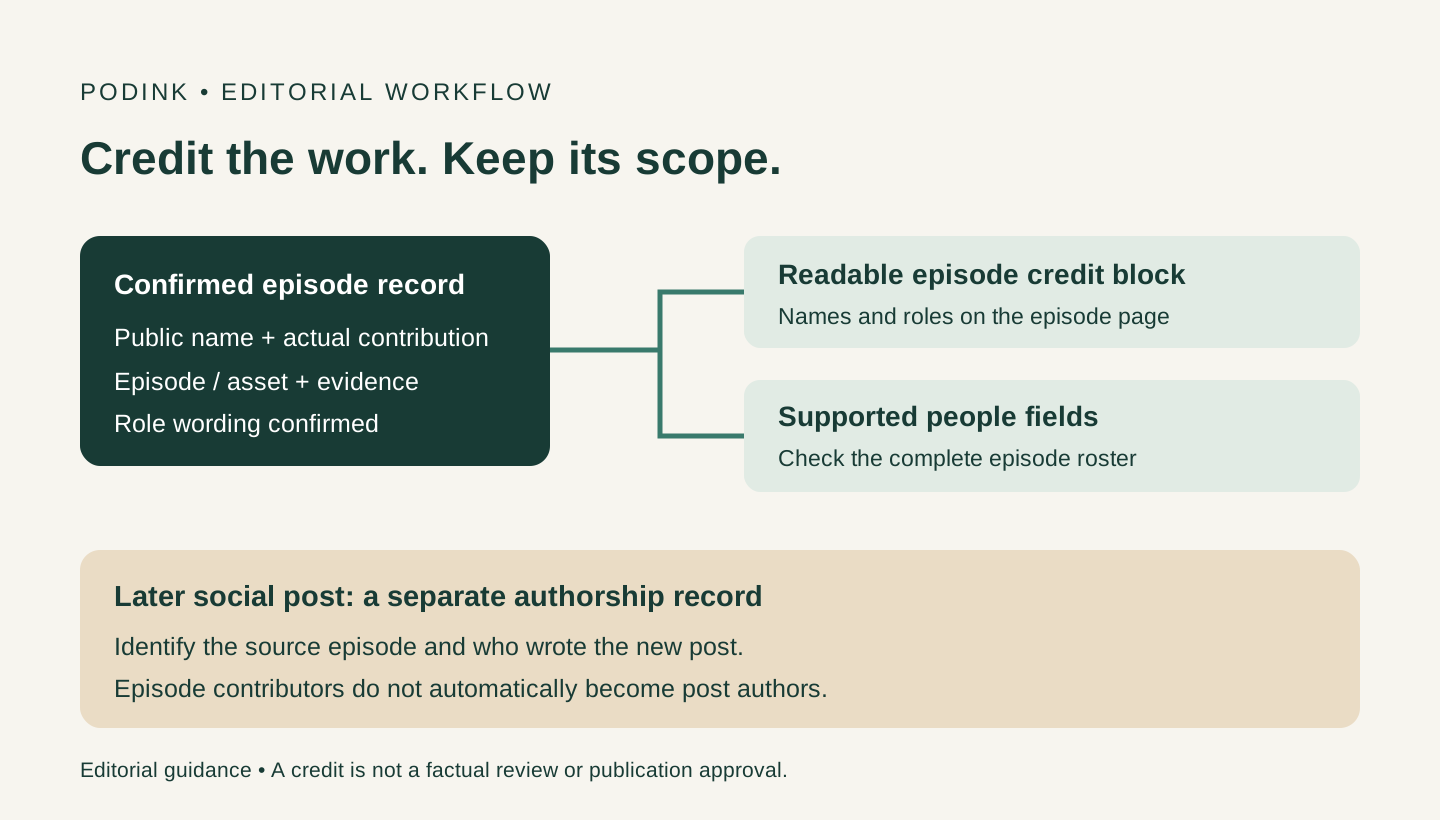
Start with a readable credit block on the episode page. If your host supports structured people fields, use the same confirmed information there. When you make a social post later, distinguish the episode’s contributors from the person who wrote or edited that post.
Name the contribution before choosing the label
Podcast Taxonomy provides role titles, groups and descriptions for podcast work. Use its definitions to discuss a role; the list cannot tell you what a particular person actually did on your episode. Source: Podcast Taxonomy project.
Confirm an unclear credit with the production owner or contributor. Someone may hold several roles, and a regular team member may not have worked on this release. A company biography cannot establish an episode-specific contribution.
| Credit describes | Confirm against | Keep separate |
|---|---|---|
| The episode | The release record: who hosted, appeared, produced, edited or supplied another contribution. | Who later wrote a promotional post. |
| A particular asset | The final artwork, clip, transcript or other deliverable and the contributor’s agreed wording. | The assumption that an asset credit covers the whole episode. |
| A statement or research result | The relevant speaker passage or original document. | A production credit, which is not evidence for the statement. |
| The social post | Who wrote or edited the specific post and which source it draws from. | The implication that the episode guest wrote or approved the post. |
Keep readable credits and feed fields consistent
The podcast:person element can describe people at show or episode level, with optional role and profile fields. The specification uses host as the default when role is omitted. For a guest or another contributor, leaving that field blank can communicate the wrong role. Source: Podcast Namespace person specification.
Write the visible credit first, then map it to supported fields. Use the contributor’s chosen name or alias and a confirmed public profile link. Do not add private contact details to a public credit.
Castopod’s published example shows people attached to a podcast or an episode, displayed on its pages and exported in RSS. That illustrates why a single confirmed record can feed multiple destinations; it does not prove how your current host or a particular listening app will display the fields. Source: Castopod’s historical person-tag example.
Rebuild the episode list when the lineup changes
The person specification says episode-level people replace the show-level people information. Adding a guest at episode level therefore requires restating the continuing host and any other people who should remain in that episode’s structured list. Source: Podcast Namespace person specification.
Compare the complete intended episode roster with the exported episode fields. Do not assume the host will merge a guest-only row with the regular show roster. If your hosting tool behaves differently, inspect its export before deciding the credits are ready.
Copyable blank credit record
Keep the source of each credit beside the public wording
Fill this internal record before preparing the public block. Leave unresolved fields marked as unresolved in the record; resolve them before publishing the affected credit.
Show / episode title / stable episode URL: [ ]
Release or media version covered: [ ]
Contributor display name or alias: [ ]
Exact contribution on this episode: [ ]
Public role wording: [ ]
Confirmed by / production record / date: [ ]
Confirmed public profile URL, if wanted: [ ]
Scope: episode / specific asset / separate social post [ ]
Destinations to update: episode page / description / supported people fields [ ]
Complete episode roster if using episode-level people fields: [ ]
Unresolved name, role or scope: [ ]
Public block — include only applicable confirmed lines:
Hosted by [name]. Guest: [name].
Produced by [name]. Audio edited by [name].
[Other confirmed contribution]: [name].
Separate social-post record: written by [name]; source episode [URL].
Build the credit record
From production notes to a readable credit block
Collect the episode’s contribution record
Start with the actual release and its production notes. List work performed, including contributions that do not appear as voices in the recording.
Resolve names and roles
Confirm the public name and role wording. When a title is ambiguous, use the role description to clarify the task rather than assigning a more impressive title. Source: Podcast Taxonomy project.
Write the episode credit block
Use short role-and-name lines. Include only the applicable confirmed roles from the template. Follow any agreed credit wording or order instead of treating this example as a universal convention.
Check supported metadata
If you use people fields, compare the entire episode roster with the export. Make non-host roles explicit and check profile links. A valid field does not establish that the name or contribution is correct. Source: Podcast Namespace person specification.
Make a separate social handoff
Identify the source episode and the author of the new post. If the post quotes a speaker, check the passage and attribution separately from the production credits.
Review the visible release
Open the episode page and the destinations you actually use. Check that names, roles and links survive. After a role correction, update the matching destinations and record what was rechecked.
Documented behavior and editorial application
A guest addition can also require a host entry
The official person specification supplies a fictional guest-episode example to explain replacement behavior. The decision below applies that documented rule; it is not a tested customer feed.
In the specification’s guest example, the episode contains both the guest and the continuing host because episode people do not simply add to the regular show list. Use that behavior to check completeness before publishing an episode-specific roster. Source: Podcast Namespace person specification.
| Destination | What belongs there | What to check |
|---|---|---|
| Episode page | Show the confirmed host, guest and applicable production contributors. | Match each name to a role on this release. |
| Episode people metadata | Supply the full intended episode roster when overriding show-level people. | A guest-only entry can omit the continuing host from the episode’s structured list.Source: Podcast Namespace person specification |
| Later social post | Identify the episode as the source and the post writer as the author of the new prose. | Do not copy the host or guest name into a post byline merely because it appears in the credits. |
Working editorial rule
“Keep the object of the contribution visible: a person can be credited for the episode without becoming the author of every post about it.”PodInk editorial recommendation
A blank social credit line might read: “Source episode: [show and episode link]. Post written by [name].” Use that wording only after confirming those roles. Add speaker attribution inside the post when the actual content requires it.
When a contributor corrects a role, find the episode page, feed fields and social drafts that copied it. Correct the affected credits and record what was rechecked. The post’s factual and publication reviews remain separate.
The useful handoff is a confirmed contribution with a defined scope. A name appearing in metadata is not a completed check of identity, statement accuracy or publication approval.
Compare how the approved core changes in the LinkedIn workflow and the X workflow.
Before sharing
Check names, roles and the release
- The credit identifies the intended episode or asset version.
- Every published name has a confirmed contribution and public wording.
- Non-host roles are explicit in supported people fields.
- The episode-level roster includes continuing contributors who should remain.
- The episode page and the destinations actually used display the intended credits.
- The social post’s author and the source speaker are not conflated.
- Unresolved credits and separate approval checks remain visible in the internal record.
Scope
What this guide does not verify
- The template and review decisions are editorial recommendations, not a universal credit order or a claim about every podcast app.
- No real production roster, contributor agreement, or episode recording was reviewed. The blank credit lines are a template, not a verified episode’s credits.
- The Castopod example is a historical publisher explanation, not a test of its current interface or of other listening apps.
- A credit record describes a contribution. Record media-use permission, factual review and publication approval separately; this guide does not establish any of them.
- No traffic, discovery, attribution accuracy or AI citation improvement was measured.
Human review remains necessary. No repurposing workflow can turn weak evidence into a strong claim.
FAQ
Frequently asked questions
Are podcast credits the same as a guest bio?
No. Credits identify a contribution to the release. A guest bio explains the guest’s relevant background. A biography can help confirm identity, but it does not establish a production role on a particular episode.
Should I put every episode credit in every social post?
Choose credits relevant to the post and any agreed requirements, and provide a clear route to the episode’s full credits. Do not imply that the guest wrote your commentary. Keep the full contribution record even when the public post is brief.
Does the podcast:person tag replace written credits?
Structured people fields can carry names and roles in compatible tools. Keep readable episode credits as well and check the destinations you use; this guide has not tested how every app displays those fields.
What if I cannot confirm a contributor’s role?
Keep the credit unresolved in the internal record and ask the responsible person to clarify. Do not guess from a job title, company biography or another episode’s credits.
Evidence
Sources and comparison pages
- Podcast Namespace person specificationPodcasting 2.0
- Podcast Taxonomy projectPodcast Taxonomy
- Castopod’s historical person-tag exampleCastopod