
Introduce the person behind the conversation
How to write a podcast guest bio
To write a podcast guest bio, introduce the guest by name, explain the work relevant to your episode, and include a checked credential or example of that work. Use a short third-person paragraph for a host-written introduction. Verify the role and links before publication, and leave episode topics in a separate sentence when the bio will be reused.
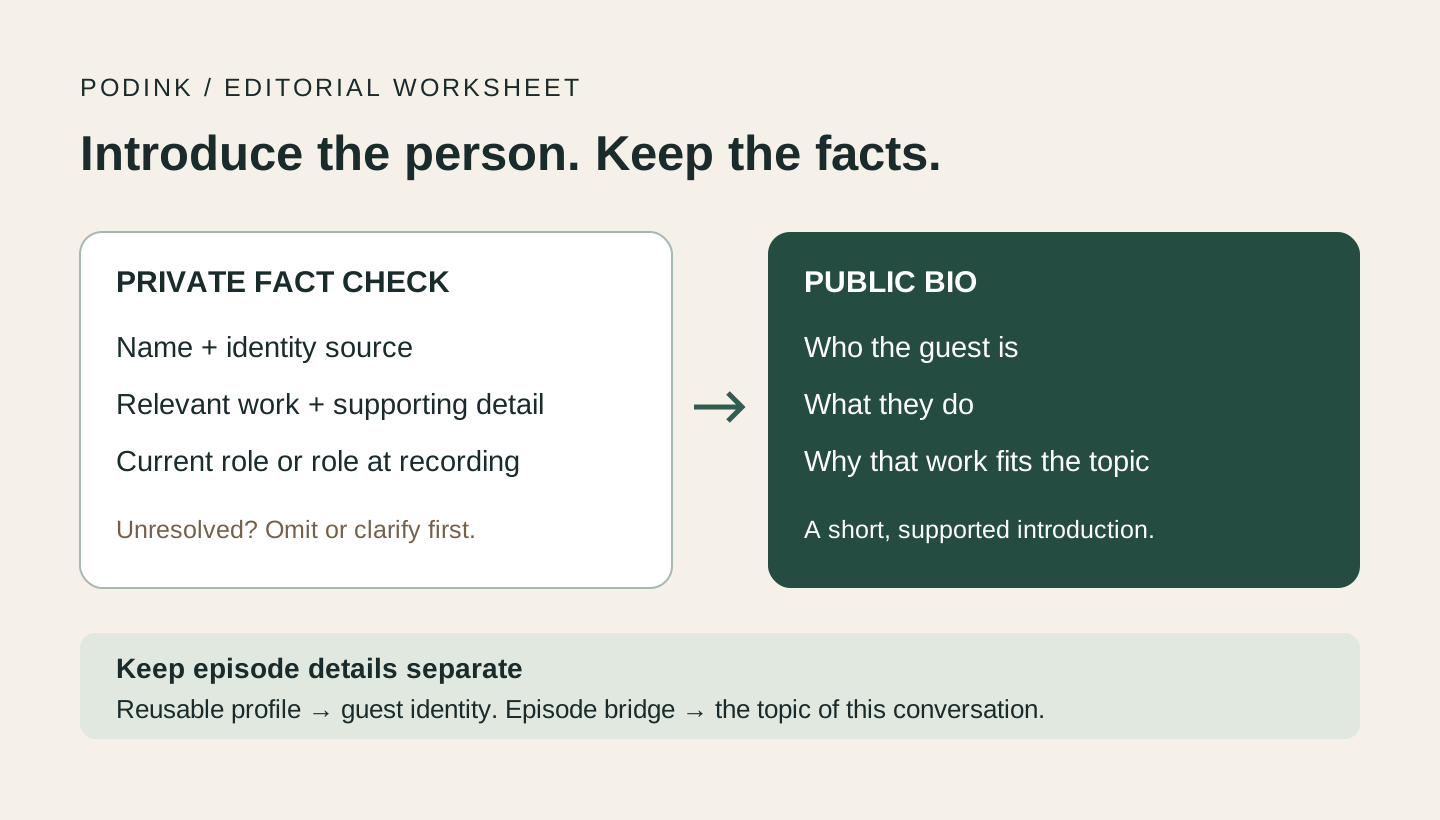
A useful bio tells a new listener why this person belongs in the conversation. The worksheet below helps you turn a long résumé or supplied introduction into a concise, factual paragraph without inventing prestige or copying an outdated job title.
Write for the listener and the destination
A guest bio introduces a person. An episode description introduces a conversation. A guest promotion kit supplies material the guest can share. Decide which piece you are writing before shortening a résumé: a reusable profile should not read as though every episode discusses the same topic.
The British Council recommends third person for event bios and selecting details relevant to the audience. Applied to a host-written guest introduction, that means naming the person and the work that explains their contribution, rather than listing every achievement. Source: British Council: audience and point of view.
A host may give you more than one place for the text. Transistor documents person profiles with a bio, photo and social links, connected to the episodes in which that person participated. That is a documented example of a reusable profile, not a promise that every host or listening app offers the same fields. Source: Transistor: people profiles.
Check identity before polishing the paragraph
Start with the guest’s supplied bio and a current source maintained by the guest or the relevant organization, such as an employer profile, personal website or publisher page. Confirm that the source belongs to the same person. Keep the URL and the wording you used in private notes. A name match alone is not enough to establish an affiliation.
If the guest’s supplied title conflicts with another source, leave the disputed title out until the conflict is resolved. Do not decide which title is current from the age of a search result alone. For a historical episode, distinguish the role held when recording from the guest’s current role instead of silently applying today’s title to the past.
Treat awards, rankings and claims such as leading expert as separate facts requiring support. A guest’s approval can confirm preferred wording; it does not independently establish an award or claim about results. Where the detail is unnecessary, remove it and describe the relevant work plainly.
| Detail | Check | If unresolved |
|---|---|---|
| Name and identity | Match the supplied name to a primary profile and confirm preferred spelling. | Hold ambiguous identity; do not merge people with similar names. |
| Role and organization | Compare the supplied role with a current source; record whether the text describes now or recording time. | Omit the disputed title or request clarification. |
| Relevant work | Check the specific book, project or responsibility that matters to this episode. | Use only supported work; do not replace missing evidence with praise. |
| Public link | Open the intended profile or work page and check the destination. | Leave out the link until it is verified. |
Keep short and longer versions consistent
Boise State’s writing guidance distinguishes long, short and two-line bios, and advises tailoring each version to its purpose while keeping shared information consistent. Use that principle to prepare a compact episode introduction and a fuller profile when the publishing destination needs both. Source: Boise State: professional biography formats.
For the compact version, retain identity, relevant work and a useful supporting detail. A fuller version can add background and a checked follow-up link. Length is an editorial choice constrained by the destination, not a universal word count that improves podcast discovery.
Keep the episode-specific bridge separate: “In this episode, [name] discusses [checked topic].” Remove that bridge from the reusable bio. When a role changes, review every saved version rather than updating only the most recent episode.
Use AI to shorten supplied facts, then review every claim
University of Utah’s guidance calls for reviewing AI-written biographies for accuracy before posting. Give a writing tool verified facts and a destination, then compare its output against those facts. Fluency cannot confirm a qualification or affiliation. Source: University of Utah: review AI-written bios.
A useful editing request is: “Write a concise third-person guest bio using only the verified details below. Keep unsupported titles and praise out. List unresolved questions separately.” Check that the output has not turned an interest into professional expertise or a contribution into sole ownership.
If your workflow calls for guest review, send the exact paragraph and its intended placement for that review. Keep a later rewrite as a new version. Writing this guide does not contact a guest or establish that anyone has approved a bio.
Copyable bio worksheet
Separate the public paragraph from the private fact check
Use the public lines for the finished introduction. Keep evidence, conflicts and approval status in working notes. Do not paste unfinished fields into your podcast host.
PUBLIC BIO
[Full name] is [verified role or concrete description of work].
[Name] [does / created / wrote / studies a relevant, verified piece of work].
[Optional: a checked link for further reading.]

EPISODE-SPECIFIC BRIDGE — OMIT FROM REUSABLE PROFILE
In this episode, [name] discusses [topic checked against the episode].

PRIVATE REVIEW
Destination: [episode introduction / reusable guest profile / other]
Name and identity source: [URL; preferred spelling]
Role and time frame: [current / at recording; evidence]
Relevant work: [specific contribution; source]
Conflicting detail: [omitted / clarification needed]
Claims removed: [unverified praise, credentials or results]
Guest review if required: [exact version; pending / confirmed]
Saved display and links: [checked / pending]
Prepare the introduction
Turn verified guest details into a usable bio
Choose the bio’s job
Name the destination and audience. Decide whether the paragraph introduces a guest for this episode or describes them across several appearances. Put the episode topic in a separate bridge when you need a reusable profile.
Build the fact ledger
Check the name, relevant role, work and public link. Record conflicting information before drafting. Keep credentials out unless they are supported and useful to the listener.
Draft from the supported details
Use the name, concrete work and a relevant supporting detail to form a short paragraph. Prefer what the guest does to how impressive they are. Make a shorter version by removing optional background, not by broadening the remaining claims.
Review the final version in place
Compare every claim to the ledger. Resolve any review required by your workflow, then inspect the saved paragraph and links in the publishing destination. Keep unresolved identity or role questions out of the public copy.
Invented editing exercise
Edit an invented guest brief into a short bio
The guest brief below is a fictional teaching example, not a real person’s biography or an account of an interview. Assume the verified brief says Morgan Vale produces an independent interview series and edits its interview preparation notes. The episode topic is preparing follow-up questions. A supplied promotional paragraph also says world-renowned coach, but the brief supplies no support for that description.
| Supplied detail | Evidence or relevance | Editing decision |
|---|---|---|
| Morgan Vale produces an independent interview series. | Supplied as a verified fact within this invented exercise. | Keep: it identifies the guest’s relevant work. |
| Morgan edits the series’ interview preparation notes. | A concrete responsibility relevant to the episode topic. | Keep: it explains the connection to preparing questions. |
| World-renowned interview coach. | Unsupported prestige and an additional professional role. | Remove both claims; do not soften them into respected expert. |
| The episode covers preparing follow-up questions. | About this conversation, rather than the guest’s continuing identity. | Use as an optional bridge outside the reusable bio. |
Completed fictional bio
“Morgan Vale produces an independent interview series and edits its interview preparation notes.”PodInk editorial biography check
The finished sentence gives the name and relevant responsibilities without inventing an employer, credential or audience result. It is short because the verified brief is short; there is no need to add background merely to fill space.
Episode bridge for this exercise: “In this episode, Morgan discusses preparing follow-up questions.” Keep that sentence with this episode. For a real recording, verify the topic before using the bridge.
If a later source supplies more background, check it before expanding the bio. Preserve the earlier approved version and identify which public placements need the new text.
Use the example’s editing decisions, not its invented identity. Replace the facts with checked information about your actual guest.
Compare how the approved core changes in the LinkedIn workflow and the X workflow.
Before publication
Check the person, wording and destination
- The name belongs to the intended person, and preferred spelling is confirmed.
- Every role, credential and claim of achievement has a source; conflicting details are resolved or omitted.
- The selected work explains why this guest is relevant to the audience.
- Short and longer versions agree on shared facts and distinguish current roles from historical ones.
- The episode-specific bridge is kept out of reusable profiles.
- Required review applies to the exact version; the saved paragraph and public links have been checked.
Evidence and scope
What this guide establishes
- Sources were reviewed on November 9, 2026. Writing guidance supports editorial choices; it does not establish search demand, ranking improvements or a required bio length.
- The example and diagram are original teaching materials. No guest identity, credential, approval or real episode audio was verified for the fictional example.
- Transistor is a documented example of profile placement, not a tested integration or a claim about every podcast host.
- PodInk does not verify a guest’s employment, credentials or permission through this worksheet. Complete those checks using appropriate sources and your editorial process.
Human review remains necessary. No repurposing workflow can turn weak evidence into a strong claim.
FAQ
Frequently asked questions
How long should a podcast guest bio be?
Use the length needed to establish the guest’s relevant identity and work within the destination’s limits. A short paragraph often serves an episode introduction; a reusable profile may need more background. Keep shared facts consistent rather than padding every version to one word count.
Should a podcast guest bio use first or third person?
For a host-written introduction, third person lets the show describe the guest clearly. A guest’s own personal profile may use first person. Choose the voice for the destination and avoid making the guest appear to endorse words they have not reviewed.
What if the guest has no formal credentials?
Describe relevant work or experience you can support. A role in the conversation does not require an invented credential. Explain the contribution plainly and leave unsupported claims of expertise out.
Can I reuse a guest bio from an older episode?
Use it as a starting point, then recheck identity, roles, links and relevant work. Preserve historical context where needed. Remove an old episode-specific topic sentence from a reusable profile, and follow your review process for the revised text.
Evidence
Sources and comparison pages
- Conference biosBritish Council
- Writing a Professional BioBoise State University Writing Center
- How to Write & Optimize Your Online Bio For an Academic AudienceUniversity of Utah Health
- Add host and guest credits to your podcastTransistor