
Podcast disagreement posts
How to disagree with a podcast guest in a social post
To disagree with a podcast guest in a social post, state the guest’s actual claim with its limits, identify exactly where you disagree, and give a reason that addresses that same point. Keep your alternative separate from the source. If your objection disappears when you restore a missing condition, revise the objection before writing the hook.
A clear rebuttal lets readers compare positions without having to guess what either person meant. This guide provides an objection record and a fictional worked example. It covers disagreement with a position, rather than a general episode summary or an engagement tactic.
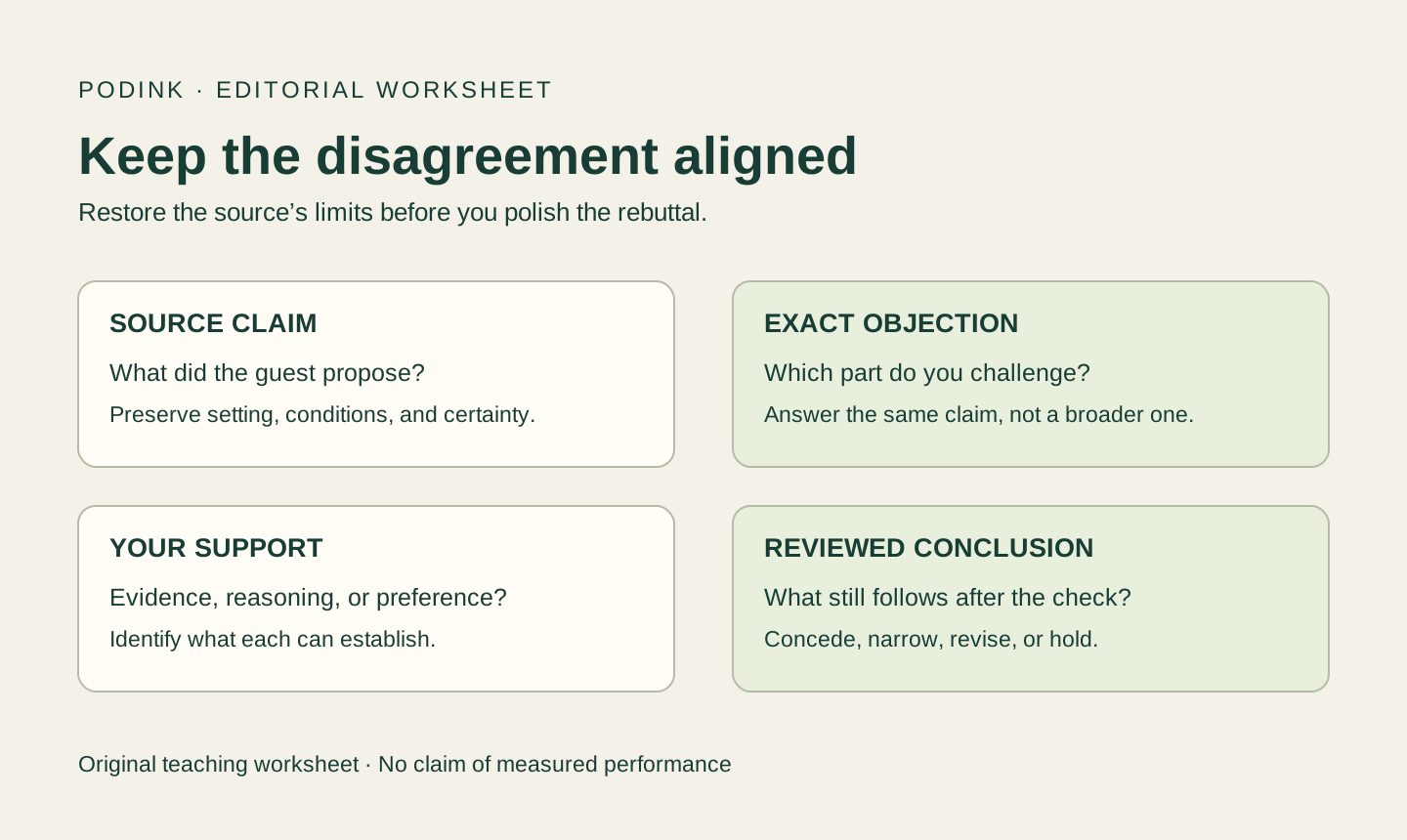
Name the part of the claim you disagree with
Write the source claim before your response. Then name the disputed part: the reported fact, the inference drawn from it, the proposed action, or the priority behind that action. Those disagreements need different support. The table is an editorial worksheet for this guide, not a classification supplied by the podcast.
| Disputed part | Useful support | A response that misses the point |
|---|---|---|
| Reported fact | A recoverable source that contradicts the same fact, with compatible dates and scope. | Disliking the guest’s recommendation does not disprove their description. |
| Inference | Explain which step from evidence to conclusion does not follow, or offer a supported alternative explanation. | Repeating the same facts with a stronger adjective. |
| Recommendation | Identify a relevant drawback, unmet condition, or alternative for the same decision. | Criticizing an unconditional rule when the guest proposed a limited experiment. |
| Priority or preference | Name the tradeoff you would weigh differently and explain why. | Calling a different preference factually false without an empirical claim to test. |
Represent the position before you challenge it
The UNC Writing Center advises representing opposing arguments fairly rather than making them look foolish. Applied to a podcast post, that means preserving a condition even when removing it would make your reply easier to write. Source: UNC: counterargument.
Save the speaker, source link, passage locator, and neighboring qualification. Check whether the guest is making a claim, asking a question, or reporting someone else’s view. Use the quote-context guide when that distinction is unresolved.
Purdue OWL recommends checking a paraphrase against the original and retaining source information. An attributed paraphrase can make a position easier to read, but it cannot replace a qualified suggestion with an absolute rule. Source: Purdue: paraphrasing.
Do not invent a stronger position on the guest’s behalf. Describe the best-supported reading of what is actually available. If two readings remain plausible, explain the ambiguity or hold the rebuttal; do not choose the reading that makes the guest easiest to defeat.
Let the objection change your own conclusion
Harvard’s Writing Center explains that a counterargument may justify revising a thesis, conceding part of it, or refining its scope. For a social post, write what you accept as well as what you would change. Source: Harvard: counterargument.
A bad outcome in a different setting does not, by itself, refute advice confined to the original setting. Compare the team, task, timeframe, and proposed action before presenting the outcome as evidence against the claim. If those differ, your post may be an application boundary rather than a rebuttal.
Separate a supported empirical objection from your preferred policy. You can say you would start with written updates because you prioritize uninterrupted work. To claim written updates perform better, you need evidence for that outcome and context. A reasoned preference and a measured result are different claims.
A fair source description does not make your response true. Check the evidence for your alternative with the same care you applied to the guest. If that evidence remains missing, narrow the ending to a question, a proposed test, or a clearly identified preference.
Copyable objection record
Save the claim, objection, and support together
Complete the source fields from material you actually checked. Keep placeholders in a draft until you can replace them with a recoverable source. This record is a writing aid, not automatic approval.
SOURCE: guest / episode / URL / locator / evidence medium checked
SOURCE CLAIM: faithful wording or attributed paraphrase
SOURCE LIMITS: people / setting / timing / exceptions / degree of certainty
DISAGREEMENT: fact / inference / recommendation / priority
MY EXACT OBJECTION: the part I challenge and why
SUPPORT FOR MY RESPONSE: source or reasoning; same setting or a different one?
WHAT I ACCEPT: the part that remains reasonable or supported
MY CONCLUSION: alternative / narrower claim / preference / unresolved question
FINAL POST VERSION / REVIEW DATE / UNRESOLVED CHECKS:
Disagreement review
Move from a reaction to a reviewable objection
Recover the full claim
Reopen the passage and its relevant context. Save the source medium you checked. Do not label a transcript-only reading as a recording check.
Write a neutral source sentence
State the speaker’s position without the wording of your objection. Compare the scope and certainty with the source before adding commentary.
State one precise objection
Explain the gap between the source position and your response. If your objection depends on a condition the guest already excluded, change the target of your post.
Match your support to your conclusion
Distinguish evidence of an outcome from a personal priority or a hypothetical concern. Label a proposed test as a proposal, not an established solution.
Recheck the hook and ending
The opening must not accuse the guest of a broader claim than the body supports. Keep the source recoverable in the version you actually share, and retain the limit that changes the disagreement.
Fictional teaching example — no real guest
A daily check-in proposal becomes a different argument when its limit is removed
Every statement in this example is invented for instruction. There is no episode, guest, recording, measured team result, or published social post behind it.
Invented source statement: “For a small team with one shared project, I would try a daily check-in while the work is changing quickly.” The proposal has a setting and an experimental status. Neither should disappear from the response.
| Draft component | Initial version | Reviewed version |
|---|---|---|
| Source position | The guest says every remote team needs a daily meeting. | The fictional speaker proposes trying a check-in for a small team on one fast-changing project. The original does not establish a rule for every remote team. |
| Objection | Daily meetings are always a waste of time. | I would use a check-in only when a shared decision is blocked; otherwise I would start with a written update. This is a proposed decision rule, not a measured superiority claim. |
| Concession | None: reject the entire idea. | A quickly changing shared project can be a reason to consider a check-in. My disagreement concerns starting with a scheduled daily check-in, even as a trial. |
| Conclusion | The guest is wrong about remote work. | Test whether a scheduled check-in or a written update addresses the actual coordination need; do not claim this fictional example settles the outcome. |
Question to ask before polishing the rebuttal:
“Am I answering the guest’s claim, or a stronger claim I supplied?”Editorial prompt for this guide
Illustrative post, based only on the fictional statement: The proposal is to try a daily check-in for a small team on a fast-changing shared project. That is narrower than a rule for all remote work. I would still make the meeting conditional on a blocked shared decision, rather than begin with a daily schedule. My priority is preserving uninterrupted work when a written update is enough; I am not claiming a measured productivity advantage. I would review what each check-in actually helped the team decide before keeping the routine. I disagree with starting the trial on a daily schedule; I still accept the need for coordination.
The revised post preserves the proposal’s setting and status. It also narrows the writer’s conclusion: a preference and a proposed review, rather than an unsupported claim that meetings always fail. The sentence about a written update is the writer’s condition, not an additional statement by the fictional speaker.
For a real post, replace the invented source with material you can reopen, add its source link and locator, and verify any factual support you introduce. If you do not share the stated preference, write your own. Do not attach a real person’s name to this teaching example.
The example demonstrates claim alignment and a bounded response. It does not establish which coordination method works better or certify any real podcast quotation.
Compare how the approved core changes in the LinkedIn workflow and the X workflow.
Objection record
What to check before sharing the response
- The source sentence retains the guest’s conditions, certainty, and attribution.
- The objection addresses the same claim and setting, or openly explains why the setting differs.
- The response identifies its own evidence, reasoning, or preference instead of borrowing authority from the source link.
- The concession is meaningful and does not invent an endorsement.
- The hook and conclusion match the narrower position described in the body.
- The shared draft retains a recoverable source and identifies any unresolved uncertainty.
Scope of this guide
What this review cannot establish
- This is an editorial method, not evidence that disagreement increases reach, persuasion, or search visibility.
- The worked example is wholly fictional. No audio was reviewed and no statements are attributed to an actual guest.
- The cited writing-center guidance supports representation and argument review. It does not validate the fictional coordination proposal or its alternative.
- Checking the source’s meaning does not establish that either the source claim or the rebuttal is true. Claims about outcomes need their own evidence.
Human review remains necessary. No repurposing workflow can turn weak evidence into a strong claim.
FAQ
Frequently asked questions
Do I need to quote the guest directly to disagree?
No. An attributed paraphrase can state the position clearly if it preserves the meaning and the source remains recoverable. If you analyze the precise wording, identify and verify the medium you quote.
What if I agree with the guest’s observation but reject the advice?
Say so. Accept the supported observation, then identify why the proposed action does not follow for your situation or priorities. Do not turn disagreement about the action into a claim that the observation is false.
Can a hypothetical example refute a podcast claim?
A hypothetical can expose an assumption or illustrate a possible limitation. It does not establish that an outcome occurred. State the example’s status and match the conclusion to what the reasoning supports.
Should I keep a strong hook if the body adds the qualification?
Revise the hook if it misstates the position. A later qualification does not make the opening attribution accurate. Make the disagreement precise in the opening and preserve that boundary through the ending.
Evidence
Sources and comparison pages
- CounterargumentHarvard College Writing Center
- ArgumentUNC Writing Center
- Paraphrasing: Write It in Your Own WordsPurdue OWL