
Name the episode listeners will actually hear
How to write podcast episode titles
To write a podcast episode title, name the episode’s central subject and the specific question, story or explanation it delivers. Put the useful distinction near the beginning. Check the title against the finished recording, then let the description add context instead of repeating the same promise.
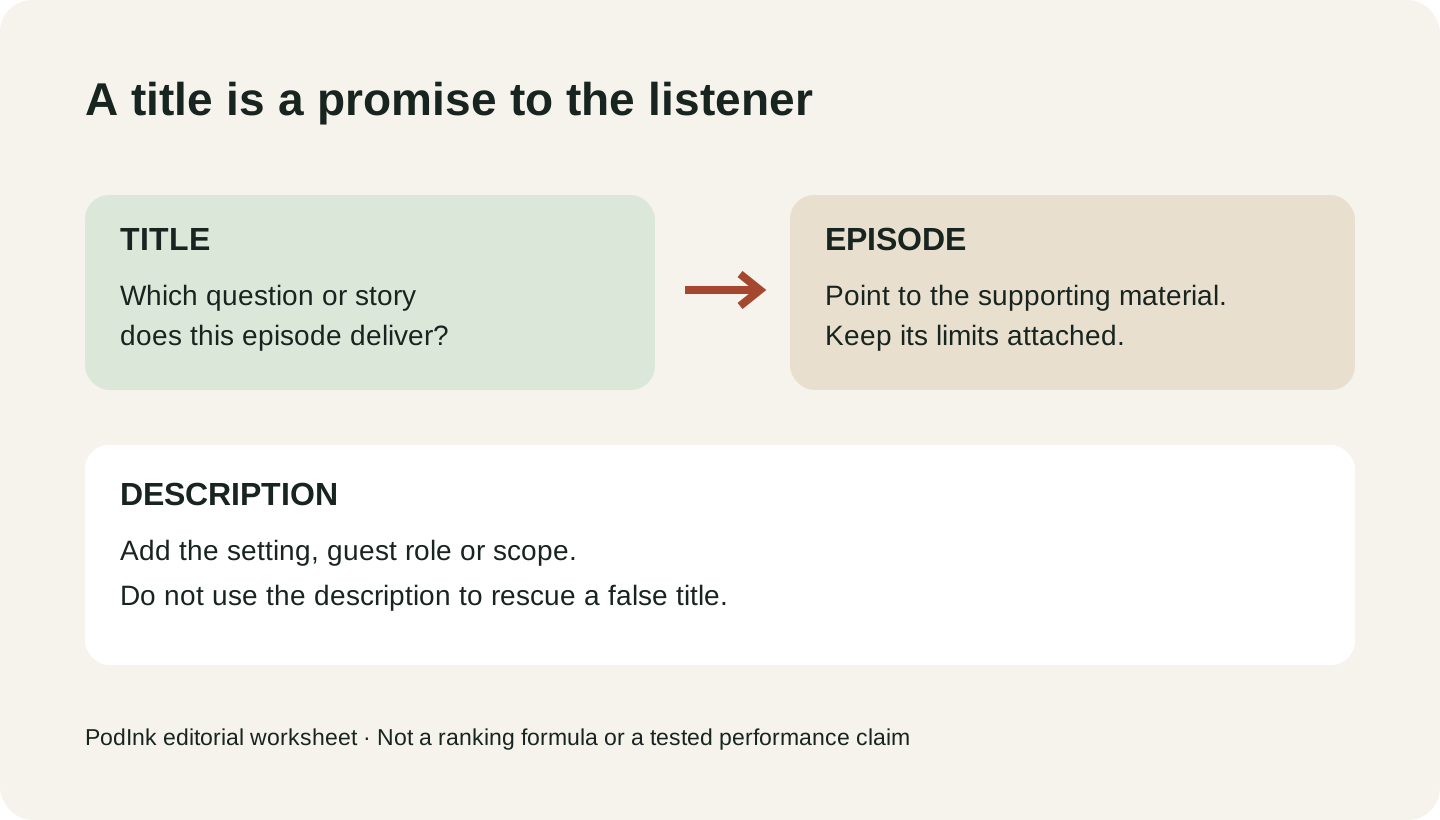
A striking sentence from a guest can be a poor title for the whole episode. Use the worksheet below to compare what a title promises with what the episode covers before choosing the wording.
Choose the whole-episode promise
A title should help someone decide whether this particular episode addresses their interest. Start with a plain sentence about the material: the guest explains a process, the host examines a question, or the episode follows a story. A question title works when the episode meaningfully explores that question; it does not need to pretend there is a definitive answer.
Apple recommends leading with important episode information and keeping a consistent title layout while giving each episode a distinct title. Apple also directs creators to put episode numbers in the appropriate feed tags instead of packing the title with show details. Source: Apple’s episode-title guidance.
For a practical interview, keep the task recognizable. For a narrative episode, identify the central situation without revealing the ending. A narrow example can carry the title if it is central to the episode, but an interesting aside should not become a promise of a full tutorial. This is an editorial decision about coverage, not a measured ranking rule.
Give the title and description different jobs
The title names the reason to listen. The description can add the guest’s relevant role, the setting, and a boundary that would overload the title. Spotify’s writers advise making the description complement the title rather than repeat its information. Source: Spotify on titles and descriptions.
Do not rely on the description to rescue a false headline. If the title promises a guaranteed result while the episode describes an uncertain attempt, change the title. The description can supply nuance; it should not contradict the line a listener sees first.
Keep the useful words visible
RSS.com recommends putting important words early and matching a curiosity hook to material the episode delivers. Treat that as writing guidance, not proof that a particular keyword order will improve your rankings. Source: RSS.com’s episode-title lesson.
There is no single title length used here as a universal cutoff. Check the title in the actual destination and on a narrow screen. If only the opening is visible, the subject should still be understandable. Move a guest’s name forward when the person is the central draw; otherwise lead with the topic and place the name after it.
A chapter title labels a section inside the episode. A social hook introduces a particular post. Keep those tasks separate from naming the complete episode, even when the same source passage contributes to all three.
Copyable title review
Keep the promise beside the evidence
Use one worksheet per candidate. Save these working notes outside the public episode description. Record unresolved checks before choosing a title.
Episode / final recording version:
Audience question or central story:
Candidate title:
What a new listener would expect from this title:
Supporting passages or sections in this version:
Does the episode explain, explore, demonstrate, or merely mention the subject?
Qualification that must remain in the title:
Context that can move to the description:
Guest name and role checked against the source:
Narrow-screen display / destination checked:
Decision: keep / narrow / replace / hold
Selected title + complementary description:
Choose the promise
From episode material to a checked title
Describe the episode before drafting a headline
Write the central question or story in ordinary words. Check that your notes represent the episode as a whole. If all your support comes from a short aside, use a broader title or prepare a separate clip title.
Draft different promises
Try a topic-led title, a question-led title and, where relevant, a guest-led title. The alternatives should offer different reasons to listen, not only shuffle the same words. Reject any version that depends on an outcome the source does not establish.
Map the title to the source
Inspect words that make a claim: why, how, proves, stopped, always. Find the source material needed for each. A how-to title should have an explanation a listener can follow; a successful case should not become a universal rule.
Pair and preview
Write a description that adds useful context. Check the saved title in the destination app, including the visible opening on a narrow screen. Confirm spelling and episode metadata, and record any display or recording checks still missing.
Constructed editing example
A title review for an invented interview
Assume an invented interview with operations lead Maya Chen. The guest discusses a delayed launch, how the team compared dependencies and customer commitments, and why the decision remained uncertain. No results or customer metrics are supplied. These invented notes are the complete evidence boundary for this exercise.
| Candidate title | Implied promise | Editorial decision |
|---|---|---|
| How to Never Miss a Launch Date Again | A repeatable method that prevents future delays. | Reject. The notes describe one uncertain decision and no prevention method or measured result. |
| A Conversation with Maya Chen | The guest is the main reason to listen. | Too little topic information for a reader who does not know this invented guest. Add the subject. |
| When to Delay a Launch: A Team’s Decision | An explanation of a particular team’s decision, with limits. | Keep as the working candidate. The wording frames a case, not a guarantee that the same choice fits every team. |
| Launch Timing with Maya Chen: Dependencies and Trade-offs | An interview about how competing constraints affect timing. | A usable alternative if the guest identity matters to the audience. Check whether the opening remains clear in the destination. |
Editorial choice
“A title can create curiosity without claiming that the episode proves a result.”PodInk editorial title check
Selected title: When to Delay a Launch: A Team’s Decision
Complementary description: Operations lead Maya Chen discusses how a team weighed unfinished dependencies against customer commitments. The conversation follows the trade-offs behind a delay and the uncertainty that remained.
The description adds the role and constraints instead of repeating the title. Every substantive detail comes from the invented notes above. If the actual recording were only a brief mention of a delay, this title would need to be narrowed or replaced.
The title comparison is a writing exercise, not a real interview or performance test. Use your own source material to choose between titles; no candidate here has been tested for clicks or listening.
Compare how the approved core changes in the LinkedIn workflow and the X workflow.
Before you save
Test the promise, not only the wording
| Draft signal | What to inspect | Repair |
|---|---|---|
| How to, with no usable explanation | Does the episode explain the task or only mention it? | Change to a topic or question the episode actually explores. |
| A universal claim from a single account | Does the source support always, never or everyone? | Name the particular case and preserve uncertainty. |
| A guest’s name with no subject | Would a new listener understand what the episode covers? | Add the concrete topic or question. |
| Description repeats the title | Does the second line add context? | Add the setting, guest role or limits without making a new unsupported promise. |
- The central subject is visible in the opening words.
- The title’s promise matches the episode’s depth and scope.
- Names, roles and quoted words have been checked against the source.
- The description complements rather than contradicts the title.
- Episode numbering and other metadata follow the destination’s instructions.
- Actual display and recording checks are recorded, including those not yet performed.
Evidence and scope
What this guide does and does not establish
- Platform guidance was read on November 7, 2026. The recommendations describe editorial choices, not guaranteed search visibility, listening or AI citations.
- The Maya Chen interview, source notes and title candidates are invented teaching material. No real guest, customer story, recording, app display or audience experiment was reviewed for the example.
- PodInk’s source-review approach can help organize evidence, but this guide does not claim PodInk edits RSS metadata or publishes episode titles for you.
Human review remains necessary. No repurposing workflow can turn weak evidence into a strong claim.
FAQ
Frequently asked questions
Should I put the episode number in the title?
Apple recommends using the relevant RSS feed tags for episode numbers and keeping redundant show details out of the title. Follow your destination’s current instructions and confirm how numbering is displayed, especially for a serial show.
Can I use the same wording as a social post hook?
Only if it describes the whole episode accurately. A social post can focus on one claim or reaction; the episode title should not promise that the complete recording is about a brief aside.
Should I change an old episode title to improve clicks?
First identify a specific problem such as an unclear topic, a misspelled name or an unsupported promise. Record the old title and the reason for the change. Any later performance comparison needs comparable data; a title edit alone does not establish why listening changed.
Evidence
Sources and comparison pages
- Present your podcastApple Podcasts for Creators
- How to write episode descriptions, according to Spotify writersSpotify for Creators
- How do you write episode titles people click?RSS.com Learning Center