
Give listeners a reason to press play
How to write a podcast episode description
To write a podcast episode description, lead with the episode’s specific topic, add the guest or setting that makes it distinct, and explain what the conversation covers. Check each promise against the finished episode. Pair the description with the title so the opening adds information, then put supporting links and credits below it.
A new listener should be able to tell what this episode covers before pressing play. Use the template and invented example below to replace broad promotional copy with a concrete preview.
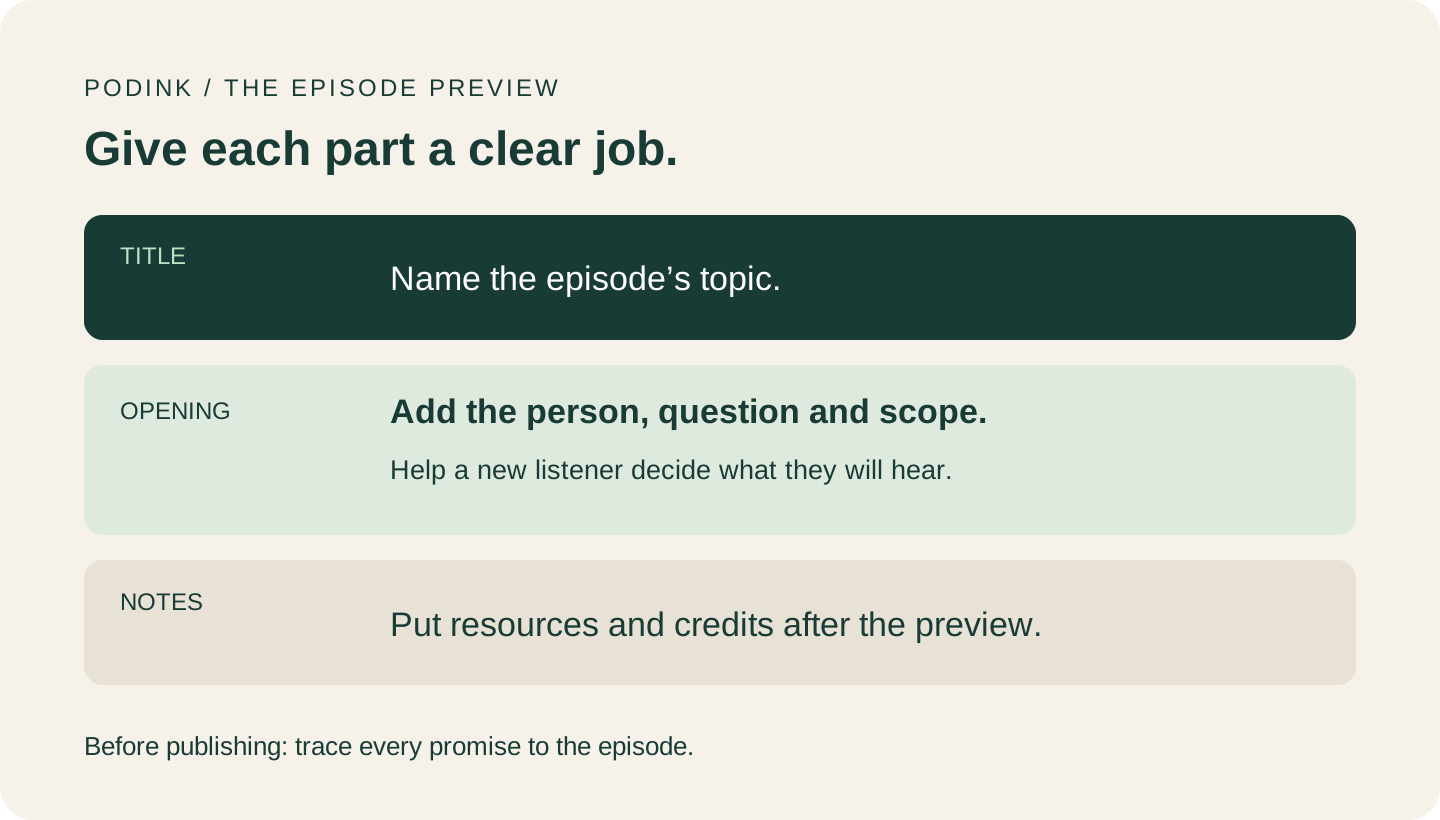
Describe the episode, not the entire show
A show description introduces the continuing series. An episode description gives someone a reason to choose this particular installment. Keep the episode’s question, event or guest contribution visible instead of opening with the same welcome sentence every week.
Apple describes the episode description as sentences that introduce the episode to potential listeners. For episodes distributed through RSS, Apple directs creators to make changes with their hosting provider; uploading a description to a separate document does not update the feed. Source: Apple episode guidance.
Spotify also calls episode descriptions show notes. The useful distinction is therefore about parts of the text, not a universal naming rule: write a clear opening preview, then add whatever references, credits or other notes the episode needs. Source: Spotify description formatting.
| Part | What it answers | Keep out |
|---|---|---|
| Title | What is this episode about? | A promise that the episode does not deliver. |
| Opening description | Who or what makes this episode specific, and what will I hear? | A repeated title, generic welcome or unsupported outcome. |
| Supporting notes | Where are the resources, credits or chapter details? | A wall of links before the listener knows the topic. |
Let the opening complement the title
Spotify’s writers recommend concise descriptions, with the guest’s relevant identity and episode topics near the front. They also advise making the title and description complement each other. Their short-description advice is an editorial recommendation, not a universal technical character limit. Source: Spotify writers’ description guidance.
Read the title and first sentence together. If both say only “how to plan an interview,” use the sentence to name the angle: preparing follow-up questions, researching a guest’s work, or handling an unexpected answer. Choose an angle the episode actually covers.
For a narrative episode, identify the situation and the question it raises without giving away the ending. For an interview, explain why this guest’s contribution matters to the topic. Do not add a professional credential or a dramatic outcome from memory.
Check the saved description where listeners will read it
Spotify’s editor supports rich text and links; externally hosted descriptions use supported HTML from the feed. Spotify specifies HTTPS links and warns that descriptions can appear differently across listening platforms. Use the host’s supported formatting, then inspect the saved result. Source: Spotify formatting and link requirements.
Preview the beginning on a narrow screen, but do not assume a fixed number of visible characters across apps. Check that the topic remains understandable if the rest is collapsed. Open important links, verify their labels, and look for merged paragraphs or visible markup.
Keep a plain-text copy before editing the host’s description field. If the preview loses formatting, simplify the affected section and save again. This is a publishing check to perform in your destination; the example below has not been tested in a podcast app.
Copyable description template
Draft the public paragraph beside a private evidence check
Fill the public lines with episode-specific details. Keep the review lines in your working notes so a reviewer can trace the promises before you paste the final description into your host.
PUBLIC DESCRIPTION
[Guest or host, with a verified relevant role] explores [specific question or situation].
The episode covers [supported point] and [supported point], including [important boundary, if needed].
[Optional: one concrete reason to listen that the episode actually delivers.]

SUPPORTING NOTES
Resources mentioned: [descriptive label + checked HTTPS link]
Credits / chapter information / relevant disclosures: [as applicable]

PRIVATE REVIEW
Episode title + final recording version:
Opening sentence adds this information beyond the title:
Passage supporting each substantive promise:
Guest name / role / resource links verified:
Outcome or claim removed because it lacks support:
Destination preview checked / still pending:
Final description and reviewer decision:
Write the preview
Build the description from checked episode material
Collect the episode’s actual scope
Use the final recording and your checked notes. Write down the central topic, the speaker’s relevant contribution, the setting and any uncertainty that affects the promise. A transcript can locate material; check the recording before presenting wording as an audio-verified quotation.
Write the opening beside the title
Draft a short paragraph that adds context to the title. Prefer a concrete question or situation over praise such as insightful or inspiring. Choose verbs that match the material: explores for an open question, explains for a process, and demonstrates only when a demonstration is actually present.
Remove promises you cannot trace
For each statement, ask what in the episode supports it. A discussion of possible improvements does not establish a measured improvement. Delete invented results, unverified credentials and universal advice drawn from a single experience.
Add useful notes and inspect the result
Place relevant resources and credits after the preview. Save through the publishing system that controls the episode, inspect the displayed text, and test the links. Keep any recording or display checks still outstanding in the private review notes. Source: Apple RSS publishing workflow.
Invented editing exercise
Turn an invented episode brief into a description
The description example is a constructed exercise, not a real interview. Assume an episode with producer Alex Rivera about preparing follow-up questions for interviews. The supplied brief covers researching a guest’s recent work, listening for an unexpected answer, and deciding when to leave the prepared question list. It contains no audience data or claim that the approach works in every interview.
| Draft element | Problem or purpose | Revision decision |
|---|---|---|
| Title: Preparing Better Interview Follow-up Questions | Names the task. | The description should add the producer’s perspective and the specific preparation choices. |
| Initial description: Join us for an insightful conversation about better interviews. | Repeats the broad topic with praise. | Replace the welcome and praise with the specific preparation and listening decisions from the brief. |
| Tempting addition: Learn the proven formula for interviews your audience will love. | Promises a validated method and audience response. | Reject. Neither claim exists in the supplied brief. |
| Revised opening: Producer Alex Rivera explores how to prepare follow-up questions without treating the question list as a script. | Names the speaker’s role and the central tension. | Keep for this exercise: it reflects the supplied topic and the decision to depart from prepared questions. |
Completed example description
“Producer Alex Rivera explores how to prepare follow-up questions without treating the question list as a script. The conversation connects research into a guest’s recent work with listening for unexpected answers and deciding when to leave the prepared list.”PodInk editorial description check
The opening adds a practical tension beyond the title. The next sentence supplies the actual material: research, listening and the choice to depart from prepared questions. Neither sentence promises an audience result.
The brief does not name resources, so the completed example does not invent links or credits. With a real episode, add only resources actually mentioned or clearly label any additional reading you recommend.
Cut test: read only the first sentence. A listener still gets the topic and angle. Then read both sentences: the second must add coverage, not repeat the first. This is a useful editing check, not a claim about where any app will truncate the text.
Replace the invented speaker and details with checked material from your own episode. Do not publish this example as an account of a real recording.
Compare how the approved core changes in the LinkedIn workflow and the X workflow.
Before you save
Review the promise and the saved display
- The opening describes this episode, rather than the whole series.
- The title and description add information to each other without conflicting.
- The speaker’s name, role and every substantive promise have support in the episode or a checked source.
- Open questions remain open; no discussion has been turned into an established result.
- Resource labels match the destination, important HTTPS links open, and the saved description contains no placeholders or visible markup.
- The saved preview is legible on a narrow screen; formatting and recording checks are recorded honestly.
Evidence and scope
What this guide establishes
- Platform documentation was reviewed on November 8, 2026. Editorial recommendations are not guarantees of search rankings, clicks or listening.
- The worked example and diagram are original teaching materials. No real episode, listener experiment or performance result is presented.
- No podcast-app display or episode audio was tested for this guide. Complete those checks for the episode and publishing destination you use.
- PodInk does not publish a podcast description to your host through this guide. The worksheet is usable independently of the product.
Human review remains necessary. No repurposing workflow can turn weak evidence into a strong claim.
FAQ
Frequently asked questions
How long should a podcast episode description be?
Use a concise opening that identifies the topic, relevant speaker or setting, and scope. Add supporting notes below when needed. Spotify’s short-description advice is a writing recommendation; confirm your host’s field limits and inspect the saved display instead of treating a single length as universal.
Are episode descriptions and show notes the same thing?
The labels overlap: Spotify calls its episode descriptions show notes. You can still separate their functions within the text. Put the listening preview first, followed by references, credits or chapter details that help someone use the episode.
Should the description repeat the episode title?
The description should work with the title. If the title names the question, the description can add the guest’s relevant perspective, setting or specific points covered. Repeating the title verbatim uses space without adding a reason to choose the episode.
Can I write the description from an AI summary?
Use a summary as a starting draft, then trace its promises to the final episode. Check names, roles, uncertainty and any claimed outcomes. A fluent summary does not verify that the recording contains the promised explanation or result.
Evidence
Sources and comparison pages
- How to write episode descriptions, according to Spotify writersSpotify for Creators
- Create an episodeApple Podcasts for Creators
- Formatting your show notesSpotify Support