
From several episodes to one argument
How to combine multiple podcast episodes into one post
To combine multiple podcast episodes into one social media post, choose a question they can help answer, compare the relevant claims and conditions, then write a conclusion that keeps each speaker’s contribution traceable. Give your interpretation its own sentence. Do not turn a collection of similar-sounding remarks into a claim that the guests agree.
Before combining episodes, decide whether the passages complement each other, apply under different conditions or genuinely disagree. Use that relationship to structure the post. The matrix below keeps the claim, its conditions and your conclusion separate.
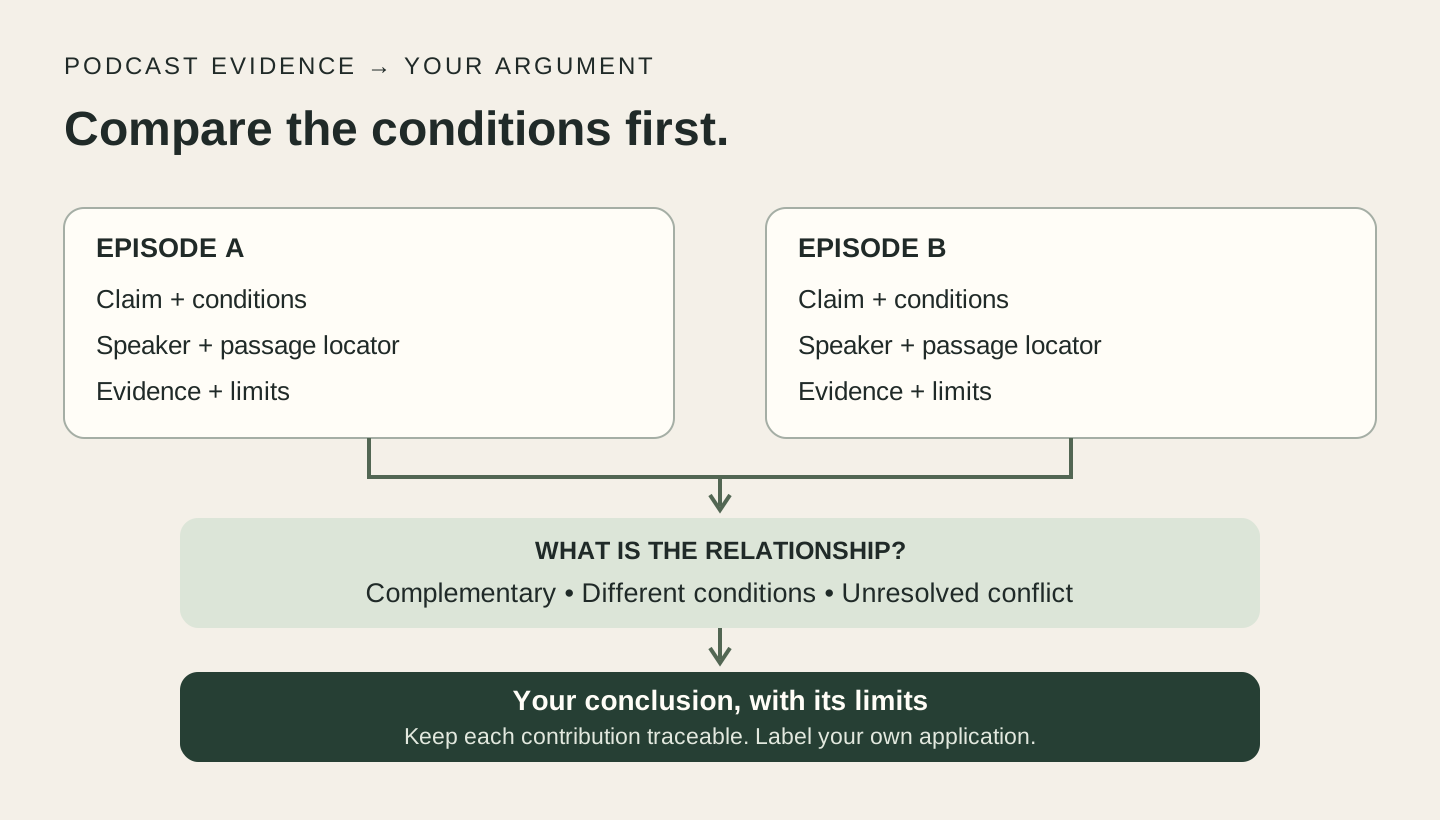
Decide what kind of connection you have
Purdue OWL describes synthesis as drawing a broader conclusion from relationships between sources, and warns against forcing connections or overlooking contrary material. Apply that distinction to episodes: identify the relationship before drafting a shared takeaway. Source: Purdue OWL: Synthesizing Sources.
A post can sound persuasive while joining advice that answers different questions. Before drafting, write who is deciding what, under which conditions. Compare each passage with the question it answers and the limitation that would change its meaning.
| Relationship | Check before combining | Shape of the post |
|---|---|---|
| Compatible contributions | The passages address the same question or clearly different parts of it. | Explain the connection, then add a bounded application of your own. |
| Different conditions | The apparent clash changes when the audience, decision or stage changes. | Name the condition that changes the advice; keep both branches visible. |
| Unresolved disagreement | The claims still conflict after checking their terms and circumstances. | Present the disagreement and what evidence would help decide it. |
| Shared words only | The topics sound similar, but no defensible relationship has emerged. | Choose a different passage or publish separate posts. |
Check whether the episodes supply distinct evidence
Record whether a speaker is offering a personal view, recounting an example or referring to research. If several episodes repeat the same study, count that underlying study once in your evidence notes. Repetition across shows does not itself demonstrate independent confirmation.
A useful comparison can involve the same host or show. Describe that scope openly. Two guests’ remarks can support an editorial comparison without establishing a consensus across a profession or proving that the proposed action works.
Copyable comparison matrix
Keep an evidence card for each episode
Fill this out before writing so you can see whether the passages support the same conclusion. Duplicate the source card as needed; leave unknown details explicit. The relationship line is your interpretation, not a speaker quotation.
Question the post will answer: [specific decision + audience + conditions]
SOURCE CARD [A / B / …]
Show / episode / speaker: [identity]
Episode URL + version checked: [link + transcript or recording]
Locator + surrounding question: [section, passage cue or checked time]
Claim in my own words: [bounded paraphrase]
Conditions / exceptions: [what must remain attached]
Evidence kind + underlying source: [opinion / example / study + link if available]
Verification: [transcript-only / audio checked with details / unresolved]
RELATIONSHIP: [compatible / different conditions / disagreement / no connection]
My conclusion: [inference, with its limit]
Counterpoint or unresolved question: [what the post must not hide]
Source links beside the corresponding sentences: [A / B / …]
Build the comparison
Write the connection before the post
Choose a question that can survive comparison
Start with the decision your reader faces, then select passages that bear on it. If you cannot explain what each episode contributes, narrow the question or leave an episode out. Include only the sources needed to answer the question.
Capture each passage separately
Save the speaker, source link, locator, surrounding question and relevant conditions. Write a short paraphrase for each card before combining anything. A transcript section label is a text locator until the recording has been checked.
Test the apparent agreement or conflict
Compare what the advice refers to. Is one guest describing a factual claim while another describes a decision? Are they addressing different audiences or stages? Write the remaining disagreement plainly when those distinctions do not resolve it.
Draft the connection and the source sentences
Write your bounded conclusion, followed by an attributed sentence for each contribution. Reopen the passages and check that your connecting sentence does not add a promise, causal result or consensus that the sources never supplied.
Make the post understandable without opening the links
Keep the essential condition in the post itself, and place each source link with the relevant claim. End with your application or a question that remains open. Links let readers inspect the evidence; they cannot repair a misleading sentence.
Real transcript comparison
Does respectful communication require sounding uncertain?
Compare these two Think Fast, Talk Smart episodes hosted by Matt Abrahams. The evidence below comes from Stanford’s official transcripts, not a listening test. The comparison asks whether uncertainty about a claim and clarity about an action are necessarily in conflict.
Julia Minson discusses hedging a claim in the transcript section beginning [00:11:37]. The point concerns acknowledging that a statement may not hold universally. Source: Minson: Navigating the Nuance.
Irv Grousbeck’s final answer about a communication recipe pairs decisiveness with respect and cautions against unclear communication. This untimed passage is located by the host’s final recipe question. Source: Grousbeck: Conviction and Compassion.
| Source locator | What the speaker addresses | What can carry into the post |
|---|---|---|
| Minson — [00:11:37] | How broadly a claim applies | Preserve uncertainty about the claim’s scope. The transcript section does not establish a rule that every instruction must sound tentative.Source: Official Minson transcript |
| Grousbeck — final recipe answer | How clearly a position is communicated | Keep the position understandable while treating the other person respectfully. Do not reinterpret decisiveness as a license to claim certainty about everything.Source: Official Grousbeck transcript |
| Writer’s connection | Different objects of clarity | A claim can carry a qualification while a next step is explicit. This is our editorial interpretation of the pair, not a joint statement by the guests. |
Demonstration post — add the corresponding source links below
“A clear next step does not require an absolute claim. In Think Fast, Talk Smart, Julia Minson describes qualifying claims during disagreement; Irv Grousbeck pairs decisiveness with respect when discussing difficult conversations. My takeaway from comparing the transcripts: name what remains uncertain, then state the action you are proposing. For a project review, I would write the assumption that could change my recommendation beside the next decision I need. That is an application I would try, not a tested result from either episode. Which assumption would change your recommendation?”PodInk editorial demonstration — original post, not a guest quotation
Keep the source links beside the sentence naming the guests. The first contribution comes from Minson’s transcript section beginning [00:11:37]. Source: Navigating the Nuance: The Art of Disagreeing Without Conflict.
Place Grousbeck’s episode link after the sentence attributing his contribution. For the combined sentence above, keep both links together immediately after it. Source: Conviction and Compassion: How to Have Hard Conversations.
The post adds an application the writer could try and labels it as such. A claim that both guests proved this project-review method improves decisions would exceed the evidence. A claim that the guests contradict each other would also need more than the isolated contrast between uncertainty and decisiveness.
Use the passages to examine a specific relationship. Keep the scope of the comparison visible: two episodes from one show, read through their published transcripts, with a writer-proposed application.
Compare how the approved core changes in the LinkedIn workflow and the X workflow.
Review the combined claim
Keep the source relationship visible
| Question | Keep | Revise or stop |
|---|---|---|
| Can each contribution be traced? | Speaker, episode and locator remain distinguishable. | A generic list of links hides which source supports which sentence. |
| Are the conditions compatible? | The post states where the advice applies. | The conclusion deletes a condition needed to make it true. |
| Who owns the conclusion? | The writer labels an interpretation or proposed application. | The post attributes its new conclusion to all the guests. |
| Was contrary material considered? | A relevant exception or disagreement remains visible. | An inconvenient passage disappears to make the story neater. |
- The post answers a question more specific than the episodes’ shared topic.
- Each source card retains the speaker, passage context, locator and evidence status.
- Repeated references to an underlying source are not counted as independent confirmation.
- The connection fits the source conditions; unresolved disagreement remains explicit.
- The writer’s inference and proposed action are distinguishable from the guests’ claims.
- Every source link sits close enough to identify the contribution it supports.
Evidence limits
What the comparison establishes
- The worked comparison was checked against official transcript text on October 19, 2026. Stanford says the transcripts are machine generated and lightly edited and may contain errors. No audio was reviewed; the time label is a transcript locator, not a verified playback boundary.
- The example compares two episodes from the same show. It does not establish independent research replication, professional consensus or an outcome from using the proposed project-review note.
- The matrix and demonstration post are editorial tools. They do not describe an automatic multi-episode import, comparison or publishing feature in PodInk.
Human review remains necessary. No repurposing workflow can turn weak evidence into a strong claim.
FAQ
Frequently asked questions
Should every episode I listened to appear in the post?
No. Include an episode when its relevant passage contributes to the question you are answering. Keep a useful exception or challenge, but do not add an unrelated episode merely to lengthen the source list.
What if the guests disagree?
First check whether the claims address the same question under comparable conditions. If the conflict remains, describe both positions and what would help resolve it. You can publish a question or a comparison without declaring a winner.
Can I merge remarks from different episodes into one quotation?
Do not present a sentence you composed across sources as something a guest said. Use attributed paraphrases for the individual contributions and label the conclusion as your interpretation. Keep separate locators for separate passages.
Evidence
Sources and comparison pages
- Synthesizing SourcesPurdue OWL
- Navigating the Nuance: The Art of Disagreeing Without ConflictStanford Graduate School of Business — Think Fast, Talk Smart
- Conviction and Compassion: How to Have Hard ConversationsStanford Graduate School of Business — Think Fast, Talk Smart