
Podcast statistics review
How to check podcast statistics before a social post
To check a podcast statistic, locate its underlying data, record the unit and denominator, and recompute the comparison. Keep an unresolved number in your research note, out of the proposed social post.
The arithmetic exercise below starts with given counts, then follows them into a rejected draft, a complete teaching post and a filled review note. It is original teaching material, not a real podcast, customer story or measured result.
Name the quantity you are comparing
Statistics Canada defines a percentage as a part divided by its whole, multiplied by 100. Percentage change divides the difference by the starting value. Its archived lesson is used here for arithmetic, not current data. Source: Statistics Canada arithmetic lesson.
ONS distinguishes percentage points, the subtraction of two percentages, from relative percentage change. Write the unit beside the result. Source: ONS percentage guidance.
OSR guidance for public bodies asks whether evidence is accessible and limitations and context are clear. Its scope is public bodies. Here, use those questions as editorial prompts when reviewing a podcast statistic. Source: OSR public-use guidance.
Copyable number record
Keep the evidence beside the arithmetic
Use a separate note for each numerical claim, so an edit to the headline can be checked against the same inputs. N-01 below is filled in.
CLAIM / POST VERSION:
EPISODE / SPEAKER / SOURCE LOCATOR:
EVIDENCE: recording checked / transcript only / unresolved
UNDERLYING SOURCE / TABLE / VERSION:
UNIT / NUMERATOR / DENOMINATOR:
POPULATION / PERIOD / DEFINITION:
STARTING VALUE / ENDING VALUE / FORMULA:
EXACT RESULT / DISPLAY ROUNDING:
LIMITATIONS / COMPLETE SOCIAL DRAFT:
REVIEWER / SCOPE / DATE / HOLD OR REVISE:
HUMAN PUBLICATION DECISION / PERSON / DATE:
Source to post
Build a number record before shortening the claim
Save the claim and its location
Copy the exact numerical sentence and neighboring explanation into the note. Add the episode link, speaker and locator. If you only read a transcript, mark transcript-only; do not call it an audio check.
Open the underlying evidence
Follow the episode reference to the original table or report. Save the table label, version, population and period. If the source cannot be located, retain the claim as unresolved instead of supplying a plausible denominator.
Write out the calculation
Save the two input values and name the calculation: count change, rate difference or relative rate change. Keep the exact result and the displayed rounding together, as N-01 does below.
Review the whole draft
Check the hook as well as the number. Keep the source and qualification with the claim; a link in a distant comment is easy to separate from it. Save the exact draft and leave the publication decision explicit.
Original arithmetic exercise
Count up, rate down: work the calculation before the hook
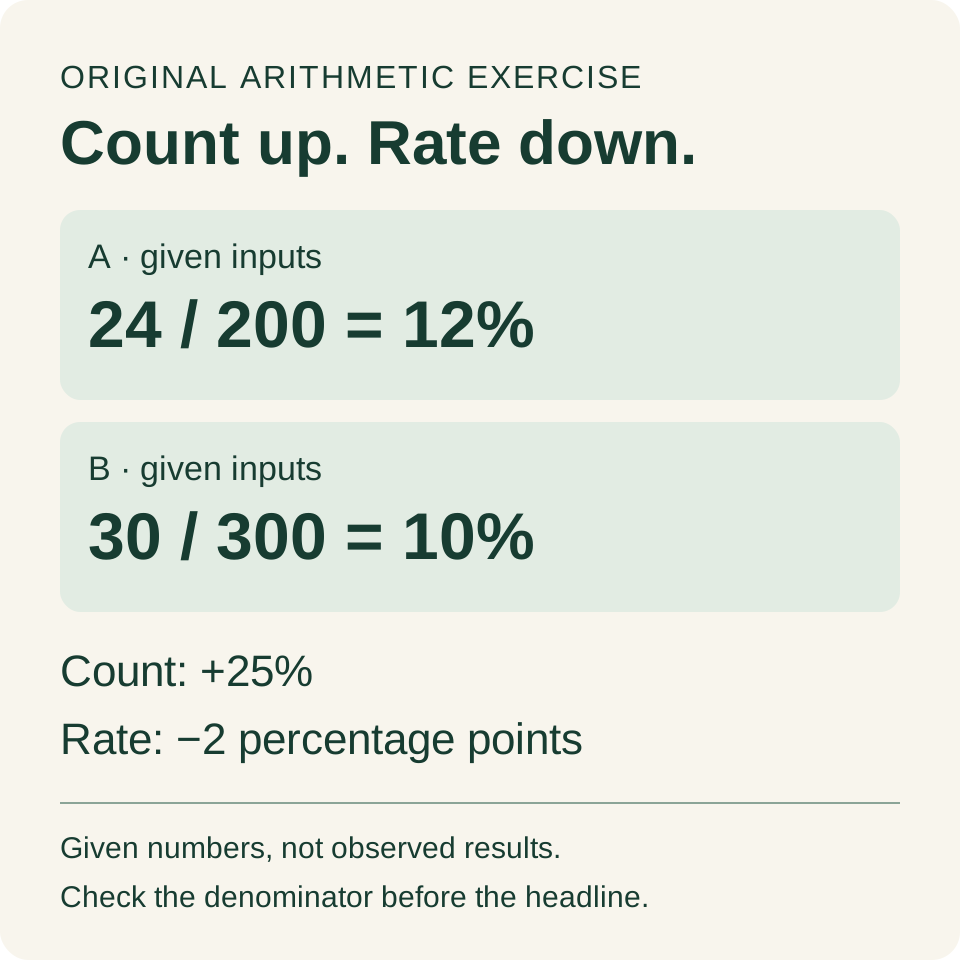
These are given values for an original mathematics exercise. A and B are labels, not observed cohorts or periods. No episode, speaker, customer or experiment is invented. Each numerator counts completed registrations; each denominator counts eligible people invited, each person counted once by definition for this exercise.
| Record | Calculation or draft | Reading decision |
|---|---|---|
| A | 24 / 200 × 100 = 12% | Given exercise input: 24 completed registrations among 200 eligible people invited. |
| B | 30 / 300 × 100 = 10% | Given exercise input: 30 completed registrations among 300 eligible people invited. |
| Count change | (30 − 24) / 24 × 100 = +25% | The count rose by 6 in this arithmetic exercise. The result is a change in counts. |
| Rate difference | 10% − 12% = −2 percentage points | The calculated rate is lower, even though the count is higher. |
| Relative rate change | (10 − 12) / 12 = −1/6; × 100 ≈ −16.7% | The exact fraction is kept; the displayed percentage is rounded to one decimal place. |
| P0 — rejected teaching draft | Registrations rose 25%, so the new approach improved conversion. | The count increase is correct. A higher conversion rate and a cause for the change are not established by these given values. |
Editorial takeaway:
“I would pause a punchy headline if I could not say which quantity had changed.”Original teaching takeaway; not a podcast quotation
P1 — complete teaching post, using only the given exercise values:
More registrations, lower rate? In this original arithmetic exercise, A has 24 registrations among 200 people invited; B has 30 among 300. The count rises 25%, but the calculated rate falls from 12% to 10%: a drop of 2 percentage points. These are given numbers, not a real campaign or podcast finding. Before turning a statistic into a headline, I would check which quantity the headline actually describes.
P1 is a teaching draft ready for human review, not an approved social post. The calculation changes the wording decision; it provides no evidence about why a real rate moved.
Compare how the approved core changes in the LinkedIn workflow and the X workflow.
Filled number record
N-01: arithmetic checked, publication undecided
| Saved item | Recorded result | Boundary |
|---|---|---|
| Inputs and source | A: 24/200; B: 30/300. Source: the given exercise inputs on this page. | No underlying research dataset, real episode or audio locator exists. |
| Recalculation | Rates: 12%, 10%; count: +25%; rate: −2 percentage points, relative −1/6 ≈ −16.7%. | The rates use different denominators. Real-population comparability is not established. |
| Wording and decision | P0 rejected; P1 retained as a teaching draft after checking the given arithmetic. | Human review and publication approval remain pending; neither statistical significance nor causation was assessed. |
- Name the quantity in the hook, not just the size of the change.
- Save the underlying evidence separately from the episode locator.
- Keep both given denominators and the rounding note in N-01.
- Recheck the complete draft after any change to the number or its surrounding claim.
Evidence boundary
What this exercise cannot establish
- This guide checks an original arithmetic exercise. It does not verify a real podcast statistic, listen to audio or test a data-analysis product.
- The exercise supplies no population design, time window or causal evidence. A real comparison would need those details; these values establish no significance or general result.
- A correct calculation cannot repair incompatible definitions or missing data. Hold the proposed claim while those questions remain unresolved.
Human review remains necessary. No repurposing workflow can turn weak evidence into a strong claim.
FAQ
Frequently asked questions
What if the starting value is zero?
Relative percentage change divides by the starting value, so that calculation is undefined at zero. Report the actual values and their difference instead of an infinite percentage increase.
Can I use rounded percentages to check the claim?
Use the available underlying counts or unrounded rates. If only rounded figures are available, label the recalculation approximate and do not manufacture extra precision.
Evidence
Sources and comparison pages
- Using basic statistical techniquesStatistics Canada
- Percentages and percentage pointsOffice for National Statistics
- Guidance on public use of statisticsOffice for Statistics Regulation